
UNITED STATES
SECURITIES AND EXCHANGE COMMISSION
Washington, D.C. 20549
FORM 10-K
(Mark One)
| ANNUAL REPORT PURSUANT TO SECTION 13 OR 15(d) OF THE SECURITIES EXCHANGE ACT OF 1934 | |||||
For the fiscal year ended December 31 , 2025
OR
| TRANSITION REPORT PURSUANT TO SECTION 13 OR 15(d) OF THE SECURITIES EXCHANGE ACT OF 1934 | |||||
For the transition period to
Commission File No. 001-36629
(Exact name of registrant as specified in its charter)
(State or other jurisdiction of
incorporation or organization)
(I.R.S. Employer
Identification No.)
(Address of principal executive offices)
Telephone: (775 ) 328-0100
(Registrant’s telephone number, including area code)
Securities registered pursuant to Section 12(b) of the Act:
| Title of each class | Trading symbol | Name of each exchange on which registered | ||||||||||||
Securities registered pursuant to section 12(g) of the Act: None
Indicate by check mark if the registrant is a well-known seasoned issuer, as defined in Rule 405 of the Securities Act. Yes ☒ No ☐
Indicate by check mark if the registrant is not required to file reports pursuant to Section 13 or Section 15(d) of the Act. Yes ☐ No ☒
Indicate by check mark whether the registrant (1) has filed reports required to be filed by Section 13 or 15(d) of the Securities Exchange Act of 1934 during the preceding 12 months (or for such shorter period that the registrant was required to file such reports), and (2) has been subject to such filing requirements for the past 90 days. Yes ☒ No ☐
Indicate by check mark whether the registrant has submitted electronically every Interactive Data File required to be submitted pursuant to Rule 405 of Regulation S-T (§232.405 of this chapter) during the preceding 12 months (or for such shorter period that the registrant was required to submit such files). Yes ☒ No ☐
Indicate by check mark whether the registrant is a large accelerated filer, an accelerated filer, a non-accelerated filer, a smaller reporting company, or emerging growth company. See the definitions of “large accelerated filer,” “accelerated filer,” “smaller reporting company” and “emerging growth company” in Rule 12b-2 of the Exchange Act.
| ☒ | Accelerated filer | ☐ | Non-accelerated filer | ☐ | |||||||||||||
| Smaller reporting company | Emerging growth company | ||||||||||||||||
If an emerging growth company, indicate by checkmark if the registrant has elected not to use the extended transition period for complying with any new or revised financial accounting standards provided pursuant to Section 13(a) of the Exchange Act. ☐
Indicate by check mark whether the registrant has filed a report on and attestation to its management’s assessment of the effectiveness of its internal control over financial reporting under Section 404(b) of the Sarbanes-Oxley Act (15 U.S.C. 7262(b)) by the registered public accounting firm that prepared or issued its audit report. ☒
If securities are registered pursuant to Section 12(b) of the Act, indicate by check mark whether the financial statements of the registrant included in the filing reflect the correction of an error to previously issued financial statements. ☐
Indicate by check mark whether any of those error corrections are restatements that require a recovery analysis of incentive-based compensation received by any of the registrant’s executive officers during the relevant recovery period pursuant to Section §240.10D-1(b). ☐
Indicate by check mark whether the registrant is a shell company (as defined in Rule 12b-2 of the Exchange Act). Yes ☐ No ☒
The aggregate market value of the common stock held by non-affiliates of the Registrant was $5.6 billion at June 30, 2025 based upon the closing price for the shares of CZR’s common stock as reported by The Nasdaq Stock Market.
As of February 12, 2026, there were 203,521,021 outstanding shares of the Registrant’s Common Stock.
Documents Incorporated by Reference
Portions of the Registrant’s definitive proxy statement to be filed with the Commission pursuant to Regulation 14A in connection with the Registrant’s Annual Meeting of Stockholders (the “Proxy Statement”) are incorporated by reference into Part III of this report. Such Proxy Statement will be filed with the Commission not later than 120 days after the conclusion of the Registrant’s fiscal year ended December 31, 2025.
CAESARS ENTERTAINMENT, INC.
ANNUAL REPORT FOR THE YEAR ENDED DECEMBER 31, 2025
TABLE OF CONTENTS
| Page | ||||||||
PART I
In this filing, Caesars Entertainment, Inc., a Delaware corporation, and its subsidiaries may be referred to as the “Company,” “CEI,” “Caesars,” “we,” “us” or “our” or the “Registrant.”
We also refer to (i) our Consolidated Financial Statements as our “Financial Statements,” (ii) our Consolidated Balance Sheets as our “Balance Sheets,” (iii) our Consolidated Statements of Operations and Consolidated Statements of Comprehensive Income (Loss) as our “Statements of Operations,” and (iv) our Consolidated Statements of Cash Flows as our “Statements of Cash Flows,” which are prepared in accordance with accounting principles generally accepted in the United States (“GAAP”). References to numbered “Notes” refer to Notes to our Consolidated Financial Statements included in Item 8.
Item 1. Business
Overview
We are a geographically diversified gaming and hospitality company that was founded in 1973 by the Carano family with the opening of the Eldorado Hotel Casino in Reno, Nevada. Beginning in 2005, we grew through a series of acquisitions, including the acquisition of MTR Gaming Group, Inc. in 2014, Isle of Capri Casinos, Inc. in 2017, Tropicana Entertainment, Inc. in 2018, Caesars Entertainment Corporation in 2020, and William Hill PLC in 2021. Our ticker symbol on the NASDAQ Stock Market is “CZR.”
Our primary source of revenue is generated by our gaming operations, which includes our casino properties, retail and online sports betting and online gaming. Additionally, we utilize our hotels, restaurants, bars, entertainment, racing, retail shops and other services to attract customers to our properties.
As of December 31, 2025, we own, lease or manage an aggregate of 52 domestic properties in 18 states. We also operate and conduct sports wagering across 34 jurisdictions in North America, 27 of which offer online sports betting, and operate iGaming in five jurisdictions in North America. We currently operate the Caesars Sportsbook app, the Caesars Racebook app, the Caesars Palace Online Casino app and the Horseshoe Online Casino app. We expect to continue to grow our operations in the Caesars Digital segment as new jurisdictions legalize retail and online sports betting and iGaming. In addition, we have other properties in North America that are authorized to use the brands and marks of Caesars Entertainment, Inc., as well as other non-gaming properties. We lease certain real property assets from third parties, including GLP Capital, L.P., the operating partnership of Gaming and Leisure Properties, Inc. (“GLPI”) and VICI Properties L.P., a Delaware limited partnership (“VICI”). See Item 2. “Properties,” for more information about our properties.
Business Operations
Our consolidated business is composed of complementary businesses that reinforce, cross-promote, and build upon each other: casino, which includes our casino properties, retail and online sports betting and iGaming, food and beverage, hotel, casino management or branding, entertainment, retail and other business operations.
Casino Operations
Our casino operations generate revenues from approximately 51,400 slot machines, 2,700 table games, including poker, sports betting from our retail and online sportsbooks, iGaming and other games such as keno, all of which represented approximately 58% of our total net revenues in 2025. Slot revenues generate the majority of our casino revenues.
Retail and Online Sports Betting and iGaming
The Company operates and conducts sports wagering across 34 jurisdictions in North America, 27 of which offer online sports betting, and operates iGaming in five jurisdictions in North America as of December 31, 2025. We offer hundreds of online casino games including slots, table games, live dealer and video poker and we expect to increase our product offerings as iGaming is legalized in additional states. We continue to leverage the World Series of Poker (“WSOP”) brand within the United States with the licensing agreement that we entered into concurrently with the sale of the WSOP brand on October 29, 2024.
Our Caesars Sportsbook app operates on our owned and integrated technology platform we have labeled Liberty (“Liberty”). The app offers extensive pre-match and live markets, extensive odds and flexible limits, player props, and same-game parlays. In addition to the Caesars Sportsbook app, we have a partnership with NYRABets LLC, the official online wagering platform of the New York Racing Association, Inc., and operate the Caesars Racebook app in 22 states. The Caesars Racebook app provides access for pari-mutuel wagering at over 300 racetracks around the world as well as livestreaming of races. Additionally, we launched our Caesars Palace Online Casino app in 2023 and our Horseshoe Online Casino app in 2024. In 2025, we added the Caesars Racebook wagering interface to the Caesars Sportsbook app and launched a universal digital wallet to access funds and Caesars Rewards in one wallet. These functions are currently available in several states with plans to extend to more jurisdictions in the future. Wagers placed can earn credits towards the Caesars Rewards loyalty program or points which can be redeemed for free wagering credits. No customers under 21 years old are allowed to wager on any of our Caesars Sportsbook, Caesars Racebook and iGaming mobile apps. Growth in the Caesars Digital segment continues to be realized with the strategic expansion into new states as jurisdictions legalize retail and online sports betting, iGaming and online horse race wagering.
Food and Beverage Operations
Our food and beverage operations generate revenues from our dining venues, bars, nightclubs, and lounges located throughout our casinos and represented approximately 15% of our total net revenues in 2025. Many of our properties include several dining options, ranging from upscale dining experiences to moderately-priced restaurants, some of which offer pickup or in-room delivery options.
Hotel Operations
Hotel operations generate revenues from hotel stays at our properties in our approximately 45,600 guest rooms and suites and represented approximately 17% of our total net revenues in 2025. Our properties operate at various price and service points, allowing us to host a variety of casino guests, who are visiting our properties for gaming and other casino entertainment options, and non-casino guests who are visiting our properties for other purposes, such as vacation travel or conventions.
Management and Branding Arrangements
We earn revenue from fees paid for the management of other hotels and casinos in North America. Managed properties represent Caesars-branded properties where we provide certain staffing and management services under management agreements. In addition, we authorize the use of certain brands and marks of Caesars Entertainment, Inc. from which we earn revenue from fees received based on the arrangements.
Entertainment and Other Non-Gaming Operations
We provide a variety of retail and entertainment offerings at our properties. We operate various entertainment venues across the United States, including the Colosseum at Caesars Palace Las Vegas and PH Live at Planet Hollywood Resort & Casino. These award-winning entertainment venues host or have announced plans to host prominent headliners such as Rod Stewart, Jerry Seinfeld, Kelly Clarkson, Def Leppard, Dolly Parton, Jennifer Lopez and Blake Shelton.
On December 12, 2024, we sold the LINQ Promenade, which was an open-air dining, entertainment, and retail development located between The LINQ Hotel & Casino and Flamingo Las Vegas. We continue to operate the High Roller, a 550-foot observation wheel, and Fly LINQ, the first and only zipline on the Las Vegas Strip located between The LINQ Hotel & Casino and Flamingo Las Vegas.
CAESARS FORUM is a 550,000 square-foot state-of-the-art conference center located at the center of the Las Vegas Strip. CAESARS FORUM can accommodate more than 10,000 participants and features more than 300,000 square feet of flexible meeting space, the two largest pillarless ballrooms in the world, a LEED-Gold-Certified FORUM Plaza, and the first 100,000 square-foot outdoor meeting and event space in Las Vegas.
Market Activities
Trends
Economic Factors Impacting Discretionary Spending — Gaming and other leisure activities we offer represent discretionary expenditures which may be sensitive to economic downturns which impacts the behavior among the components of our customer mix differently.
We monitor the effects of current and recent trends, including inflation, interest rates, global hostilities, trade tension and related actions, such as the imposition of tariffs between the United States and other countries, and the associated effects, if any,
on travel, visitation, our customers, and our operations. For example, our leases with VICI are impacted by inflation as they are subject to annual escalators based on the Consumer Price Index (“CPI”).
We are also continuing to monitor interest rates which have a direct impact on certain of our debt instruments, in addition to an effect on consumer spending. We evaluate projected changes in interest rates when entering into borrowing arrangements and manage our mix of fixed versus variable debt accordingly.
We continue to manage the economic challenges affecting our industry and our Company that arise including labor shortages, higher labor costs, supply chain disruptions, increased costs of goods and services, among other impacts. Further discussion of the effects of these trends are described throughout this Form 10-K. The extent and duration of these trends is uncertain and may intensify.
Online Betting and Gaming — Online betting and gaming is a rapidly developing sector of the e-commerce industry and we believe the digital segment of the global betting and gaming industry will continue to grow in popularity and consumer confidence. The market for online betting platforms is being driven by the increased use of digital processes and growing bettor demand. We anticipate that the United States market will continue to have a strong and steady uptake in active wagers as state-by-state legislation in the United States continues to evolve resulting in new opportunities in the United States sports betting market. The extent and future effects of online betting and gaming on our casino properties is uncertain but we expect that our online betting and gaming offerings will be complementary to our overall brick-and-mortar casino business.
Competition
The casino entertainment business is highly competitive. The industry is composed of a diverse group of competitors that vary considerably in size and geographic diversity, quality of facilities and amenities available, marketing and growth strategies, and financial condition. In most regions, we compete directly with other casino facilities operating in the immediate and surrounding areas. There has been increased competition from openings of newly developed casinos and plans of development in certain regions, including new tribal expansions throughout the United States. In Las Vegas, our largest jurisdiction, there have been openings, projects in development, and proposals for other large scale gaming and non-gaming development projects by various other developers and local casino operators. In response to changing trends, Las Vegas operators have been focused on expanding their non-gaming offerings, including upgrades to hotel rooms, new food and beverage offerings, and new entertainment offerings. Our Las Vegas Strip hotels and casinos also compete, in part, with each other.
In recent years, many casino operators, including us, have been reinvesting in existing facilities, developing or rebranding new casinos or complementary facilities, and acquiring established facilities. These reinvestment and expansion efforts combined with aggressive marketing strategies by us and many of our competitors have resulted in increased competition in many regions. As companies have completed new expansion projects, supply has grown at a faster pace than demand in some areas. The expansion of properties and entertainment venues into new jurisdictions also presents competitive pressures.
Our properties also compete with legalized gaming from casinos located on Native American tribal lands. While the competitive impact on operations in Las Vegas from the continued growth of Native American gaming establishments in California remains uncertain, the proliferation of gaming in California and other areas located in the same regions as our properties could have an adverse effect on our results of operations. In some instances, particularly in the case of Native American casinos, our competitors pay lower taxes or no taxes. In addition, certain states have legalized, and others may legalize, casino gaming in specific areas, including metropolitan areas from which we traditionally attract customers. These factors create additional challenges for us in competing for customers and accessing cash flow or financing to fund improvements for our casino and entertainment products that enable us to remain competitive.
We also compete with other non-gaming resorts and vacation areas, various other entertainment businesses, and other forms of gaming, such as state lotteries, on-track and off-track wagering, video lottery terminals, and card parlors. Our non-gaming offerings also compete with other retail facilities, amusement attractions, food and beverage offerings, and entertainment venues. Internet gaming and sports betting may also create additional competition in certain jurisdictions that our brick-and-mortar properties are located.
We face significant competition in our online sports betting, online horse racing wagering and iGaming businesses in jurisdictions where we currently operate and those jurisdictions in which we wish to expand. We continue to face new forms of competition with the advancement of other mobile sports betting, daily fantasy sports, sweepstakes betting products, sports event trading as derivative products in prediction markets regulated by the Commodity Futures Trading Commissions and other products by operators in similar jurisdictions in which we operate, as well as operators which are unregulated and operate outside of the United States. Although we have experienced recent success in obtaining approval for sports betting and iGaming licenses in new jurisdictions, new state launches may require significant upfront investment and may not be successful.
Resources Material to Business
Rewards Programs
We believe Caesars Rewards enables us to compete more effectively and capture a larger share of our customers’ entertainment spending when they travel among regions or engage in online wagering and gaming versus that of a standalone property, which is core to our cross-market strategy.
Caesars Rewards members earn Reward Credits for qualifying gaming activities, including sports betting, online gaming and iGaming apps and wagering in the Caesars Sportsbook, Caesars Palace Online Casino, Horseshoe Online Casino, and Caesars Racebook apps. Members also earn Reward Credits for qualifying hotel, dining and retail spending at most Caesars Entertainment destinations in the United States and Canada. Additionally, Reward Credits are earned when members use their Caesars Rewards VISA credit card or make a purchase through a Caesars Rewards partner. Members can redeem their earned Reward Credits for those same experiences.
Caesars Rewards is structured by member tier level (designated as Gold, Platinum, Diamond, Diamond Plus, Diamond Elite or Seven Stars) and member value. This structure allows a member to progressively access the full range of benefits available across our portfolio of destinations as they progress through tier levels. Caesars Rewards is designed to cultivate a gratifying and frictionless relationship with our customers, motivating members to enhance both their frequency of visits and expenditures. Additionally, member data is utilized in conjunction with diverse marketing promotions. This includes campaigns spanning direct mail, email, our websites, mobile devices, social media, and interactive slot machines.
Intellectual Property and Resources
We use a variety of trade names, service marks, trademarks, patents and copyrights in our operations and believe that we have the rights necessary to conduct our continuing operations. The development of intellectual property is part of our overall business strategy. We regard our intellectual property to be an important element of our success. We file applications for patents, trademarks and copyrights in the United States and foreign countries where we believe filing for such protection is appropriate. While our business as a whole is not substantially dependent on any one patent, trademark, or copyright, we seek to establish and maintain our proprietary rights in our business operations and technology through the use of patents, trademarks, copyrights, and trade secret laws. We also seek to maintain our trade secrets and confidential information by nondisclosure policies and through the use of appropriate confidentiality agreements. Our United States patents have varying expiration dates.
We have not applied for the registration of all of our trademarks, copyrights, proprietary technology, or other intellectual property rights, as the case may be, and may not be successful in obtaining all intellectual property rights for which we have applied. Despite our efforts to protect our proprietary rights, parties may infringe upon our intellectual property and use information that we regard as proprietary, and our rights may be invalidated or unenforceable. The laws of some foreign countries do not protect proprietary rights or intellectual property to as great of an extent as do the laws of the United States. In addition, others may independently develop substantially equivalent intellectual property.
We own or have the right to use proprietary rights to a number of trademarks that we consider, along with the associated name recognition, to be valuable to our business, including Eldorado, Silver Legacy, Isle, Lady Luck, Tropicana, Circus Circus, Caesars, Flamingo, Harrah’s, Horseshoe, Paris, Planet Hollywood, Caesars Rewards, Caesars Sportsbook, and William Hill.
Our Caesars Sportsbook app is powered by our Liberty platform. The Liberty platform resulted in a significant upgrade to our user interface and significant product upgrades including numerous pre-match and live markets, extensive odds and flexible limits, player props, and same-game parlays. Our Liberty platform also powers our Caesars Palace Online Casino and Horseshoe Online Casino iGaming applications. Our Liberty platform integrates customers with the Caesars Rewards loyalty program along with a universal digital wallet to access funds and Caesars Rewards in one wallet. In addition, we and NYRABets LLC, the official online wagering platform of the New York Racing Association, Inc., have launched the Caesars Racebook app in 22 jurisdictions. The Caesars Racebook app provides access for pari-mutuel wagering at over 300 racetracks around the world. Wagers placed can earn credits towards the Caesars Rewards loyalty program.
Industry Overview
See Item 7. “Management’s Discussion and Analysis of Financial Condition and Results of Operations.” See also Exhibit 99.1, “Gaming and Regulatory Overview,” to this Annual Report on Form 10-K, which is incorporated herein by reference.
Seasonality
We believe that business at our regional properties outside of Las Vegas is subject to seasonality, including seasonality based on the weather in the region in which they operate and the travel habits of visitors. Business in our properties can also fluctuate
due to specific holidays, particularly when a holiday falls in a different quarter than the prior year, or other significant events such as the timing of the WSOP tournament (with respect to our Las Vegas properties), city-wide conventions, large sporting events or concerts, or visits by our premium players. We also believe that any seasonality, holiday, or other significant event may affect our various properties or regions differently. We may also experience seasonality with retail and online sports betting which coincides with certain sporting events, as well as seasons of professional sports teams.
Gaming Licenses and Governmental Regulations
The gaming and racing industries are highly regulated, and we must maintain our licenses and pay gaming taxes to continue our operations. We are subject to extensive regulation under laws, rules and supervisory procedures. These laws, rules and regulations generally concern the responsibility, financial stability and characters of the owners, managers, and persons with financial interests in the gaming operations. If additional gaming regulations are adopted in a jurisdiction in which we operate, such regulations could impose restrictions or costs that could have a significant adverse effect on us. From time to time, various proposals have been introduced in legislatures of jurisdictions in which we have operations that, if enacted, could adversely affect the tax, regulatory, operational or other aspects of the gaming industry and us. We do not know whether or when such legislation will be enacted. Gaming companies are currently subject to significant state and local taxes and fees in addition to normal federal and state corporate income taxes, and such taxes and fees are subject to increase at any time. Any material increase in these taxes or fees could adversely affect us.
Some jurisdictions, including those in which we are licensed, empower their regulators to investigate participation by licensees in gaming outside their jurisdiction and require access to periodic reports respecting those gaming activities. Violations of laws in one jurisdiction could result in disciplinary action in other jurisdictions.
Under provisions of gaming laws in jurisdictions in which we have operations, and under our organizational documents, certain of our securities are subject to restriction on ownership which may be imposed by specified governmental authorities. The restrictions may require a holder of our securities to dispose of the securities or, if the holder refuses, or is unable to dispose of the securities, we may be required to repurchase the securities.
A more detailed description of the regulations to which we are subject is contained in Exhibit 99.1 to this Annual Report on Form 10-K, which is incorporated herein by reference.
Internal Revenue Service Regulations, Bank Secrecy Act & Anti-Money Laundering
The Internal Revenue Service requires operators of casinos and online sports betting apps located in the United States to file information returns for U.S. citizens, including names and addresses of winners for certain table games, keno, bingo, slot machine and retail and online sports betting winnings in excess of stipulated amounts. The Internal Revenue Service also requires operators to withhold taxes on some table games, keno, bingo, slot machine and retail and online sports betting winnings of nonresident aliens. We are unable to predict the extent to which these requirements, if extended, might impede or otherwise adversely affect operations of, and/or income from, other games.
Regulations adopted by the Financial Crimes Enforcement Network of the Treasury Department (“FINCEN”) requires the reporting of currency transactions in excess of $10,000 occurring within a gaming day, including identification of the patron by name and social security number. This reporting obligation began in May 1985 and may have resulted in the loss of gaming revenues to jurisdictions outside the United States which are exempt from the ambit of these regulations. In addition to currency transaction reporting requirements, suspicious financial activity is also required to be reported to FINCEN.
Caesars maintains a comprehensive risk-based Bank Secrecy Act (“BSA”) and Anti-Money Laundering (“AML”) program. It includes strong governance and effective internal controls and procedures to comply with applicable BSA requirements, regulatory guidance, and any related laws, and to take measures to prevent its affiliated casinos from being used for money laundering or other criminal activity. Execution of the program is governed with reference to FINCEN’s guidance on the Culture of Compliance. Caesars’ internal AML Policy, Know Your Customer Policy and BSA Identification Policy outline the Caesars AML Program and set the minimum standards for the related procedures and internal controls of the Caesars casino affiliates. Certain employees are required to complete annual trainings related to company policies, including AML.
Other Laws and Regulations
Our businesses are subject to various federal, state and local laws and regulations in addition to gaming regulations. These laws and regulations include, but are not limited to, restrictions and conditions concerning alcoholic beverages, food service, smoking, environmental matters, employees and employment practices, currency transactions, taxation, zoning and building codes, and marketing and advertising. Such laws and regulations could change or could be interpreted differently in the future, or new laws and regulations could be enacted. Material changes, new laws or regulations, or material differences in interpretations by courts or governmental authorities could adversely affect our operating results.
The sale of alcoholic beverages is subject to licensing, control and regulation by applicable local regulatory agencies. All licenses are revocable and are not transferable. The agencies involved have full power to limit, condition, suspend or revoke any license, and any disciplinary action could, and revocation would, have a material adverse effect upon our operations.
We also deal with significant amounts of cash in our operations and are subject to various reporting and anti-money laundering regulations. Such laws and regulations could change or could be interpreted differently in the future, or new laws and regulations could be enacted. Material changes, new laws or regulations, or material differences in interpretations by courts or governmental authorities could adversely affect our operating results. See Item 1A, “Risk Factors,” for additional discussion.
Taxation
Gaming companies are typically subject to significant taxes and fees in addition to normal federal, state and local income taxes, and such taxes and fees are subject to increase at any time. We pay substantial taxes and fees with respect to our operations. From time to time, federal, state, local and provincial legislators and officials have proposed changes in tax laws, or in the administration of such laws, affecting the gaming industry. It is not possible to determine with certainty the likelihood of changes in tax laws or in the administration of such laws.
Environmental Matters
We are subject to various federal, state and local environmental, health and safety laws and regulations, including but not limited to air quality, indoor air quality, water quality, bulk storage of regulated materials, and disposal of waste, including hazardous waste. Such laws and regulations can impose liability on potentially responsible parties (owner/operators of real property) to clean up, or contribute to the cost of cleaning up, sites at which regulated materials were disposed of or released. In addition to investigation and remediation liabilities that could arise under such laws and regulations, we could face personal injury, property damage, fines or other claims by third parties concerning environmental compliance, contamination or exposure to hazardous conditions. Environmental regulatory violations also include monetary penalties assessed by the jurisdictional regulatory agency and civil or criminal penalties for intentional negligence. Occasionally and under certain circumstances, we have investigated and remediated (or contributed to remediation costs) contamination located at or near our facilities. Examples included contamination related to underground storage tanks and groundwater contamination arising from prior uses of land on which certain facilities are located. In addition, we have and continue to contain, manage, and dispose of manure and wastewater generated by concentrated animal feeding operations due to our racetrack operations; manage, abate, or remove indoor air quality concerns such as mold, lead, or asbestos-containing materials; and manage operations within applicable environmental permitting requirements. Although we have incurred and expect to incur costs related to various environmental matters such as investigations, remediation, and management of hazardous materials or conditions known or discovered to exist at our properties, those costs have not had, and are not expected to have, a material adverse effect on our financial condition, results of operations or cash flow. However, such matters in the future could have a material adverse effect on our business.
Climate Change
There has been an increasing focus of international, national, state, regional and local regulatory bodies on greenhouse gas (“GHG”), including carbon emissions, and climate change issues. Future regulation could impose stringent standards to substantially reduce GHG emissions. Legislation to regulate GHG emissions has periodically been introduced in the U.S. Congress. Some Administrations have taken steps to further regulate GHG emissions. Those reductions could be costly and difficult to implement or estimate.
Beyond financial and regulatory effects, the projected severe effects of climate change – such as property damage or supply chain issues stemming from extreme weather events – has already and may continue to directly affect our facilities and operations. We recognize the impacts of climate change and are engaged in long-term initiatives to identify, assess, and manage the risks and opportunities associated with climate change (see “Environmental Stewardship” below).
Reporting and Record-Keeping Requirements
We are required periodically to submit detailed financial and operating reports and furnish any other information about us and our subsidiaries that gaming authorities may require. We are required to maintain a current stock ledger that may be examined by gaming authorities at any time. If any securities are held in trust by an agent or by a nominee, the record holder may be required to disclose the identity of the beneficial owner to gaming authorities. A failure to make such disclosure may be grounds for finding the record holder unsuitable. Gaming authorities may, and in certain jurisdictions do, require certificates for our securities to bear a legend indicating that the securities are subject to specified gaming laws.
Human Capital Management
We aim to provide a workplace that is engaging, empowering, inclusive and respectful for all employees (our “Team Members”), embracing a culture of openness, passion for service and recognition. Our ongoing investment in professional training and development, safety, health and wellbeing, and Team Member recognition linked to guest satisfaction and community engagement are all important drivers of our success in delivering strong business results and creating value. We have approximately 50,000 Team Members throughout our organization, excluding all tribal partnerships.
Labor Relations
Approximately 21,000, or 42% of our Team Members, are covered by collective bargaining agreements with certain of our subsidiaries. The majority of these employees in various job positions are covered by the following agreements:
| Employee Group | Approximate Number of Active Employees Represented | Union | Expiration Date of Collective Bargaining Agreement (a) | |||||||||||||||||
| Las Vegas Culinary Employees | 9,600 | Culinary Workers Union, Local 226 | September 30, 2028 | |||||||||||||||||
| Atlantic City Food & Beverage and Hotel Employees | 2,500 | UNITE HERE, Local 54 | May 31, 2026 | |||||||||||||||||
| Las Vegas Dealers | 1,900 | United Auto Workers | June 30, 2026 | |||||||||||||||||
| Las Vegas Bartenders | 1,200 | Bartenders Union, Local 165 | September 30, 2028 | |||||||||||||||||
| Las Vegas Teamsters | 1,000 | Teamsters, Local 986 | August 31, 2029 | |||||||||||||||||
____________________
(a)The agreements are generally amendable 60 days prior to expiration date.
Talent acquisition and retention are key priorities. We maintain a wide range of channels for recruiting, including outreach to academic institutions, trade training centers, culinary institutions and nonprofits that help us source a dynamic pool of candidates who represent the communities in which we operate across the United States. We are committed to supporting Team Members throughout their career with Caesars and providing opportunities to achieve their professional goals.
We strive to inspire our Team Members through our mission, vision and values, and our Code of Commitment (described below). To evaluate our Team Member experience and our retention efforts, we monitor several Team Member measures, such as turnover rates and Team Member satisfaction. We send out Team Member experience surveys to help us further understand the drivers of engagement and areas where we can improve. These surveys are completed on a regular basis alongside additional surveys targeted at specific events within a Team Member cycle such as new hire onboarding and exit inquiries.
Our compensation and benefits programs are designed to attract, retain and motivate our Team Members. In addition to competitive salaries and wages, we provide a variety of short-term, long-term and incentive-based compensation programs to reward performance relative to key metrics relevant to our business. We offer comprehensive benefit options including, but not limited to, retirement savings plans, health insurance coverage (including medical, mental health, dental, vision and pharmacy), parental leave, educational assistance, training opportunities, company-paid life insurance and a Team Member assistance program.
We place utmost importance on creating a safe workplace for our Team Members, embedding procedures so that all our Team Members have the awareness, knowledge and tools to make safe working a habit.
We also maintain programs to help our Team Members improve their health and wellbeing. These programs strive to provide metrics to demonstrate improvements in health for participating Team Members and their covered family members. We continue to make enhancements to our offerings and wellbeing programs with a wide range of affordable options, mental health initiatives and onsite primary care clinics.
We remain focused on recruiting and retaining Team Members who represent the communities in which we operate and creating an inclusive environment where all Team Members and guests are welcome. We embrace the unique and dynamic perspectives of our workforce and are committed to providing a workplace where every individual feels valued and empowered to be their best.
Corporate Social Responsibility
Caesars’ Board of Directors (the “Board”) and senior executives view corporate social responsibility (“CSR”) as an integral element in the way we do business, with the belief that being a good corporate citizen helps protect the Company against risk, contributes to improved performance and helps foster positive relationships with all those with whom we connect. The Board and our executive management are committed to being an industry leader in CSR. In 2025, our leadership continued to advance CSR priorities focused on inclusion, social impact, sustainability, and responsible business practices. These priorities are reflected in our 2024 CSR Report, published in 2025 in accordance with Global Reporting Initiative Standards.
CSR Committee of the Board
Caesars’ Board has a CSR committee that defines the duties and responsibilities of the Board in supporting delivery of our corporate purpose and CSR strategy.
Code of Commitment
Caesars is committed to being a responsible corporate citizen and environmental steward through our CSR strategy, PEOPLE PLANET PLAY. This is reflected in our Code of Commitment which is our public pledge to our guests, Team Members, communities, business partners and all those we reach that we will honor the trust they have placed in us through ethical conduct and integrity. We commit to:
•PEOPLE: Supporting the wellbeing of our Team Members, guests and local communities.
•PLANET: Taking care of the world we all call home.
•PLAY: Creating memorable experiences for our guests and leading responsible gaming practices in the industry.
PEOPLE PLANET PLAY Strategy
Our PEOPLE PLANET PLAY strategy guides how we fulfill our Code of Commitment, including multi-year targets such as science-based greenhouse gas reduction goals aligned with global best practices. In 2022, we conducted a double materiality assessment with external support, followed by a desktop review in 2024 to integrate materiality and CSR risk assessments for annual review. This process evaluates our impacts on the economy, society, the environment, and the influence of CSR topics on our business. It identified 15 material topics aligned with our PEOPLE PLANET PLAY strategy. Details are available at https://investor.caesars.com within the ESG resource hub on our Corporate Social Responsibility page.
Responsible Gaming
For more than thirty years, Caesars has maintained its Responsible Gaming (“RG”) program. We train tens of thousands of Team Members each year and a cohort of RG Ambassadors throughout our properties to identify guests in need of assistance and provide support. In recent years, Caesars has contributed to the National Center for Responsible Gaming, the National Council on Problem Gaming and other state programs to help advance responsible practices in the gaming industry. Caesars Digital also maintains responsible gaming programs tailored to each state in which it operates, participates in Caesars’ overarching Responsible Gaming program, and offers users in-application RG tools such as time on device restrictions and wagering limits. No customers under 21 years old are allowed to wager on any of our Caesars Sportsbook, Caesars Racebook and iGaming mobile apps.
Code of Ethics and Business Conduct
Caesars also maintains a Code of Ethics and Business Conduct (the “Code”) that includes standards designed to deter wrongdoing and to promote, amongst other standards, honest and ethical conduct and full, fair, accurate, timely and understandable disclosure in reports and documents that the Company files with the Securities and Exchange Commission. Caesars’ Chief Legal Officer serves as the compliance officer of the Code and Caesars provides periodic training regarding the contents and importance of the Code.
Gaming Compliance Plan
Caesars also maintains an Amended and Restated Gaming Compliance Plan (the “Plan”), which is approved by various gaming regulators. The Plan is designed to implement procedures to enhance the likelihood that no activities of the Company or any
affiliate of the Company will impugn the reputation and integrity of Caesars. The Plan also establishes a Compliance Committee that assists the Company in implementing its strict policy that its business be conducted with honesty and integrity, and in accordance with high moral, legal and ethical standards. Caesars’ Chief Legal Officer and Senior Vice President & Assistant General Counsel – Regulatory & Compliance administer the Compliance Plan.
Environmental Stewardship
We take a proactive approach to environmental sustainability through our CodeGreen strategy established in 2007, striving to improve our performance across energy and GHG emissions efficiencies, reduction of water consumption and increasing diversion of waste from landfills. Caesars recognizes the impact climate change can play both on our business and the guests we serve. Identifying, assessing, and managing the risks and opportunities therefore plays a vital role in our long-term strategic thinking on climate and water, and how we approach our CSR goals. Our goals are based in science as part of our strategy to reduce our environmental impact.
Caesars remains committed to engaging in long-term initiatives to identify, assess and manage the risks and opportunities associated with climate change and continues to align our Scope 1 and 2 emission reduction goals with a 1.5-degree pathway and our Scope 3 emission reduction goal with a 2-degree pathway recommended by the Intergovernmental Panel on Climate Change. We have updated our inventory management plan to allow for ongoing management and reporting of Scope 1 and 2 emissions in accordance with industry standards and we have updated and restated our energy and GHG emissions data dating back to 2019. We have an interim Scope 1 and 2 emission reduction goal of 46.2% by 2030 against a 2019 baseline with a long-term goal of becoming carbon neutral by 2050. Between 2019 and 2024, Caesars delivered a reduction in absolute Scopes 1 and 2 GHG emissions of 20%. We also have an absolute reduction target for Scope 3 emissions of 37.5% by 2035 against a 2022 baseline. In 2024, we achieved a 16% reduction against our baseline.
To achieve our goals, we have taken initiatives such as pursuing renewable energy sources and low-carbon options, including on-site solar developments. For example, we have contracts to purchase energy from solar covered parking canopies completed at two Atlantic City properties, we installed solar covered parking at Harrah’s Pompano Beach and the Harrah’s Atlantic City convention center solar rooftop project is expected to be completed in 2026. We also entered into a long-term purchase power agreement for solar energy in Nevada from an off-site utility-scale project. Our long-term goals include a continued focus on energy efficiency and conservation as well as evaluating additional renewable energy supply opportunities for each of our properties.
We are engaged in extensive waste reduction efforts across our facilities, including recycling, food donation, and manure composting. In 2024, we estimated our total waste diversion from landfills at 41%. Additionally, we reduced water consumption per square foot by 5% in 2024 against a 2019 base year.
Community Investment
Caesars contributes to our local communities to help them develop and prosper, through funding community projects, Team Member volunteering and cash donations from the Caesars Foundation, a private foundation funded from our operating income. In 2025, the Caesars Foundation contributed $3.6 million to communities across the United States. During 2025, our Team Members, including Team Members through our tribal partnerships volunteered approximately 78,000 hours through the HERO program.
Available Information
We are required to file annual, quarterly and other current reports and information with the Securities and Exchange Commission (“SEC”). Because we submit filings to the SEC electronically, access to this information is available at the SEC’s website (www.sec.gov). This site contains reports and other information regarding issuers that file electronically with the SEC.
We make our Annual Reports on Form 10-K, our Quarterly Reports on Form 10-Q, our Current Reports on Form 8-K, and all amendments to these reports, available free of charge on our corporate website (www.caesars.com/corporate) as soon as reasonably practicable after such reports are filed with, or furnished to, the SEC. In addition, our Code of Ethics and Business Conduct and charters of the Audit Committee, Compensation Committee, Corporate Social Responsibility Committee, and the Nominating and Corporate Governance Committee are available on our website. We will provide reasonable quantities of electronic or paper copies of filings free of charge upon request. In addition, we will provide a copy of the above referenced charters to stockholders upon request.
References in this document to our website address do not incorporate by reference the information contained on the website into this Annual Report on Form 10-K.
Cautionary Statements Regarding Forward-Looking Information
This Annual Report on Form 10-K includes “forward-looking statements” within the meaning of Section 27A of the Securities Act of 1933, as amended, and Section 21E of the Securities Exchange Act of 1934, as amended. Forward-looking statements include statements regarding our strategies, objectives and plans for future development or acquisitions of properties or operations, as well as expectations, future operating results, trends and other information that is not historical information. When used in this report, the terms or phrases such as “anticipates,” “believes,” “projects,” “plans,” “intends,” “expects,” “might,” “may,” “estimates,” “could,” “should,” “would,” “will likely continue,” and variations of such words or similar expressions and their negative forms are intended to identify forward-looking statements. These statements are made on the basis of management’s current views and assumptions regarding future events.
Forward-looking statements are based upon certain underlying assumptions, including any assumptions mentioned with the specific statements, as of the date such statements were made. Such assumptions are in turn based upon internal estimates and analyses of market conditions and trends, management plans and strategies, economic conditions and other factors. Such forward-looking statements are only predictions and involve known and unknown risks and uncertainties, many of which are beyond our control, and are subject to change. By their nature, forward-looking statements involve risks and uncertainties because they relate to events and depend upon future circumstances that may not occur. Actual results and trends may differ materially from any future results, trends, performance or achievements expressed or implied by such statements. Forward-looking statements speak only as of the date they are made, and we assume no duty to update forward-looking statements. Forward-looking statements should not be regarded as a representation by us or any other person that the forward-looking statements will be achieved. Undue reliance should not be placed on any forward-looking statements. Some of the contingencies and uncertainties to which any forward-looking statement contained herein are subject include, but are not limited to, the following:
•our sensitivity to reductions in discretionary consumer spending as a result of downturns in the economy and other factors outside our control;
•projections of future results of operations or financial condition;
•expectations regarding our business and results of operations of our existing casino properties and prospects for future development;
•the impact of economic trends, inflation and public health emergencies on our business and financial condition;
•expectations regarding trends that will affect our market and the gaming industry generally, including expansion of internet betting and gaming, and the impact of those trends on our business and results of operations;
•our ability to comply with the covenants in the agreements governing our outstanding indebtedness and leases;
•our ability to meet our projected debt service obligations, operating expenses, and maintenance capital expenditures;
•expectations regarding availability of capital resources;
•our intention to pursue development opportunities and additional acquisitions and divestitures;
•the ability to identify suitable acquisition opportunities and realize growth and cost synergies from any future acquisitions;
•our ability to complete dispositions and divestitures and effectively reinvest the proceeds thereof;
•the impact of regulation on our business and our ability to receive and maintain necessary approvals for our existing properties, future projects and the operation of our online sportsbook, poker and iGaming applications;
•the effect of disruptions or corruption to our information technology and other systems and infrastructure;
•potential compromises of our information systems or unauthorized access to confidential information and customer data;
•the impact of the Data Incident (as defined below) and any other future cybersecurity breaches on our business, financial conditions and results of operations;
•factors impacting our ability to successfully operate our digital betting and iGaming platform and expand its user base;
•our ability to adapt to the very competitive environments in which we operate, including the online market;
•the impact of win rates and liability management risks on our results of operations;
•our reliance on third parties for strategic relationships and essential services;
•costs associated with investments in our online offerings and technological and strategic initiatives;
•risk relating to fraud, theft and cheating;
•our ability to collect gaming receivables from our credit customers;
•the impact of our substantial indebtedness and significant financial commitments, including our obligations under our lease arrangements;
•restrictions and limitations in agreements governing our debt and leased properties could significantly affect our ability to operate our business and our liquidity;
•financial, operational, regulatory or other potential challenges that may arise as a result of leasing of a number of our properties;
•the impact of governmental regulation on our business and the cost of complying or the impact of failing to comply with such regulations;
•changes in gaming taxes and fees in jurisdictions in which we operate;
•risks relating to pending claims or future claims that may be brought against us;
•changes in interest rates and capital and credit markets;
•the effect of seasonal fluctuations;
•our particular sensitivity to energy and water prices;
•deterioration in our reputation or the reputation of our brands;
•our reliance on information technology, particularly for our digital business;
•our ability to protect our intellectual property rights;
•our reliance on licenses to use the intellectual property of third parties and our ability to renew or extend our existing licenses;
•the effects of war, terrorist activity, acts of violence, natural disasters and other catastrophic events;
•increased scrutiny and changing expectations regarding our environmental, social and governance practices and reporting;
•our reliance on key personnel and the intense competition to attract and retain management and key employees in the gaming industry;
•work stoppages and other labor problems;
•our ability to secure and retain performers and other entertainment offerings on acceptable terms; and
•other factors described in Part II, Item 1A. “Risk Factors” contained herein and our Quarterly Reports on Form 10-Q and Current Reports on Form 8-K filed with the SEC.
In light of these and other risks, uncertainties and assumptions, the forward-looking events discussed in this report might not occur. These forward-looking statements speak only as of the date on which this statement is made, even if subsequently made available on our website or otherwise, and we do not intend to update publicly any forward-looking statement to reflect events or circumstances that occur after the date on which the statement is made, except as may be required by law.
You should also be aware that while we, from time to time, communicate with securities analysts, we do not disclose to them any material non-public information, internal forecasts or other confidential business information. Therefore, you should not assume that we agree with any statement or report issued by any analyst, irrespective of the content of the statement or report. To the extent that reports issued by securities analysts contain projections, forecasts or opinions, those reports are not our responsibility and are not endorsed by us.
Item 1A. Risk Factors
Risks Relating to Operating Our Business
We face substantial competition and expect that such competition will continue.
The gaming industry is highly competitive and competition is intense in most of the markets in which we operate. We compete with a variety of gaming operations, including land-based casinos, dockside casinos, riverboat casinos, casinos located on racing tracks, casinos located on Native American reservations and other forms of legalized gaming such as video gaming terminals at bars, restaurants and truck stops and online gambling and sports betting. We also compete, to a lesser extent, with other forms of legalized gaming and entertainment such as bingo, pull tab games, card parlors, sportsbooks, fantasy sports websites, cruise line operations, pari-mutuel or telephonic betting on horse racing and dog racing, state-sponsored lotteries and, in the future, may compete with gaming at other venues. In addition, we compete more generally with other forms of entertainment for the discretionary spending of our customers. In some instances, particularly in the case of Native American casinos, our competitors pay lower taxes or no taxes.
In recent years, many casino and online gaming operators, including us, have reinvested in existing jurisdictions to attract new customers or to gain market share, thereby increasing competition in those jurisdictions. In particular, we and other online betting and gaming operators have undertaken extensive marketing campaigns and made significant investments in customer acquisition through pricing and promotional policies. In addition, in response to changing trends, Las Vegas operators have focused on expanding their non-gaming offerings, including upgrades to hotel rooms, new food and beverage offerings, and new entertainment offerings. The expansion of online betting and gaming in new jurisdictions and the growth of the number of competitors in the online betting and gaming market, the expansion of existing casino entertainment properties, the increase in the number of properties, and the aggressive marketing strategies of many of our competitors have increased competition in many markets in which we operate, and this intense competition is expected to continue. These competitive pressures have and are expected to continue to adversely affect our financial performance.
Our brick-and-mortar operations face increasing competition as a result of the expansion of legalized online gaming and betting, including our own online betting and gaming operations, in a number of the jurisdictions in which we operate. Additionally, we face new competition from sports event trading as derivative products in prediction markets regulated by the Commodity Futures Trading Commission. This new competition purports to be available nationwide and is currently being offered by a growing number of providers. While we believe that we are well positioned to compete with new entrants to the betting and gaming market through our online betting and gaming offerings, the competitive dynamic is evolving and we cannot assure you that our results of operations will not be adversely impacted by the expansion of legalized online gaming and betting.
States that already have legalized casino gaming may further expand gaming, and other states that have not yet legalized gaming, may do so in the future. We also compete with Native American gaming operations in California and other jurisdictions where Native American tribes operate large-scale gaming facilities or otherwise conduct gaming activities on Native American lands, which we expect will continue to expand. Further expansion of legalized casino gaming in jurisdictions in or near our markets or changes to gaming laws in states in which we have operations and in states near our operations could increase competition and could adversely affect our operations.
Increased competition may require us to make substantial expenditures in marketing, customer development and capital projects to maintain and enhance the competitive positions of our online and brick and mortar operations to increase the attractiveness and add to the appeal of our facilities and product offerings. Because a significant portion of our cash flow is required to pay obligations under our outstanding indebtedness and our lease obligations, there can be no assurance that we will have sufficient funds to undertake, or that we will be able to obtain sufficient financing to fund, such expenditures. If we are unable to make such expenditures, our competitive position could be negatively affected.
Our business is sensitive to reductions in discretionary consumer spending as a result of downturns in the economy and other factors outside our control.
Consumer demand for leisure activities such as casinos, hotels, racetracks, online betting, iGaming and other forms of hospitality or gambling is particularly sensitive to downturns in the economy, inflation and the associated impact on discretionary spending. Changes in discretionary consumer spending or consumer preferences brought about by factors such as perceived or actual general economic conditions, effects of declines in consumer confidence in the economy, the impact of high energy and food costs, rising interest rates, the increased cost of travel, decreased disposable consumer income and wealth, fears of war and future acts of terrorism, or widespread illnesses, epidemics, or similar public health emergencies, can have a material adverse effect on leisure and business travel, discretionary spending and other areas of economic behavior that directly impact the gaming and entertainment industries in general and could further reduce customer demand for the amenities and
products that we offer. In addition, increases in gasoline prices, including increases prompted by global political and economic instabilities, can adversely affect our casino operations because most of our patrons travel to our properties by car or on airlines that may pass on increases in fuel costs to passengers in the form of higher ticket prices.
Win rates (hold rates) for our casino operations depend on a variety of factors, some of which are beyond our control, and participation in the sports betting industry exposes us to trading, liability management and pricing risks. We may experience lower than expected profitability and potentially significant losses as a result of factors beyond our control or a failure to accurately determine odds.
The gaming industry is characterized by an element of chance. Accordingly, we employ theoretical win rates to estimate what a certain type of game, on average, will win or lose in the long run. In addition to the element of chance, win rates (hold percentages) are also affected by the spread of table limits and factors that are beyond our control, such as a player’s skill, experience and behavior, the mix of games played, the financial resources of players, the volume of bets placed, and the amount of time players spend gambling. As a result of the variability in these factors, the actual win rates at our casinos may differ from the theoretical win rates we have estimated and could result in the winnings of our gaming customers exceeding those anticipated. The variability of win rates (hold rates) also has the potential to negatively impact our financial condition, results of operations, and cash flows.
Our fixed-odds betting products involve betting where winnings are paid on the basis of the amounts wagered and the odds quoted. Odds are determined with the objective of providing an average return to the bookmaker over a large number of events. However, there can be significant variation in gross win percentage event-by-event and day-by-day. We have systems and controls that seek to reduce the risk of daily losses occurring on a gross-win basis, but there can be no assurance that these will be effective in reducing our exposure to this risk. As a result, we may experience (and we have from time to time experienced) significant losses with respect to individual events or betting outcomes, in particular if large individual bets are placed on an event or betting outcome or series of events or betting outcomes. Any significant losses on a gross-win basis could have a material adverse effect on our business, financial condition and results of operations.
In addition, the odds that we offer in our sportsbook operations may occasionally contain an obvious error. Examples of such errors are inverted lines between teams, or odds that are significantly different from the true odds of the outcome in a way that all reasonable persons would agree is an error. If regulatory restrictions do not permit us to void or re-set odds to correct odds on bets associated with large obvious errors in odds making, we could be subject to covering significant liabilities.
We rely on third parties to provide services that are essential to the operation of our online betting and gaming business, including, player account management, geolocation and identity verification, payment processing and sports data.
We rely on third parties to provide services that are essential to the operation of our online betting and gaming business, including player account management, geolocation and identity verification systems to ensure we comply with laws and regulations, processing deposits and withdrawals made by our online users and providing information regarding schedules, results, performance and outcomes of sporting events to determine when and how bets are settled. Additionally, we rely on third-party sports data providers, such as SportRadar and Genius Sports, among others, to obtain accurate information regarding schedules, results, performance and outcomes of sporting events for our sportsbook product. We rely on this data to determine when and how bets are settled. The software, systems and services provided by our third-party providers may not meet our expectations, contain errors or weaknesses, be compromised or experience outages. A failure of such third-party systems to perform effectively, or any service interruption to those systems, could adversely affect our business by preventing users from accessing our online platform, delaying payment or resulting in errors in settling bets, which could give rise to regulatory issues relating to the operation of our business. By way of example, incorrect or misleading geolocation and identity verification data with respect to current or potential users received from third-party service providers may result in us inadvertently allowing access to our offerings to individuals who are not permitted to access them or otherwise inadvertently denying access to individuals who are permitted to access them, and errors or failures by our payment processors and sports data providers could result in a failure to timely and accurately process payments to and from users or errors in settling bets. Any such errors or failures could result in violations of applicable regulatory requirements and adversely affect our reputation and our ability to attract and retain our online users. Furthermore, negative publicity related to any of our third-party partners could adversely affect our reputation and brand, and could potentially lead to increased regulatory or litigation exposure.
In addition, if any of our third-party service providers terminates its relationship with us, is unable to maintain necessary regulatory approvals, or refuses to renew its agreement with us on commercially reasonable terms, we would have to find alternate service providers. We cannot be certain that we would be able to secure favorable terms from alternative service providers that are critical to the operation of our business or enter into alternative arrangements in a timely manner. Our digital business, results of operations and prospects would be adversely impacted by our inability or delay in securing replacement services that are sufficient to support our online business or are on comparable terms.
The growth of our digital business will require investments in our online offerings, technology and strategic marketing initiatives, which could be costly and negatively impact the economics of our online business.
The online betting and gaming industry is subject to rapid and frequent changes in standards, technologies, products and service offerings, as well as in customer demands and preferences and regulations, which will require us to continually introduce and successfully implement new and innovative technologies, marketing strategies, product offerings and enhancements to remain competitive and effectively stimulate customer demand, acceptance and engagement. The process of developing new online offerings and systems is inherently complex and uncertain, and new offerings may not be well received by users, even if they are well-reviewed and of high quality. Developing new offerings and marketing strategies can also divert our management’s attention from other business issues and opportunities. New online offerings that attain market acceptance and aggressive marketing strategies implemented in the competitive online market environment could impact the mix of our existing business, including our casino business, or the share of our patron’s wallets in a manner that could negatively impact our results of operations. In addition, online betting and gaming operates in a competitive environment that requires significant investment in marketing initiatives, including free play and use of a variety of free and paid marketing channels, including television, radio, social media platforms, such as Facebook, Instagram, X (formerly known as Twitter), and other digital channels. We cannot be sure that our investments in technology, products, service offerings and marketing initiatives will be successful or generate the return on investment that we expect. We have incurred losses in the past in our digital business and cannot be sure that our profitability will continue. If new or existing competitors offer more attractive offerings or engage in marketing initiatives that are better received by customers, we may lose users or users may decrease their spending on our offerings. Further, new customer demands, superior competitive offerings, new industry standards or changes in the regulatory environment could render our offerings unattractive, unmarketable or obsolete and require us to make substantial unanticipated changes to our technology or business model. Failure to adapt to a rapidly changing market or evolving customer demands, and costs required to be incurred to react to dynamic market conditions, could harm our business, financial condition, results of operations and prospects.
We face the risk of fraud, theft, and cheating.
We face the risk that gaming customers may attempt or commit fraud or theft or cheat in order to increase winnings. Such acts of fraud, theft, or cheating could involve the use of counterfeit chips or other tactics, possibly in collusion with our employees. Internal acts of cheating could also be conducted by employees through collusion with dealers, surveillance staff, floor managers, or other casino or gaming area staff. Additionally, we also face the risk that customers may attempt or commit fraud or theft with respect to our non-gaming offerings or against other customers. Such risks include stolen credit or charge cards or cash, falsified checks, theft of retail inventory and purchased goods, and unpaid or counterfeit receipts. Failure to discover such acts or schemes in a timely manner could result in losses in our operations. Negative publicity related to such acts or schemes could have an adverse effect on our reputation, potentially causing a material adverse effect on our business, financial condition, results of operations, and cash flows.
We extend credit to a portion of our customers, and we may not be able to collect gaming receivables from our credit customers.
We conduct our gaming activities on a credit and cash basis. Any such credit we extend is unsecured. High-stakes players typically are extended more credit than customers who tend to wager lower amounts. High-end gaming is more volatile than other forms of gaming, and variances in win-loss results attributable to high-end gaming may have a significant positive or negative impact on cash flow and earnings in a particular period. We extend credit to those customers whose level of play and financial resources warrant, in the opinion of management, an extension of credit. These large receivables could have a significant impact on our results of operations if deemed uncollectible. Gaming debts evidenced by a credit instrument, including what is commonly referred to as a “marker,” and judgments on gaming debts are enforceable under the current laws of the jurisdictions in which we allow play on a credit basis, and judgments on gaming debts in such jurisdictions are enforceable in all U.S. states under the Full Faith and Credit Clause of the U.S. Constitution; however, other jurisdictions may determine that enforcement of gaming debts is against public policy. Although courts of some foreign nations will enforce gaming debts directly and the assets in the U.S. of foreign debtors may be reached to satisfy a judgment, judgments on gaming debts from U.S. courts are not binding on the courts of many foreign nations.
In addition, the Chinese government has taken steps to prohibit the transfer of cash for the payment of gaming debts. These developments may have the effect of reducing the collectability of gaming debts of players from China. It is unclear whether these and other measures will continue to be in effect or become more restrictive in the future. These and any future foreign currency control policy developments that may be implemented by foreign jurisdictions could significantly impact our business, financial condition and results of operations.
The outbreak of pandemics and other public health matters and related impacts have had, and may once again have, a significant impact on our operations and results of operations.
Public health issues and mitigation measures recommended or required by public health officials have had a material adverse effect on our operations. For example, all of our casino properties were temporarily closed for several weeks during 2020 due to orders issued by various government agencies and tribal bodies. Following re-opening of our properties, our operations were affected by social distancing measures, including reduced gaming operations, limitations on number of customers present in our facilities, restrictions on hotel, food and beverage outlets and limits on events that would otherwise attract customers to our properties. As required restrictions were eased, prolonged impacts on the economy, our industry and our business continued, with increased challenges arising from labor shortages, higher labor costs, supply chain challenges, increasing costs of goods and services, inflation and rising interest rates, among other impacts. The extent and duration of the impact of such measures on our business in the future is difficult to predict and could have a material adverse effect on our business, financial condition, results of operations, and cash flows.
Acts of terrorism, war, natural disasters, severe weather, and political, economic and military conditions may impede our ability to operate or may negatively impact our financial results.
Terrorist attacks and other acts of war or hostility have created many economic and political uncertainties. For example, a substantial number of the customers of our properties in Las Vegas use air travel. As a result of terrorist acts that occurred on September 11, 2001, domestic and international travel was severely disrupted, which resulted in a decrease in customer visits to our properties in Las Vegas. Visitation to Las Vegas also declined for a period of time following the mass shooting tragedy on October 1, 2017. We cannot predict the extent to which disruptions in air or other forms of travel as a result of any further terrorist act, security alerts or war, uprisings, or hostilities in places such as Iraq, Afghanistan, Israel, Ukraine, and/or Syria or other countries throughout the world, and governmental responses to those acts or hostilities, will directly or indirectly impact our business and operating results. For example, a third party that is responsible for our player account management has employees located internationally in countries impacted by such hostility and further negative developments in such countries could negatively impact our digital business. As a consequence of the threat of terrorist attacks and other acts of war or hostility in the future, premiums for a variety of insurance products have increased, and some types of insurance may no longer be available. If any such event were to affect our properties, we would likely be adversely affected.
In addition, natural and man-made disasters such as major fires, floods, severe snowstorms, hurricanes, earthquakes, and oil spills could also adversely impact our business and operating results. Severe weather and natural disasters may increase in frequency and severity as a result of climate change. Such events could lead to the loss of use of one or more of our properties for an extended period of time and disrupt our ability to attract customers to certain of our gaming facilities. For example, our property in Lake Charles, Louisiana was closed in August 2020 until December 2022 due to damage resulting from Hurricane Laura. Inadequate insurance or lack of available insurance for these and other certain types or levels of risk could expose us to significant losses in the event that a catastrophe occurred for which we are underinsured. In most cases, we have insurance that covers portions of any losses from a natural disaster, but it is subject to deductibles and maximum payouts in many cases. Although we may be covered by insurance from a natural disaster, the timing of our receipt of insurance proceeds, if any, may be out of our control. In some cases, however, we may receive no proceeds from insurance. In addition, if such events increase in frequency and/or severity, insurance premiums may increase significantly or insurance may not be available to protect against future events. Further, if properties subject to our leases with VICI and GLPI are impacted by a casualty event, such leases require us to repair or restore the affected properties even if the cost of such repair or restoration exceeds the insurance proceeds that we receive. Under such circumstances, the rent under such leases is required to be paid during the period of repair or restoration even if all or a portion of the affected property is not operating. In addition to the damage caused to our properties by a casualty loss, we may suffer business disruption as a result of the casualty event or be subject to claims by third parties that may be injured or harmed. While we carry general liability insurance and business interruption insurance, there can be no assurance that insurance will be available or adequate to cover all loss and damage to which our business or our assets might be subjected and the timing and receipt of insurance proceeds, if any, may be out of our control.
Increased scrutiny and changing expectations from investors, consumers, employees, regulators, and others regarding our environmental, social and governance practices and reporting could cause us to incur additional costs, devote additional resources and expose us to additional risks, which could adversely impact our reputation or expose us to claims.
Companies across all industries are facing increasing scrutiny related to their environmental, social and governance (“ESG”) practices and reporting. Many investors, consumers, employees and other stakeholders are focused on ESG practices and the implications and social cost of their investments, purchases and other interactions with companies. Regulators are also focused on compliance with applicable laws. If our ESG practices and reporting do not meet investor, consumer, employee or regulator expectations, which continue to evolve, our brand, reputation and business may be negatively impacted.
As ESG practices and reporting standards continue to develop, we may incur increasing costs related to ESG monitoring and reporting and compliance with ESG initiatives. We publish an annual Corporate Social Responsibility Report, which highlights, among other things, our climate change mitigation activities and how we are supporting our workforce. Our disclosures on these matters, or a failure to meet our goals or evolving expectations and requirements for ESG practices and reporting, may potentially expose us to liabilities or criticism.
Our ability to achieve any ESG objective is subject to numerous risks, many of which are outside of our control. Examples of such risks include:
•the availability and cost of low or non-carbon-based energy sources;
•the evolving regulatory requirements affecting ESG standards or disclosures;
•the availability of suppliers that can meet sustainability and other ESG standards that we may set;
•our ability to recruit, develop and retain talent in our labor markets; and
•the success of our organic growth and acquisitions or dispositions of businesses or operations.
If we fail, or are perceived to be failing, to meet the standards or objectives included in any sustainability disclosure or the expectations of our various stakeholders, it could negatively impact our reputation, customer attraction and retention, access to capital and employee retention. In addition, new sustainability rules and regulations have been adopted and may continue to be introduced. Our failure to comply with any applicable rules or regulations could lead to penalties and adversely impact our reputation or business.
Climate change regulations and greenhouse gas effects may adversely impact our operations.
We may become subject to legislation and regulation regarding climate change, and compliance with any new rules could be difficult, burdensome and costly. Concerned parties, such as legislators and regulators, stockholders and nongovernmental organizations, as well as companies in many business sectors, are considering ways to reduce greenhouse gas (“GHG”) emissions. Many states have announced or adopted programs to stabilize and reduce GHG emissions and, in the past, federal legislation has been proposed in Congress. We expect to incur increased energy, environmental and other costs and capital expenditures to comply with new regulations and legislation. Further, regulation of GHG emissions may limit our customers’ ability to travel to our properties (e.g. as a result of increased fuel costs or restrictions on transport-related emissions).
Our business may be subject to fluctuations due to seasonality and other factors that could result in volatility and have an adverse effect on our operating results.
Our business may fluctuate due to seasonality and other factors. Our casino business is impacted by weather conditions that may deter or prevent customers from reaching the facilities or undertaking trips, which would particularly affect customers who are traveling longer distances to visit our properties. Our casino business can also fluctuate due to specific holidays (particularly when the holiday falls in a different quarter than the prior year) or other significant events, the World Series of Poker tournament (with respect to our Las Vegas properties), city-wide conventions, a large sporting event or concert, or visits by our premium players. Our sportsbook business may also be impacted by availability or scheduling of major sporting events or the cancellation or postponement of sporting events or races, including lockouts, strikes or similar disruptions. Seasonality, holiday, or other significant events may affect our digital operations, properties or regions differently. These factors, among other things, could adversely affect our business, financial condition, and operating results, cause volatility in the trading price of our stock and impact our cash flow from quarter to quarter.
Our business is particularly sensitive to energy or water prices and a rise in these prices could harm our operating results.
We are a large consumer of electricity, water and other energy and utility services and, therefore, higher prices may have an adverse effect on our results of operations. Accordingly, increases in water, energy and other utility costs may have a negative impact on our operating results. Additionally, higher electricity and gasoline prices that affect our customers may result in reduced visitation to our resorts and a reduction in our revenues. Further, our operations or the operations of our critical suppliers could be negatively impacted by the duration of drought conditions, or other cause of water stress or shortages, such as those experienced in recent years in the southwest United States, or other areas in which we operate. We may be indirectly impacted by regulatory requirements aimed at reducing the impacts of climate change directed at up-stream utility providers, and we could experience potentially higher utility, fuel, water and transportation costs.
Any deterioration in our reputation or the reputation of our brands could adversely impact our business, financial condition, or results of operations.
Our business is dependent on the quality and reputation of our Company and brands. Events beyond our control could affect the reputation of one or more of our properties, including our digital operations, or more generally impact our corporate or brand image. Other factors that could influence our reputation include the quality of the services we offer and our actions with regard to social issues such as human rights and support for local communities. Broad access to social media makes it easy for anyone to provide public feedback that can influence perceptions of us, our brands or our properties. It may be difficult to control or effectively manage negative publicity, regardless of whether it is accurate. Negative events and publicity could quickly and materially damage perceptions of us, our brands or our properties, which, in turn, could adversely impact our business, financial condition or results of operations through loss of customers, loss of business opportunities, lack of acceptance of our Company to operate in host communities, employee retention or recruiting difficulties or other difficulties.
Risks Relating to Information Systems and Technology
We are vulnerable to compromises of our information systems and unauthorized access to confidential information or our customers’ personal information which could materially harm our reputation and business.
We collect and store confidential, personal information relating to our customers for various business purposes, including marketing and financial purposes, and credit card information for processing payments. For example, we handle, collect and store personal information in connection with our customers staying at our hotels and enrolling in Caesars Rewards. We may share this personal and confidential information with vendors or other third parties in connection with processing of transactions, operating certain aspects of our business, or for marketing purposes. Our collection and use of personal data are governed by state and federal privacy laws and regulations as well as the applicable laws and regulations in other countries in which we operate. Privacy law is subject to frequent changes and varies significantly by jurisdiction. We may incur significant costs in order to ensure compliance with the various applicable privacy requirements. In addition, privacy laws and regulations may limit our ability to market to our customers.
We assess and monitor the security of our IT systems as well as the collection, storage, and transmission of customer information on an ongoing basis, including utilizing commercially available software and technologies to monitor, assess and secure our network. Further, some of the systems currently used for transmission and approval of payment card transactions and the technology utilized in payment cards themselves, all of which can put payment card data at risk, are determined and controlled by the payment card industry, and other such systems are determined and controlled by us. Although we had taken steps designed to safeguard our customers’ confidential personal information and important internal company data, on September 14, 2023, we announced that we identified suspicious activity in our information technology network resulting from a social engineering attack on one of our outsourced IT support vendors and that we determined that the unauthorized actor acquired a copy of, among other data, our loyalty program database, which includes driver’s license numbers and/or social security numbers for a significant number of members in the database (the “Data Incident”). We took steps to ensure that the stolen data was deleted by the unauthorized actor, implemented corrective measures, and continue to work with industry-leading third-party IT advisors to harden our systems and protect against future attacks. We also took steps to require that the specific outsourced IT support vendor involved in the matter implement corrective measures to protect against further attacks that could have posed a threat to our systems. While we took these actions, we cannot assure that the stolen data was deleted by the unauthorized actor or that our network and other systems and those of third parties, such as service providers, will not be compromised, damaged, or disrupted by a third-party breach of our system security or that of a third-party provider or as a result of purposeful or accidental actions of third parties, our employees, or those employees of a third party, power outages, computer viruses, system failures, natural disasters, or other catastrophic events in the future. Our third-party information system service providers face risks relating to cybersecurity similar to ours, and we do not directly control any of such parties’ information security operations. As an example, the Data Incident arose from a social engineering attack on one of our outsourced IT vendors resulting in our customer information and other data being accessed by an unauthorized actor. Advances in computer and software capabilities, encryption technology, new tools used by threat actors (including artificial intelligence), and other developments substantially increase the risk of successful cyberattacks and security breaches in the future that can cause operational disruption (e.g., ransomware), compromises to customer information or other proprietary data and other losses. Despite the measures we have implemented to safeguard our information, including actions taken following the Data Incident, there can be no assurance that we are adequately protecting our or our third-party service providers’ systems or information.
As a result of the Data Incident, we have become subject to multiple lawsuits and inquiries from state regulators and we may become subject to additional lawsuits, claims and inquiries related to the Data Incident. While the Data Incident did not impact our customer-facing operations, we are unable to predict the full impact of the Data Incident, including any regulatory effects or
changes in guest behavior in the future, including whether a change in our guests’ behavior could negatively impact our financial condition and results of operations on an ongoing basis.
We have cybersecurity insurance to respond to a breach which is designed to cover expenses associated with a cybersecurity incident, including costs related to notification, credit monitoring, investigation, crisis management, public relations and legal advice. We also carry other insurance which may cover ancillary aspects of cybersecurity events. While we have submitted claims for insurance coverage relating to the costs incurred as a result of the Data Incident, we are not certain of the extent to which such coverage or third-party indemnification will cover such costs.
A future cyberattack or incident that causes material operational disruption or material loss, disclosure of, misappropriation of, or access to customers’ or other proprietary information could result in significant legal claims or proceedings, including regulatory investigations and actions, or liability for failure to comply with privacy and information security laws, including for failure to protect personal information or for misusing personal information could damage our reputation, and expose us to fines, penalties and injunctive relief, as well as claims from customers, financial institutions, regulators, payment card associations, employees, and other persons, any of which could have an adverse effect on our financial condition, results of operations, and cash flow. Any such damages and claims arising from a future breach may not be completely covered or may exceed the amount of any insurance available.
Our operations, and particularly our digital betting and gaming operations, are reliant on information technology and other systems and services, and any failures, errors, defects or disruptions in our systems or services could adversely affect our operations.
Our technology infrastructure is critical to the performance of our digital betting and gaming operations and to user satisfaction and we rely significantly on our computer systems and software to receive and properly process internal and external data, including data related to Caesars Rewards. We devote significant resources to our technology infrastructure, but our systems may not be adequate to avoid performance delays or outages that could be harmful to our online business. In addition, while we believe we have taken appropriate steps, working with industry-leading third-party IT advisors, to harden our systems following the Data Incident and implement corrective measures to protect against future attacks that could pose a threat to our systems, we cannot assure you that such measures or any additional measures we take to prevent cyber-attacks and protect our systems, data and user information and to prevent outages, data or information loss, fraud and to prevent or detect security breaches will be sufficient to ensure uninterrupted operation of our digital platform and provide absolute security. We have experienced, and are likely in the future to experience, website disruptions, outages and other performance problems due to a variety of factors, including infrastructure changes, human or software errors and capacity constraints, as well as cyberattacks. Disruptions from unauthorized access to, fraudulent manipulation of, or tampering with our computer systems and technological infrastructure, or those of third parties that provide support to our operations, could result in a wide range of negative outcomes, each of which could materially adversely affect the operation of our online business and our financial condition, results of operations and prospects.
Additionally, our computer systems and software may fail or may contain errors, bugs, flaws or corrupted data, and these defects may only become apparent after the launch of our online products. These types of issues could disrupt our operations or render a product unavailable when users attempt to access it or cause access to our offerings to be slower than our users expect. Inaccessibility or slow access to our products could make users less likely to return to our digital platform as often, if at all, or to recommend our offerings to other potential users, which could harm our brand perception, cause our users to stop utilizing our online offerings, divert our resources and delay market acceptance of our online offerings. We also deploy scanning tools in our IT environment that allow us to regularly identify and track known security vulnerabilities but we cannot guarantee that patches or mitigating measures will be applied before vulnerabilities can be exploited by a threat actor.
Our information systems are not fully redundant and our disaster recovery planning cannot account for all eventualities. If our systems are damaged, breached, attacked, interrupted, or otherwise cease to function properly, we may have to make a significant investment to repair or replace them, and may experience loss or corruption of critical data as well as suffer interruptions in our business operations in the interim.
We expect that we will continue to expand our online betting and gaming offerings as our user base grows and we enter into new markets, which will require an enhancement of our technical infrastructure, including network capacity and computing power, and may require additional reliance on third party providers to support the growth of our digital business and to satisfy our users’ needs. Such infrastructure expansion may be complex and costly, and unanticipated delays in completing these projects or availability of components may lead to increased project costs, operational inefficiencies, or interruptions in the delivery or degradation of the quality of our offerings. In addition, there may be issues related to our online infrastructure that are not identified during the testing phases of design and implementation and become evident after we have started to fully use the underlying equipment or software, which could impact the user experience or increase our costs. An inability to effectively
scale our technical infrastructure to accommodate increased demands could adversely impact our ability to grow our digital betting and gaming business.
Our online business is dependent on the Internet and we rely on Amazon Web Services and other third-party technology, platforms and services to deliver our offerings to users.
A substantial portion of the infrastructure that is required to enable users to access our digital betting and gaming offerings is provided by third parties, including Internet service providers and other technology-based service providers. In particular, we currently host our online betting and gaming offerings and support our operations using Amazon Web Services (“AWS”) and other third-party technology, platforms and services. Our third-party providers may experience service interruptions, delays, outages or damage, including due to capacity constraints, an event causing an unusually high volume of Internet use (such as a pandemic or public health emergency), infrastructure changes or upgrades (such as 5G or 6G services), human or software errors, website hosting disruptions, natural disasters, cybersecurity attacks, terrorist attacks, power outages and similar events or acts of misconduct. We exercise little control over our third-party providers and any difficulties that these providers experience, including the potential of certain network traffic receiving priority over other traffic (i.e., lack of net neutrality) and any future cyberattacks that disrupt our providers’ operations and services, which may adversely affect our business. Because our ability to provide our users with continuing and uninterrupted access to our platform is critical to the success of our digital business, we prioritize our efforts to ensure that our facilities and infrastructure and the facilities and infrastructure of our third-party providers support our current and expected operations and are designed to mitigate the impacts of system malfunctions. Nevertheless, there can be no guarantee that such systems will be able to meet the demand of our current and future digital business, the overall online betting and gaming industry and the growth of the Internet, or that such systems are adequately protected from cyberattacks and other security incidents. Furthermore, if we do not maintain business relationships with our third-party providers, and in particular, AWS, we may not be able to secure required third-party services on terms that are acceptable to us or on an acceptable time frame. Any of these risks could result in a loss of revenue and cause us to incur unexpected costs that could be significant, which could have a material adverse effect on our online business, financial condition, results of operations and prospects.
Our online business model depends upon the continued compatibility between our apps and the major mobile operating systems and upon third-party platforms for the distribution of our product offerings, which depend on factors beyond our control such as the design of third-party operating systems and continued access to our apps on third-party distribution platforms like the Apple App Store.
Our digital business is dependent on the interoperability of our technology with popular mobile operating systems, technologies, networks and standards as our users access our online betting and gaming product offerings primarily on mobile devices. As a result, our business model depends upon the continued compatibility between our app and the major mobile operating systems, such as the Android and iOS operating systems, and we rely upon third-party platforms for distribution of our product offerings. We do not have formal or informal relationships with parties that control design of mobile devices and operating systems and there is no guarantee that popular mobile devices will start or continue to support or feature our product offerings. Any changes, bugs, technical or regulatory issues in such operating systems, our relationships with mobile manufacturers and carriers, or in their terms of service or policies that degrade our offerings’ functionality, reduce or eliminate our ability to distribute our offerings, give preferential treatment to competitive products, limit our ability to deliver high quality offerings, or impose fees or other charges related to delivering our offerings, could adversely affect our product usage and monetization on mobile devices. In addition, if any of the third-party platforms used for distribution of our product offerings were to limit or disable the availability of our app or advertising on their platforms, our ability to generate revenue could be harmed. These changes could materially impact the way we do business, and if we are unable to adjust to those changes quickly and effectively, there could be an adverse effect on our business, financial condition, results of operations and prospects.
Risks Related to Human Capital
We rely on our key personnel and we may face difficulties in attracting and retaining qualified employees for our casinos and racetracks.
Our future success will depend upon, among other things, our ability to keep our senior executives and highly qualified employees. The operation of our business requires qualified executives, managers and skilled employees with gaming and horse racing industry experience and qualifications who are able to obtain the requisite licenses and approval from the applicable gaming authorities. We compete with other potential employers for employees, and we may not succeed in hiring or retaining the executives and other employees that we need. A sudden loss of or inability to replace key employees could have a material adverse effect on our business, financial condition and results of operations. Moreover, there has from time to time been a shortage of skilled labor in our markets and the continued expansion of gaming near our facilities, including the expansion of Native American gaming and internet betting and gaming, may make it more difficult for us to attract qualified candidates.
While we believe that we will continue to be able to attract and retain qualified employees, shortages of skilled labor will make it increasingly difficult and expensive to attract and retain the services of a satisfactory number of qualified employees, and we may incur higher costs than expected as a result.
Work stoppages and other labor problems could negatively impact our future profits.
As of December 31, 2025, we had collective bargaining agreements covering approximately 21,000 employees. A lengthy strike or other work stoppages at any of our casino properties could have an adverse effect on our business and results of operations. New contracts, such as the ones we signed in 2023, increase our labor costs.
From time to time, we have also experienced attempts by labor organizations to organize certain of our non-union employees, which have achieved some past success. We cannot provide any assurance that we will not experience additional successful unionization attempts in the future. The impact of this union activity is undetermined and could negatively impact our results of operations.
We cannot assure you that we will be able to retain our performers and other entertainment offerings on acceptable terms or at all.
Historically, our performers have drawn customers to our properties and have been a significant source of our revenue. We cannot assure you that we will be able to retain our performers or other shows on acceptable terms or at all. In addition, the third parties that we depend on for our properties’ entertainment offerings may become incapable or unwilling to provide their services at the level agreed upon or at all. Disruptions in the performance schedule can leave us without entertainment offerings, which could negatively impact our business.
Risks Relating to Our Capital Structure
Our substantial indebtedness and the fact that a significant portion of our cash flow is used to make interest payments and rent payments under our debt and lease agreements could adversely affect our ability to raise additional capital to fund our operations, limit our ability to react to changes in the economy or our industry and prevent us from making debt service payments and rent payments.
As of December 31, 2025, we had $11.9 billion of outstanding indebtedness, in addition to leases with VICI and GLPI that require an annual rent payment of $1.4 billion in 2026 and are subject to annual escalation, including annual escalations based on the CPI. See Note 7 for a description of our obligations under our leases with VICI and GLPI and Note 9 for details regarding our debt outstanding and related restrictive covenants. As a result, a significant portion of our cash flow is applied to make interest payments with respect to our outstanding debt and payments under our leases. These financial obligations may have important negative consequences for us, including:
•limiting our ability to use operating cash flow in other areas of our business because we must dedicate a significant portion of these funds to make payments on our debt and lease obligations;
•limiting our flexibility in planning for, or reacting to, changes in our businesses and the markets in which we operate;
•placing us at a competitive disadvantage compared to competitors with debt and rent obligations that are less than ours;
•increasing our vulnerability to, and limiting our ability to react to, changing market conditions, public health emergencies and related public health restrictions, changes in our industry and economic downturns;
•limiting our ability to obtain additional financing to fund working capital requirements, capital expenditures, debt service, acquisitions, general corporate or other obligations;
•subjecting us to a number of restrictive covenants that, among other things, require us to make capital expenditures and limit our ability to pay dividends and distributions, make acquisitions and dispositions, borrow additional funds and make other investments;
•exposing us to interest rate risk due to the variable interest rate on borrowings under our credit facility; and
•affecting our ability to renew gaming and other licenses necessary to conduct our business.
Our ability to service our current and future levels of indebtedness will depend upon, among other things, our future financial and operating performance, which will be affected by prevailing economic conditions, including the interest rate environment and financial, business, regulatory and other factors, some of which are beyond our control.
There is no assurance that we will generate sufficient cash flow from operations or that future debt or equity financings will be available to us to enable us to pay our indebtedness or to fund other needs and we may be forced to take actions such as reducing or delaying business activities, acquisitions, investments or capital expenditures, selling assets, restructuring or
refinancing debt, reducing or discontinuing dividends we may pay in the future, or seeking additional equity capital. These actions may not be effected on satisfactory terms, or at all. Any inability to generate sufficient cash flow or refinance our indebtedness on favorable terms could have a material adverse effect on our business, results of operations and financial condition. While we expect to refinance or replace our debt facilities when they mature, we cannot be sure that we will be able to obtain financing on commercially reasonable terms.
Despite our current indebtedness levels, we and our subsidiaries may still incur significant additional indebtedness. Incurring more indebtedness could increase the risks associated with our substantial indebtedness.
We and our subsidiaries may be able to incur substantial additional indebtedness, including additional secured indebtedness, and may enter into financing obligations similar to our leases with VICI and GLPI in the future. As of December 31, 2025, we had $1.9 billion of borrowing capacity under our CEI Revolving Credit Facility and the Caesars Virginia Revolving Credit Facility, after consideration of $83 million in outstanding letters of credit and $46 million committed for regulatory purposes, the outstanding amount on the CEI Revolving Credit Facility, and $40 million of other reserves which is only available for certain permitted uses. Further, our existing debt agreements currently permit, and we expect that agreements governing debt that we incur in the future will permit, us to incur certain other additional secured and unsecured debt. Further, we may incur other liabilities that do not constitute indebtedness. The risks that we face based on our outstanding indebtedness may intensify if we incur additional indebtedness or financing obligations in the future.
Our variable rate indebtedness exposes us to interest rate volatility, which could cause our debt service obligations to increase significantly.
Borrowings under certain of our facilities are at variable rates of interest and expose us to interest rate volatility. As of December 31, 2025, $6.1 billion of aggregate principal amount of our debt had variable rates. If interest rates increase, our debt service obligations on certain of our variable rate indebtedness will increase even though the amount borrowed remains the same.
A significant portion of our casinos are located on leased property. If we default on one or more leases, the applicable lessors could terminate the affected leases and we could lose possession of the affected casino.
We currently lease certain parcels of land on which a significant portion of our properties are located. As a ground lessee, we have the right to use the leased land; however, we do not hold fee ownership of the underlying land. Accordingly, we have no interest in the leased land or improvements thereon at the expiration of the ground leases. If our use of the land underlying our casino properties is disrupted permanently or for a significant period of time, then the value of our assets could be impaired and our business and operations could be adversely affected. Our leases provide that they may be terminated for a number of reasons, including failure to pay rent, taxes or other payment obligations or the breach of other covenants contained in the leases. In particular, our leases with VICI and GLPI require annual rent payments of $1.4 billion in 2026, which is subject to escalation annually, and obligate us to make specified minimum capital expenditures with respect to the leased properties. If our business and properties fail to generate sufficient earnings, the payments required to service the rent obligations under our leases with VICI and GLPI could materially and adversely limit our ability to react to changes in our business and make acquisitions and investments in our properties. If we were to default on any one or more of these leases, the applicable lessors could terminate the affected leases and we could lose possession of the affected land and any improvements on the land, including the hotels and casinos. A termination of our ground leases or our leases with GLPI or VICI could result in a default under our debt agreements and could have a material adverse effect on our business, financial condition and results of operations. Further, in the event that any lessor of our leased properties, including GLPI or VICI, encounters financial, operational, regulatory or other challenges, there can be no assurance that such lessor will be able to comply with its obligations under the applicable lease.
Certain of our leases, including our leases with VICI and GLPI, are “triple-net” leases. Accordingly, in addition to rent, we are required to pay, among other things, the following: (1) lease payments to the underlying ground lessor for properties that are subject to ground leases; (2) facility maintenance costs; (3) all insurance premiums for insurance with respect to the leased properties and the business conducted on the leased properties; (4) taxes levied on or with respect to the leased properties (other than taxes on the income of the lessor); and (5) all utilities and other services necessary or appropriate for the leased properties and the business conducted on the leased properties. We are responsible for incurring the costs described in the preceding sentence notwithstanding the fact that many of the benefits received in exchange for such costs shall in part accrue to the lessor as the owner of the associated facilities. In addition, we remain obligated for lease payments and other obligations under our leases with VICI and GLPI and other ground leases even if one or more of such leased facilities is unprofitable or if we decide to withdraw from those locations. We could incur special charges relating to the closing of such facilities including lease termination costs, impairment charges and other special charges that would reduce our net income and could have a material adverse effect on our business, financial condition and results of operations.
Legal and Regulatory Risks
We are subject to extensive governmental regulation, taxation policies and licensing, and gaming authorities have significant control over our operations, which could have an adverse effect on our business.
Licensing Requirements. The ownership and operation of casino gaming, online betting and gaming, riverboat and horse racing facilities are subject to extensive federal, state and local regulation, and regulatory authorities at local, state and national levels have broad powers with respect to the licensing of gaming businesses. We currently hold all state and local licenses and related approvals necessary to conduct our present gaming operations, but we must periodically apply to renew many of our licenses and registrations. We cannot assure you that we will be able to obtain such renewals. Any failure to maintain or renew our existing licenses, registrations, permits or approvals would have a material adverse effect on us. In addition, we are required to provide information relating to our operations to various gaming regulatory agencies. A failure to provide accurate information could result in the imposition of fines or other penalties by the relevant regulatory authority. Furthermore, if additional laws or regulations are adopted or existing laws or regulations are amended or interpreted differently, these regulations could impose additional restrictions or costs that could have a significant adverse effect on us.
Gaming authorities with jurisdiction over our operations may, in their discretion, require the holder of any securities issued by us to file applications, be investigated, and be found suitable to own our securities, and, if a holder is found unsuitable, we can be sanctioned, including the loss of approvals that are required for us to continue our gaming operations in the relevant jurisdictions, if such unsuitable person does not timely sell our securities. Our officers, directors and key employees are also subject to similar findings of unsuitability and the gaming authorities may require us to terminate the employment of any person who refuses to file appropriate applications. See “Item 1 - Gaming Licenses and Governmental Regulations” and Exhibit 99.1 for further description of the regulations to which we are subject. We may be required under applicable gaming laws and regulations to obtain approval of applicable gaming authorities to issue securities, incur debt and undertake other financing activities and our financing counterparties, including lenders, might be subject to various licensing and related approval procedures in the various jurisdictions in which we operate gaming facilities.
Compliance with Other Laws. We are also subject to a variety of other federal, state and local laws, rules, regulations and ordinances that apply to non-gaming businesses, including restrictions enacted in response to public health concerns such as pandemics, zoning, environmental, construction and land-use laws and regulations governing smoking and the serving of alcoholic beverages. Our operations have been and may again be adversely impacted by regulations enacted to limit the impact of public health concerns. In addition, legislation in various forms to ban indoor tobacco smoking has been enacted or introduced in many states and local jurisdictions, including several of the jurisdictions in which we operate. If additional restrictions are enacted in our jurisdictions, we could experience a significant decrease in gaming revenue and operating results at our properties and, particularly if such restrictions are not applicable to all competitive facilities in that gaming market, our business could be materially adversely affected. The likelihood or outcome of similar legislation in other jurisdictions and referendums in the future cannot be predicted, though any additional limitations on our operations would be expected to negatively impact our financial performance.
Regulations adopted by FINCEN require us to report currency transactions in excess of $10,000 occurring within a gaming day. U.S. Treasury Department regulations also require us to report certain suspicious activity, including any transaction that exceeds $5,000, if we know, suspect or have reason to believe that the transaction involves funds from illegal activity or is designed to evade federal regulations or reporting requirements. Substantial penalties can be imposed if we fail to comply with these regulations. FINCEN has recently increased its focus on gaming companies.
We are required to report certain customer’s gambling winnings via Form W-2G to comply with current Internal Revenue Service regulations. Should these regulations change, we would expect to incur additional costs to comply with the revised reporting requirements.
Taxation and Fees. In addition, gaming companies are generally subject to significant revenue-based taxes and fees in addition to normal federal, state and local income taxes, and such taxes and fees are subject to increase at any time. We pay substantial taxes and fees with respect to our operations. Tax laws are dynamic and subject to change as new laws are passed and new interpretations of the law are issued or applied, affecting the gaming industry. The large number of state and local governments with significant current or projected budget deficits makes it more likely that those governments that currently permit gaming will seek to fund such deficits with new or increased gaming taxes and/or property taxes and worsening economic conditions could intensify those efforts. Any material increase, or the adoption of additional taxes or fees, could have a material adverse effect on our future financial results.
The growth of our online betting and gaming business will depend on expansion of online betting and gaming into new jurisdictions and our ability to obtain required licenses.
Our ability to achieve growth in our online betting and gaming business will depend, in large part, upon expansion of online betting and gaming into new jurisdictions, the terms of regulations relating to online betting and gaming and our ability to obtain required licenses. Following the 2018 decision of the U.S. Supreme Court to overturn the federal ban on sports betting, a number of jurisdictions have legalized sports betting and online gaming and we expect that additional jurisdictions may do so in the future. Our ability to further expand our sports betting and online operations is dependent on the adoption of regulations permitting such activities. However, the expansion of betting and online gaming in new jurisdictions is dependent on a number of factors that are beyond our control and there can be no assurances of when, or if, such regulations will be adopted or the terms of such regulations, including restrictions, tax rates and license fees and availability of such licenses to casino owners exclusively or at all.
We may not be able to protect the intellectual property rights we own or may be prevented from using intellectual property necessary for our business.
The development of intellectual property is part of our overall business strategy, and we regard our intellectual property to be an important element of our success. We rely primarily on trade secret, trademark, domain name, copyright, and contract law to protect the intellectual property and proprietary technology we own. We also actively pursue business opportunities in the United States and in international jurisdictions involving the licensing of our trademarks to third parties. It is possible that third parties may copy or otherwise obtain and use our intellectual property or proprietary technology without authorization or otherwise infringe on our rights. For example, while we have a policy of entering into confidentiality, intellectual property invention assignment, and/or non-competition and non-solicitation agreements or restrictions with our employees, independent contractors, and business partners, such agreements may not provide adequate protection or may be breached, or our proprietary technology may otherwise become available to or be independently developed by our competitors. In addition, the laws of some foreign countries may not protect proprietary rights or intellectual property to as great an extent as do the laws of the United States. Despite our efforts to protect our proprietary rights, the unauthorized use or reproduction of our trademarks could diminish the value of our trademarks and our market acceptance, competitive advantages, or goodwill, which could adversely affect our business.
Our technology contains software modules licensed to us by third-party authors under “open source” licenses. Use and distribution of open source software may entail greater risks than use of third-party commercial software, as open source licensors generally do not provide support, warranties, indemnification or other contractual protections regarding infringement claims or the quality of the code. In addition, the public availability of such software may make it easier for others to compromise our technology and, under certain open source licenses, we could be required to release the source code of our proprietary software to the public. This would allow our competitors to create similar offerings with lower development effort and time and ultimately could result in a loss of our competitive advantages.
Third parties have alleged and may in the future allege that we are infringing, misappropriating, or otherwise violating their intellectual property rights. Third parties may initiate litigation against us without warning or may send us letters or other communications that make allegations without initiating litigation. We may elect not to respond to these letters or other communications if we believe they are without merit, or we may attempt to resolve these disputes out of court by negotiating a license, but in either case it is possible that such disputes will ultimately result in litigation. Any such claims could interfere with our ability to use technology or intellectual property that is material to the operation of our business. Such claims may be made by competitors seeking to obtain a competitive advantage or by other parties, such as entities that purchase intellectual property assets for the purpose of bringing infringement claims. We also periodically employ individuals who were previously employed by our competitors or potential competitors, and we may therefore be subject to claims that such employees have used or disclosed the alleged trade secrets or other proprietary information of their former employers.
We may have to rely on litigation to enforce our intellectual property rights, protect our trade secrets, determine the validity and scope of the proprietary rights of others, or defend against claims of infringement or invalidity, including with respect to technology that we believe to be “open source.” Any such litigation could result in substantial costs and the diversion of resources and the attention of management. If unsuccessful, such litigation could result in the loss of important intellectual property rights, require us to pay substantial damages, subject us to injunctions that prevent us from using certain intellectual property, require us to make admissions that affect our reputation in the marketplace, or require us to enter into license agreements that may not be available on favorable terms, re-engineer our technology or discontinue or delay the provision of our offerings. Finally, even if we prevail in any litigation, the remedy may not be commercially meaningful or fully compensate us for the harm we suffer or the costs we incur. Any of the foregoing could have a material adverse effect on our business, financial condition and results of operations.
We rely on licenses to use the intellectual property rights of third parties which are incorporated into our products and services. Failure to renew or expand existing licenses may require us to modify, limit or discontinue certain offerings.
We rely on products, technologies and intellectual property that we license from third parties, for use in our business-to-business and business-to-consumers offerings. Certain of our offerings and services use intellectual property licensed from third parties and we expect that our future products will require the use of third-party intellectual property. The future success of our business may depend, in part, on our ability to obtain, retain and/or expand licenses for popular technologies and games in a competitive market. We cannot assure that third-party licenses that may be necessary or desirable for the operation of our products, or support for such licensed products and technologies, will be available to us on commercially reasonable terms, if at all. If we are unable to renew and/or expand existing licenses or obtain new licenses, including as a result of reluctance of third parties to subject themselves to regulatory review that may be required to operate as our supplier, we may be required to discontinue or limit our use of the products that include or incorporate the licensed intellectual property, which could adversely impact our business, results of operations and prospects.
We are or may become involved in legal proceedings that, if adversely adjudicated or settled, could impact our business and financial condition.
From time to time, we are named in lawsuits or other legal proceedings relating to our respective businesses. Some of these matters involve commercial or contractual disputes, intellectual property claims, legal compliance, personal injury claims, and employment claims. As a result of the Data Incident (defined below), numerous putative class action lawsuits have been filed against us purporting to represent various classes of persons whose personal information was affected by the Data Incident. As with all legal proceedings, no assurances can be given as to the outcome of these matters. Moreover, legal proceedings can be expensive and time consuming, and we may not be successful in defending or prosecuting these lawsuits, which could result in settlements or damages that could significantly impact our business, financial condition and results of operations.
Item 1B. Unresolved Staff Comments
None.
Item 1C. Cybersecurity
Risk management and strategy
We maintain a cybersecurity team responsible for the development and implementation of a program intended to protect the confidentiality, integrity and availability of our critical systems and information. A component of our program is a cybersecurity Incident Response Plan (“IRP”) which has been built by the team utilizing current and historical industry knowledge and experience.
Key elements of our risk management procedures and processes include:
•risk assessments to help mitigate material cybersecurity risks to our critical systems, information, services, and our broader enterprise IT environment;
•a team composed of IT security, IT infrastructure, and IT compliance personnel principally responsible for directing (1) our cybersecurity risk assessment processes, (2) our security processes, and (3) our response to cybersecurity incidents;
•the use of external cybersecurity service providers, where appropriate, to assess, test or otherwise assist with aspects of our security processes;
•formal information security training program for all team members as well as supplemental training on specific matters such as phishing and email security best practices;
•a cybersecurity incident response plan and Security Operations Center (SOC) to respond to cybersecurity incidents;
•attack and response simulations at the technical level and executive tabletop response exercises at the management level;
•a third-party risk management process for service providers; and
•cybersecurity insurance to cover certain expenses in the event of a cybersecurity incident.
The cybersecurity team reports to the Chief Information Officer (“CIO”) and the Chief Information Security Officer (“CISO”), who has significant experience in leading cybersecurity teams to assume the leadership of management’s responsibilities and governance discussed below.
We evaluate our cybersecurity risk management processes and continue to integrate our procedures into our overall enterprise risk management program, which shares common methodologies, reporting channels and governance processes that apply across the enterprise risk management program to other legal, compliance, strategic, operational, and financial risk areas.
Incidents are investigated by the cybersecurity team as they are identified and may be resolved or escalated based upon the specific details and severity of each incident. Incidents are evaluated throughout the investigation and remediation processes and incidents determined to be insignificant may be resolved by the cybersecurity team without further escalation at that time. Incidents determined to be more severe, such as those that may have compromised the confidentiality, integrity and availability of our critical systems and information, are escalated by the cybersecurity team to notify legal counsel, our Cybersecurity & Privacy Executive Steering Committee, our Board of Directors, or various regulators, as required.
We have received, and continue to pursue, reimbursements from insurance carriers for costs incurred as a result of the Data Incident. Based on our assessment, the incident has not had a material impact, and we do not believe the incident has materially affected or will materially affect us, including our operations, business strategy, results of operations, or financial condition.
As a result of the Data Incident, numerous putative class action lawsuits have been filed against us purporting to represent various classes of persons whose personal information was affected by the Data Incident. These class actions assert a variety of common law and statutory claims based on allegations that we failed to use reasonable security procedures and practices to safeguard customers’ personal information, and seek monetary and statutory damages, injunctive relief and other related relief. In addition to those putative class action lawsuits, individual claims have been filed or threatened against us as well.
We have also received inquiries from numerous state regulators related to the Data Incident. We have responded to all such inquiries and have cooperated fully with regulators. See Note 8 for further discussion.
We face certain ongoing risks from cybersecurity threats that, if realized, are reasonably likely to materially affect us, including our operations, business strategy, results of operations, or financial condition. See Item 1A, “Risk Factors” for further discussion.
Governance
The Board has determined that retaining responsibility for risks related to cybersecurity oversight is appropriate, given the complexity of the risks associated with cybersecurity and the attention required to appropriately review and monitor such risks. The full Board lends its collective experience and attention to discussing and overseeing potential risks identified by management and stays up to date on management’s risk-mitigation processes related to cybersecurity.
Our CISO also supervises efforts to prevent, detect, mitigate, and remediate cybersecurity risks and incidents through various means, which include briefings from internal security personnel; threat intelligence and other information obtained from governmental, public or private sources, including external cybersecurity service providers; and alerts and reports produced by security tools deployed in the IT environment.
Item 2. Properties
As of December 31, 2025, the following are our properties. All amounts are approximations.
| Property | Location | Casino Space– Sq. Ft. | Slot Machines | Table Games | Hotel Rooms and Suites | |||||||||||||||||||||||||||
| Las Vegas Segment | ||||||||||||||||||||||||||||||||
| Owned-Domestic | ||||||||||||||||||||||||||||||||
| The Cromwell | Las Vegas, NV | 40,600 | 350 | 30 | 190 | |||||||||||||||||||||||||||
Flamingo Las Vegas | Las Vegas, NV | 60,100 | 830 | 50 | 3,450 | |||||||||||||||||||||||||||
| Horseshoe Las Vegas | Las Vegas, NV | 61,100 | 740 | 60 | 2,060 | |||||||||||||||||||||||||||
| The LINQ Hotel & Casino | Las Vegas, NV | 39,100 | 660 | 40 | 2,240 | |||||||||||||||||||||||||||
| Paris Las Vegas | Las Vegas, NV | 96,700 | 870 | 70 | 3,670 | |||||||||||||||||||||||||||
| Planet Hollywood Resort & Casino | Las Vegas, NV | 68,600 | 890 | 80 | 2,500 | |||||||||||||||||||||||||||
| Leased | ||||||||||||||||||||||||||||||||
| Caesars Palace Las Vegas | Las Vegas, NV | 124,500 | 1,310 | 170 | 3,980 | |||||||||||||||||||||||||||
| Harrah’s Las Vegas | Las Vegas, NV | 88,800 | 1,050 | 60 | 2,540 | |||||||||||||||||||||||||||
| Regional Segment | ||||||||||||||||||||||||||||||||
| Owned-Domestic | ||||||||||||||||||||||||||||||||
Caesars Virginia | Danville, VA | 107,000 | 1,510 | 90 | 320 | |||||||||||||||||||||||||||
| Circus Circus Reno | Reno, NV | 59,900 | 470 | — | 1,570 | |||||||||||||||||||||||||||
| Eldorado Gaming Scioto Downs | Columbus, OH | 108,400 | 1,750 | — | — | |||||||||||||||||||||||||||
| Eldorado Resort Casino Reno | Reno, NV | 70,000 | 750 | 30 | 810 | |||||||||||||||||||||||||||
| Grand Victoria Casino | Elgin, IL | 48,200 | 750 | 50 | — | |||||||||||||||||||||||||||
Harrah’s Columbus Nebraska | Columbus, NE | 19,500 | 400 | 10 | — | |||||||||||||||||||||||||||
| Harrah’s Hoosier Park Racing & Casino | Anderson, IN | 86,100 | 1,250 | 40 | — | |||||||||||||||||||||||||||
| Horseshoe Baltimore | Baltimore, MD | 133,300 | 1,400 | 110 | — | |||||||||||||||||||||||||||
Horseshoe Black Hawk | Black Hawk, CO | 26,900 | 670 | 30 | 400 | |||||||||||||||||||||||||||
Horseshoe Indianapolis | Shelbyville, IN | 99,300 | 1,550 | 80 | — | |||||||||||||||||||||||||||
Horseshoe Lake Charles | Westlake, LA | 62,000 | 750 | 30 | 250 | |||||||||||||||||||||||||||
| Isle of Capri Casino Boonville | Boonville, MO | 28,000 | 650 | 20 | 140 | |||||||||||||||||||||||||||
| Isle of Capri Casino Lula | Lula, MS | 59,300 | 470 | 10 | 150 | |||||||||||||||||||||||||||
Harrah’s Pompano Beach | Pompano Beach, FL | 71,700 | 1,130 | 60 | — | |||||||||||||||||||||||||||
| Lady Luck Casino - Black Hawk | Black Hawk, CO | 11,200 | 290 | — | — | |||||||||||||||||||||||||||
| Silver Legacy Resort Casino | Reno, NV | 90,100 | 830 | 60 | 1,680 | |||||||||||||||||||||||||||
| Leased | ||||||||||||||||||||||||||||||||
| Caesars Atlantic City | Atlantic City, NJ | 114,800 | 1,740 | 110 | 1,140 | |||||||||||||||||||||||||||
Caesars New Orleans | New Orleans, LA | 111,300 | 1,330 | 120 | 790 | |||||||||||||||||||||||||||
Caesars Republic Lake Tahoe | Lake Tahoe, NV | 56,100 | 590 | 40 | 740 | |||||||||||||||||||||||||||
| Harrah’s Atlantic City | Atlantic City, NJ | 150,200 | 1,830 | 130 | 2,580 | |||||||||||||||||||||||||||
| Harrah’s Council Bluffs | Council Bluffs, IA | 27,600 | 630 | 20 | 250 | |||||||||||||||||||||||||||
| Harrah’s Gulf Coast | Biloxi, MS | 37,200 | 600 | 30 | 500 | |||||||||||||||||||||||||||
| Harrah’s Joliet | Joliet, IL | 39,000 | 760 | 20 | 200 | |||||||||||||||||||||||||||
| Harrah’s Lake Tahoe | Lake Tahoe, NV | 40,900 | 690 | 70 | 510 | |||||||||||||||||||||||||||
| Harrah’s Laughlin | Laughlin, NV | 58,200 | 710 | 30 | 1,510 | |||||||||||||||||||||||||||
| Harrah’s Metropolis | Metropolis, IL | 23,500 | 600 | 20 | 210 | |||||||||||||||||||||||||||
| Harrah’s North Kansas City | N. Kansas City, MO | 57,500 | 1,080 | 60 | 390 | |||||||||||||||||||||||||||
| Harrah’s Philadelphia | Chester, PA | 88,700 | 1,570 | 50 | — | |||||||||||||||||||||||||||
| Horseshoe Bossier City | Bossier City, LA | 34,000 | 850 | 50 | 600 | |||||||||||||||||||||||||||
| Horseshoe Council Bluffs | Council Bluffs, IA | 59,400 | 1,130 | 60 | 150 | |||||||||||||||||||||||||||
| Horseshoe Hammond | Hammond, IN | 109,600 | 1,560 | 80 | — | |||||||||||||||||||||||||||
Horseshoe St. Louis | St. Louis, MO | 75,800 | 910 | 40 | 490 | |||||||||||||||||||||||||||
| Horseshoe Tunica | Tunica, MS | 63,000 | 860 | 80 | 510 | |||||||||||||||||||||||||||
| Isle Casino Bettendorf | Bettendorf, IA | 38,200 | 750 | 20 | 510 | |||||||||||||||||||||||||||
| Property | Location | Casino Space– Sq. Ft. | Slot Machines | Table Games | Hotel Rooms and Suites | |||||||||||||||||||||||||||
| Isle Casino Waterloo | Waterloo, IA | 39,200 | 810 | 20 | 190 | |||||||||||||||||||||||||||
| Trop Casino Greenville | Greenville, MS | 22,800 | 400 | — | — | |||||||||||||||||||||||||||
| Tropicana Atlantic City | Atlantic City, NJ | 119,900 | 1,600 | 110 | 2,360 | |||||||||||||||||||||||||||
| Tropicana Laughlin Hotel & Casino | Laughlin, NV | 43,200 | 620 | 20 | 1,490 | |||||||||||||||||||||||||||
| Managed and Branded Segment | ||||||||||||||||||||||||||||||||
| Managed | ||||||||||||||||||||||||||||||||
| Harrah’s Ak-Chin | Phoenix, AZ | 64,800 | 1,160 | 20 | 530 | |||||||||||||||||||||||||||
| Harrah’s Cherokee | Cherokee, NC | 222,600 | 2,970 | 150 | 1,830 | |||||||||||||||||||||||||||
| Harrah’s Cherokee Valley River | Murphy, NC | 71,500 | 1,330 | 70 | 550 | |||||||||||||||||||||||||||
| Harrah’s Resort Southern California | Funner, CA | 72,900 | 1,320 | 50 | 1,090 | |||||||||||||||||||||||||||
Caesars Windsor (a) | Canada | 101,600 | 1,620 | 80 | 760 | |||||||||||||||||||||||||||
| Branded | ||||||||||||||||||||||||||||||||
| Caesars Southern Indiana | Elizabeth, IN | 74,400 | 970 | 90 | 500 | |||||||||||||||||||||||||||
| Harrah’s Northern California | Ione, CA | 30,100 | 730 | 30 | — | |||||||||||||||||||||||||||
(a)In May 2025, the Ontario Lottery and Gaming Corporation selected Caesars to assume the full operation of Caesars Windsor, which is expected to occur in March 2026, at which time the property will move into our Regional segment as a Leased property.
Certain of our properties operate off-track betting locations, including Harrah’s Hoosier Park Racing & Casino, which operates Winner’s Circle Indianapolis and Winner’s Circle New Haven, and Horseshoe Indianapolis, which operates Winner’s Circle Clarksville. On December 12, 2024, we sold the LINQ Promenade, which is an open-air dining, entertainment, and retail promenade next to The LINQ Hotel & Casino (the “LINQ”). We continue to operate the High Roller, a 550-foot observation wheel, and the Fly LINQ Zipline attraction, located on the east side of the Las Vegas Strip next to the LINQ. We own and operate the CAESARS FORUM which is a 550,000 square feet conference center with 300,000 square feet of flexible meeting space, two of the largest pillarless ballrooms in the world and direct access to the LINQ.
Item 3. Legal Proceedings
For a discussion of our “Legal Proceedings,” refer to Note 8 to our Financial Statements located elsewhere in this Annual Report on Form 10-K.
Item 4. Mine Safety Disclosures
Not applicable.
PART II
Item 5. Market for Registrants’ Common Equity, Related Stockholder Matters and Issuer Purchases of Equity Securities
Our Common Stock is quoted on the NASDAQ Stock Market under the symbol “CZR”. As of February 12, 2026, there were approximately 273 holders of record of our common stock. Shareholders of record do not include the number of stockholders whose shares are held nominally by banks, brokerage houses or other institutions, but include each such institution as one shareholder.
We have not paid any cash dividends on our common stock. We intend to retain all of our earnings to finance the development of our business, and thus, do not anticipate paying cash dividends on our common stock for the foreseeable future. Payment of any cash dividends in the future will be at the discretion of our Board and will depend upon, among other things, our future earnings, operations and capital requirements, our general financial condition, general business conditions and restrictions that may be in place under our borrowing arrangements or existing lease agreements.
Equity Compensation Plan Information
Our equity compensation plan information required by this item is incorporated by reference to the information in Part III, Item 12 of this Annual Report on Form 10-K.
Issuer Purchases of Equity Securities
The following table summarizes our shares repurchased during the three months ended December 31, 2025:
| Period | Total Number of Shares Purchased (a) | Average Price Paid per Share | Total Number of Shares Purchased as Part of Publicly Announced Plans or Programs | Approximate Dollar Value of Shares that May Yet Be Purchased Under the Plans or Programs (in millions) (b) | ||||||||||||||||||||||
October 1, 2025 to October 31, 2025 | 1,780,556 | $ | 22.45 | 1,780,556 | $ | 231 | ||||||||||||||||||||
November 1, 2025 to November 30, 2025 | 502,623 | 19.88 | 502,623 | 221 | ||||||||||||||||||||||
December 1, 2025 to December 31, 2025 | — | — | — | 221 | ||||||||||||||||||||||
Total | 2,283,179 | $ | 21.88 | 2,283,179 | $ | 221 | ||||||||||||||||||||
____________________
(a)Shares repurchased reflect repurchases settled during the periods, excluding repurchases, if any, traded but not yet settled before the end of the applicable periods.
(b)On October 2, 2024, we announced that our Board of Directors authorized a $500 million common stock repurchase program (the “2024 Share Repurchase Program”). Under the 2024 Share Repurchase Program, we may, from time to time, repurchase shares of common stock on the open market (either with or without a 10b5-1 plan) or through privately negotiated transactions. The 2024 Share Repurchase Program has no time limit and may be suspended or discontinued at any time without notice. There is no minimum number of shares of common stock that we are required to repurchase under the 2024 Share Repurchase Program. All shares repurchased under the 2024 Share Repurchase Program are retired upon repurchase.
Stock Performance Graph
The graph depicted below compares the cumulative total stockholder return on our common stock with the cumulative total return on the Standard & Poor's 500 Stock Index (“S&P 500”) and the Dow Jones U.S. Gambling Total Stock Market Index (“Dow Jones U.S. Gambling”) for the period beginning on December 31, 2020 and ending on December 31, 2025. NASDAQ OMX furnished the data. The performance graph assumes a $100 investment in our stock and each of the two indices, respectively, on December 31, 2020, and that all dividends were reinvested. Stock price performance, presented for the period from December 31, 2020 to December 31, 2025, is not necessarily indicative of future results.
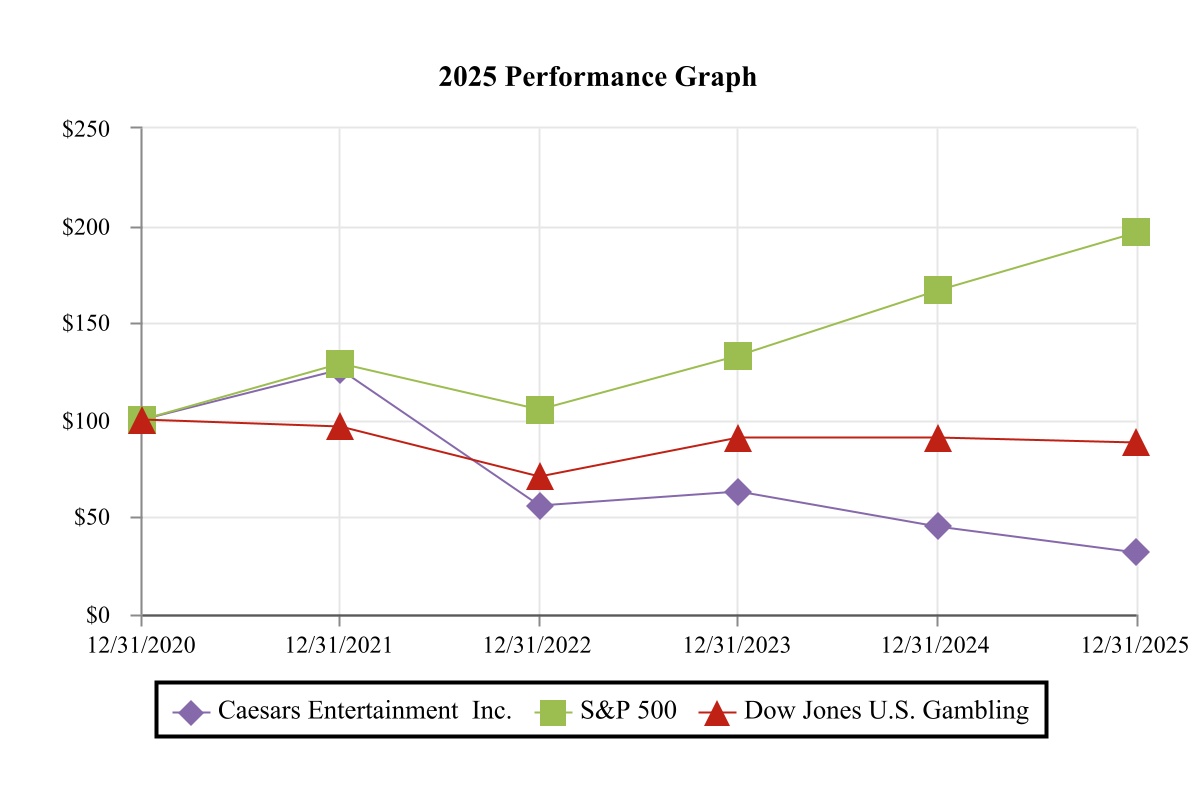
The performance graph should not be deemed filed or incorporated by reference into any other of our filings under the Securities Act or the Exchange Act, unless we specifically incorporate the performance graph by reference therein.
Item 6. [Reserved]
Not used.
Item 7. Management’s Discussion and Analysis of Financial Condition and Results of Operations
The following discussion should be read in conjunction with, and is qualified in its entirety by, the audited consolidated financial statements and the notes thereto and other financial information included elsewhere in this Annual Report on Form 10-K.
Caesars Entertainment, Inc., a Delaware corporation, and its subsidiaries, may be referred to as the “Company,” “CEI,” “Caesars,” “we,” “our,” “us,” or the “Registrant.”
We also refer to (i) our Consolidated Financial Statements as our “Financial Statements,” (ii) our Consolidated Balance Sheets as our “Balance Sheets,” (iii) our Consolidated Statements of Operations and Consolidated Statements of Comprehensive Income (Loss) as our “Statements of Operations,” and (iv) our Consolidated Statements of Cash Flows as our “Statements of Cash Flows.” References to numbered “Notes” refer to Notes to our Consolidated Financial Statements included in Item 8.
The statements in this discussion regarding our expectations of our future performance, liquidity and capital resources, and other non-historical statements are forward-looking statements. These forward-looking statements are subject to numerous risks and uncertainties. Our actual results may differ materially from those contained in or implied by any forward-looking statements. See “Cautionary Statements Regarding Forward-Looking Information.”
Objective
This Management’s Discussion and Analysis of Financial Condition and Results of Operations (“MD&A”) is intended to be a narrative explanation of the financial statements and other statistical data that should be read in conjunction with the accompanying financial statements to enhance an investor’s understanding of our financial condition, changes in financial condition and results of operations. Our objectives are: (i) to provide a narrative explanation of our financial statements that will enable investors to see the Company through the eyes of management; (ii) to enhance the overall financial disclosure and provide the context within which financial information should be analyzed; and (iii) to provide information about the quality of, and potential variability of, our earnings and cash flows so that investors can ascertain the likelihood of whether past performance is indicative of future performance.
Overview
We are a geographically diversified gaming and hospitality company that was founded in 1973 by the Carano family with the opening of the Eldorado Hotel Casino in Reno, Nevada. Beginning in 2005, we grew through a series of acquisitions, including the acquisition of MTR Gaming Group, Inc. in 2014, Isle of Capri Casinos, Inc. in 2017, Tropicana Entertainment, Inc. in 2018, Caesars Entertainment Corporation in 2020, and William Hill PLC in 2021. Our ticker symbol on the NASDAQ Stock Market is “CZR.”
We own, lease or manage an aggregate of 52 domestic properties in 18 states with approximately 51,400 slot machines, video lottery terminals and e-tables, approximately 2,700 table games and approximately 45,600 hotel rooms as of December 31, 2025. In addition, we have other properties in North America that are authorized to use the brands and marks of Caesars Entertainment, Inc. Our primary source of revenue is generated by our gaming operations, which includes our casino properties, retail and online sports betting and online gaming. Additionally, we utilize our hotels, restaurants, bars, entertainment, racing, retail shops and other services to attract customers to our properties.
As of December 31, 2025, we owned 22 of our casinos and leased 24 casinos in the U.S. We lease 18 casinos from VICI Properties L.P., a Delaware limited partnership (“VICI”) pursuant to a regional lease, a Las Vegas lease and a Joliet lease (the “VICI Leases”). In addition, we lease six casinos from GLP Capital, L.P., the operating partnership of Gaming and Leisure Properties, Inc. (“GLPI”), pursuant to a Master Lease (as amended, the “GLPI Master Lease”) and a Lumière lease (together with the GLPI Master Lease, the “GLPI Leases”). See descriptions below under the “GLPI Leases” and “VICI Leases.”
We operate and conduct retail and online sports wagering across 34 jurisdictions in North America, 27 of which offer online sports betting. Additionally, we operate iGaming in five jurisdictions in North America. The map below illustrates Caesars Digital’s presence as of December 31, 2025:
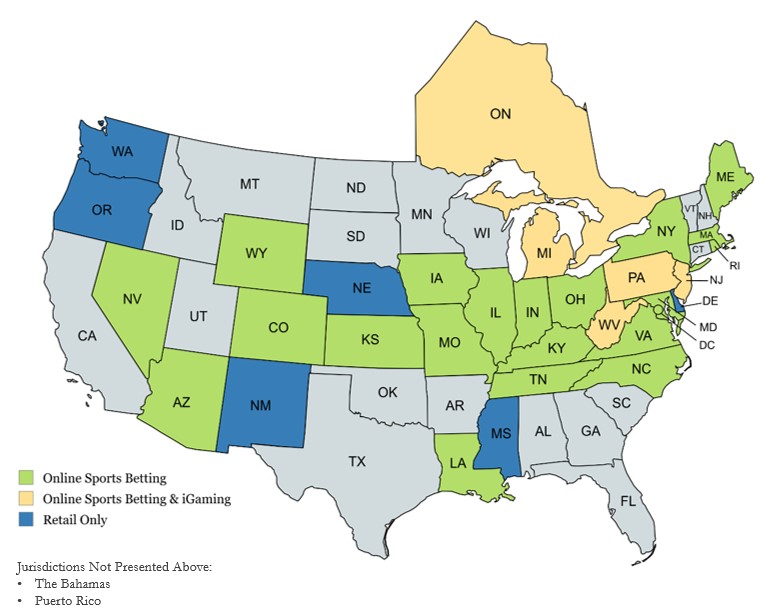
We have a partnership with NYRABets LLC, the official online wagering platform of the New York Racing Association, Inc., and operate the Caesars Racebook app in 22 states as of December 31, 2025. The Caesars Racebook app provides access for pari-mutuel wagering at over 300 racetracks around the world as well as livestreaming of races. Wagers placed can earn credits towards our Caesars Rewards loyalty program or points which can be redeemed for free wagering credits.
We are also in the process of continuing the expansion of our Caesars Digital footprint into other states in the near term with our Caesars Sportsbook, Caesars Racebook and iGaming mobile apps as jurisdictions legalize or provide necessary approvals. No customers under 21 years old are allowed to wager on any of our Caesars Sportsbook, Caesars Racebook and iGaming mobile apps.
We periodically divest assets to raise capital or, in previous cases, to comply with conditions, terms, obligations or restrictions imposed by antitrust, gaming and other regulatory entities. The following is a summary of divestitures completed as of December 31, 2025:
| Segment | Property/Assets | Date Sold | Sales Price | |||||||||||||||||
| Caesars Digital | World Series of Poker (“WSOP”) Trademark | October 29, 2024 | $500 million | |||||||||||||||||
| Las Vegas | The LINQ Promenade | December 12, 2024 | $275 million | |||||||||||||||||
In addition to the divestitures above, the operations of Rio All-Suite Hotel & Casino (“Rio”) were assumed by the lessor on October 2, 2023, and we exited our management agreement with Caesars Dubai on November 16, 2023. See Note 3 for further discussion on these key transactions and any applicable gain (loss) recorded.
Investments and Partnerships
We have investments in unconsolidated affiliates accounted for under the equity method which are recorded in Investment in and advances to unconsolidated affiliates on the Balance Sheets.
Pompano Joint Venture
In April 2018, we entered into a joint venture with Cordish Companies (“Cordish”) to plan and develop a mixed-use entertainment and hospitality destination expected to be located on unused land adjacent to our Pompano property. As the managing member, Cordish will operate the business and manage the development, construction, financing, marketing, leasing, maintenance and day-to-day operation of the various phases of the project. Additionally, Cordish is responsible for the development of the master plan for the project with our input and will submit it for our review and approval. While we hold a 50% variable interest in the joint venture, we are not the primary beneficiary; as such the investment in the joint venture is accounted for using the equity method. We participate evenly with Cordish in the profits and losses of the joint venture, which are included in Transaction and other costs, net on our Statements of Operations.
During the years ended December 31, 2025 and 2024, we received distributions of $23 million and $39 million, respectively, and recorded $19 million and $11 million of income related to our investment due to the joint venture’s gains on the sales of certain land parcels, respectively. As of December 31, 2025 and 2024, our investment in the joint venture totaled $115 million and $119 million, respectively.
Reportable Segments
Segment results in this MD&A are presented consistent with the way our management reviews operating results, assesses performance and makes decisions on a “significant market” basis. Management views each of the Company’s casinos as an operating segment. Operating segments are aggregated based on their similar economic characteristics, types of customers, types of services and products provided, and their management and reporting structure. Our principal operating activities occur in four reportable segments: (1) Las Vegas, (2) Regional, (3) Caesars Digital, and (4) Managed and Branded, in addition to Corporate and Other. See Item 2. “Properties” for listing of properties by segment.
Presentation of Financial Information
The financial information included in this Item 7 for the periods after the Company’s divestiture of various properties or assets, described above, is not fully comparable to the periods prior to the date of divestiture.
This MD&A is intended to provide information to assist in better understanding and evaluating our financial condition and results of operations. Our historical operating results may not be indicative of our future results of operations because of the factors described in the preceding paragraph and the changing competitive landscape in each of our markets, including changes in market and societal trends, increased competition, as well as by factors or trends discussed elsewhere herein. We recommend that you read this MD&A together with our audited consolidated financial statements and the notes to those statements included in this Annual Report on Form 10-K.
Key Performance Metrics
Our primary source of revenue is generated by our gaming operations, which includes our casino properties, retail and online sports betting and online gaming. Additionally, we utilize our hotels, restaurants, bars, entertainment venues, retail shops, racing and other services to attract customers to our properties. Our operating results are highly dependent on the volume and quality of customers staying at, or visiting, our properties and using our sports betting, horse racing and iGaming applications.
Key performance metrics include volume indicators such as drop or handle, which refer to amounts wagered by our customers. The amount of volume we retain, which is not fully controllable by us, is recognized as casino revenues and is referred to as our win or hold. Slot win percentage is typically in the range of approximately 9% to 11% of slot handle. Table games hold percentage is typically in the range of approximately 16% to 23% of table games drop. Sports betting hold is typically in the range of 7% to 11% and iGaming hold typically ranges from 3% to 5%. In addition, hotel occupancy, which is the average percentage of available hotel rooms occupied during a period, is a key indicator for our hotel business in the Las Vegas segment. Complimentary and discounted rooms are treated as occupied rooms in our calculation of hotel occupancy. The key metrics we utilize to measure our profitability and performance are Adjusted EBITDA and Adjusted EBITDA margin. See “Results of Operations” section below.
Results of Operations
The following table highlights the results of our operations:
| Years Ended December 31, | |||||||||||||||||
| (Dollars in millions) | 2025 | 2024 | 2023 | ||||||||||||||
| Net revenues: | |||||||||||||||||
| Las Vegas | $ | 4,049 | $ | 4,274 | $ | 4,470 | |||||||||||
| Regional | 5,756 | 5,539 | 5,778 | ||||||||||||||
| Caesars Digital | 1,408 | 1,163 | 973 | ||||||||||||||
| Managed and Branded | 279 | 274 | 307 | ||||||||||||||
Corporate and Other (a) | (6) | (5) | — | ||||||||||||||
| Total | $ | 11,486 | $ | 11,245 | $ | 11,528 | |||||||||||
Net income (loss) | $ | (437) | $ | (211) | $ | 828 | |||||||||||
Adjusted EBITDA (b): | |||||||||||||||||
| Las Vegas | $ | 1,728 | $ | 1,907 | $ | 2,016 | |||||||||||
| Regional | 1,789 | 1,810 | 1,962 | ||||||||||||||
| Caesars Digital | 236 | 117 | 38 | ||||||||||||||
| Managed and Branded | 67 | 71 | 76 | ||||||||||||||
Corporate and Other (a) | (196) | (166) | (154) | ||||||||||||||
Total | $ | 3,624 | $ | 3,739 | $ | 3,938 | |||||||||||
Net income (loss) margin | (3.8) | % | (1.9) | % | 7.2 | % | |||||||||||
| Adjusted EBITDA margin | 31.6 | % | 33.3 | % | 34.2 | % | |||||||||||
___________________
(a)Corporate and Other includes revenues related to certain licensing arrangements and various revenue sharing agreements and includes eliminations of transactions among segments to reconcile to the Company’s consolidated results. Corporate and Other Adjusted EBITDA includes corporate overhead costs, which consist of certain expenses, such as: payroll, professional fees, cybersecurity and other general and administrative expenses.
(b)See the “Supplemental Unaudited Presentation of Consolidated Adjusted Earnings before Interest, Taxes, Depreciation and Amortization (“Adjusted EBITDA”)” discussion later in this MD&A for a description of Adjusted EBITDA and a reconciliation of net income (loss) to Adjusted EBITDA.
Consolidated comparison for the years ended December 31, 2025, 2024 and 2023
The tables below highlight the results of our operations. Comparisons between 2025 and 2024 are described below. A discussion of changes in our results of operations for the year ended December 31, 2024 compared to 2023 has been omitted from this Annual Report on Form 10-K and can be found in “Item 7. Management's Discussion and Analysis of Financial Condition and Results of Operations” of the Company’s Annual Report on Form 10-K for the fiscal year ended December 31, 2024.
Net Revenues
Net revenues were as follows:
| Years Ended December 31, | Variance | Percent Change | Variance | Percent Change | |||||||||||||||||||||||||||||||||||||
| (Dollars in millions) | 2025 | 2024 | 2023 | 2025 vs 2024 | 2024 vs 2023 | ||||||||||||||||||||||||||||||||||||
| Casino | $ | 6,617 | $ | 6,267 | $ | 6,367 | $ | 350 | 5.6 | % | $ | (100) | (1.6) | % | |||||||||||||||||||||||||||
| Food and beverage | 1,714 | 1,716 | 1,728 | (2) | (0.1) | % | (12) | (0.7) | % | ||||||||||||||||||||||||||||||||
| Hotel | 1,945 | 2,016 | 2,090 | (71) | (3.5) | % | (74) | (3.5) | % | ||||||||||||||||||||||||||||||||
| Other | 1,210 | 1,246 | 1,343 | (36) | (2.9) | % | (97) | (7.2) | % | ||||||||||||||||||||||||||||||||
| Net Revenues | $ | 11,486 | $ | 11,245 | $ | 11,528 | $ | 241 | 2.1 | % | $ | (283) | (2.5) | % | |||||||||||||||||||||||||||
Consolidated net revenues increased for the year ended December 31, 2025, as compared to the same prior year period. The increase in casino revenues was primarily driven by significant growth in iGaming handle coupled with improved iGaming and sports betting hold in our Caesars Digital segment. The completion of Caesars Virginia’s permanent facility in December 2024 and the renovation and expansion of the rebranded Caesars New Orleans in October 2024 also contributed incremental gaming and non-gaming revenues in 2025. These increases were partially offset by declines in net revenues in certain competitive markets in our Regional segment and net revenues in our Las Vegas region which was due to lower customer visitation, consistent with city-wide trends, and lower table games hold compared to the same prior year period.
Operating Expenses
Operating expenses were as follows:
| Years Ended December 31, | Variance | Percent Change | Variance | Percent Change | |||||||||||||||||||||||||||||||||||||
| (Dollars in millions) | 2025 | 2024 | 2023 | 2025 vs 2024 | 2024 vs 2023 | ||||||||||||||||||||||||||||||||||||
| Casino | $ | 3,602 | $ | 3,370 | $ | 3,342 | $ | 232 | 6.9 | % | $ | 28 | 0.8 | % | |||||||||||||||||||||||||||
| Food and beverage | 1,106 | 1,073 | 1,049 | 33 | 3.1 | % | 24 | 2.3 | % | ||||||||||||||||||||||||||||||||
| Hotel | 615 | 580 | 570 | 35 | 6.0 | % | 10 | 1.8 | % | ||||||||||||||||||||||||||||||||
| Other | 420 | 396 | 434 | 24 | 6.1 | % | (38) | (8.8) | % | ||||||||||||||||||||||||||||||||
| General and administrative | 1,926 | 1,920 | 2,012 | 6 | 0.3 | % | (92) | (4.6) | % | ||||||||||||||||||||||||||||||||
| Corporate | 322 | 307 | 306 | 15 | 4.9 | % | 1 | 0.3 | % | ||||||||||||||||||||||||||||||||
| Impairment charges | 182 | 302 | 95 | (120) | (39.7) | % | 207 | * | |||||||||||||||||||||||||||||||||
| Depreciation and amortization | 1,417 | 1,324 | 1,261 | 93 | 7.0 | % | 63 | 5.0 | % | ||||||||||||||||||||||||||||||||
Transaction and other costs, net | 38 | (331) | (13) | 369 | * | (318) | * | ||||||||||||||||||||||||||||||||||
| Total operating expenses | $ | 9,628 | $ | 8,941 | $ | 9,056 | $ | 687 | 7.7 | % | $ | (115) | (1.3) | % | |||||||||||||||||||||||||||
* Not meaningful.
Casino expenses consist primarily of salaries and wages, gaming taxes, and marketing and advertising costs associated with our gaming operations. Food and beverage expenses consist principally of salaries and wages and costs of goods sold associated with our food and beverage operations. Hotel expenses consist principally of salaries and wages, supplies and costs of services associated with our hotel operations. Other expenses consist principally of salaries and wages and costs of goods sold associated with our retail operations, entertainment costs (including professional talent fees), reimbursable management costs and other operations.
Casino expenses increased for the year ended December 31, 2025, as compared to the same prior year period. Casino expenses, such as gaming taxes, platform costs and processing fees, rose in connection with increased revenues in our Caesars Digital segment. Additionally, increased gaming tax rates on sports betting wagers and iGaming in certain states took effect on July 1, 2025. Casino expenses in the Regional segment increased in connection with additional casino revenues and targeted customer reinvestment spend in certain competitive markets. Increased casino expenses were partially offset by decreased marketing expenses in our Las Vegas segment associated with the Super Bowl held in Las Vegas in the first quarter of 2024. Food and beverage and hotel expenses have increased due to incremental wages correlating with additional revenues associated with the opening of Caesars Virginia’s permanent facility and the completed renovation and expansion of Caesars New Orleans, as well as higher union and non-union wages. We continue to focus on labor efficiencies across the enterprise to manage increased labor costs.
General and administrative expenses include items such as information technology, facility maintenance, utilities, property and liability insurance, expenses for administrative departments such as accounting, compliance, purchasing, human resources, legal, internal audit, property taxes and marketing expenses indirectly related to our gaming and non-gaming operations.
Corporate expenses include unallocated expenses such as payroll, inclusive of the annual bonus, stock-based compensation, professional fees, cybersecurity and other various expenses not directly related to the Company’s operations. Corporate expenses increased for the year ended December 31, 2025, as compared to the same prior year period, primarily driven by an increase in payroll and benefits expense.
Impairment charges for the year ended December 31, 2025 were recorded within our Regional segment as a result of a decrease in projected future cash flows at certain properties primarily due to localized competition.
Depreciation and amortization expenses increased for the year ended December 31, 2025, as compared to the same prior year period, primarily related to recently completed construction projects.
Transaction and other costs, net primarily includes non-cash losses on the write down and disposal of assets, gains and losses on the sales of certain assets, certain non-recurring litigation reserves, non-recurring asset recoveries, professional services for transaction and integration costs, various contract exit or termination costs, pre-opening costs in connection with new property openings and non-cash changes in equity method investments. For the year ended December 31, 2025, as compared to the same prior year period, transaction and other costs, net increased primarily due to gains from the sales of the WSOP trademark and the LINQ Promenade recognized in the prior year period.
Other income (expenses)
Other income (expenses) were as follows:
| Years Ended December 31, | Variance | Percent Change | Variance | Percent Change | |||||||||||||||||||||||||||||||||||||
| (Dollars in millions) | 2025 | 2024 | 2023 | 2025 vs 2024 | 2024 vs 2023 | ||||||||||||||||||||||||||||||||||||
| Interest expense, net | $ | (2,304) | $ | (2,366) | $ | (2,342) | $ | 62 | 2.6 | % | $ | (24) | (1.0) | % | |||||||||||||||||||||||||||
| Loss on extinguishment of debt | (4) | (89) | (200) | 85 | 95.5 | % | 111 | 55.5 | % | ||||||||||||||||||||||||||||||||
Other income | 2 | 27 | 10 | (25) | (92.6) | % | 17 | 170.0 | % | ||||||||||||||||||||||||||||||||
| Benefit (provision) for income taxes | 11 | (87) | 888 | 98 | * | (975) | * | ||||||||||||||||||||||||||||||||||
___________________
* Not meaningful.
Interest expense, net decreased for the year ended December 31, 2025, as compared to the same prior year period, primarily due to a reduction in outstanding debt and our strategic shift in our debt mix from higher fixed rate debt to variable rate debt during the first quarter of 2024. Since September 2024, key borrowing rates have been decreased by the Federal Reserve by 175 basis points resulting in significant decreases in our cash paid for interest on our variable debt. Decreased interest expense was partially offset by lower capitalized interest for the year ended December 31, 2025, as compared to the same prior year period, due to the completion of construction projects. See Note 2 to our Financial Statements for the major components of interest expense, net.
For the year ended December 31, 2025, loss on extinguishment of debt was related to the full redemption of the CEI Senior Notes due 2027. For the year ended December 31, 2024, loss on extinguishment of debt was primarily related to the prepayments of the CEI Senior Secured Notes due 2025 and the Caesars Resort Collection (“CRC”) Senior Secured Notes and the partial prepayments of the CEI Term Loan B and the CEI Senior Notes due 2027.
Other income for the year ended December 31, 2024 primarily represents a change in estimate of our disputed claims liability.
The income tax benefit was $11 million for the year ended December 31, 2025, as compared to an income tax provision of $87 million for the year ended December 31, 2024. The reported income tax benefit in 2025 differed from the statutory income tax benefit primarily due to nondeductible goodwill impairments and nondeductible interest expense. The reported income tax expense in 2024 differed from the statutory income tax benefit primarily due to nondeductible goodwill impairments and write offs and nondeductible interest expense. See Note 14 to our Financial Statements for the effective income tax rate reconciliation.
Segment comparison for the years ended December 31, 2025, 2024 and 2023
Las Vegas Segment
| Years Ended December 31, | Variance | Percent Change | Variance | Percent Change | |||||||||||||||||||||||||||||||||||||
| (Dollars in millions) | 2025 | 2024 | 2023 | 2025 vs 2024 | 2024 vs 2023 | ||||||||||||||||||||||||||||||||||||
Net revenues: | |||||||||||||||||||||||||||||||||||||||||
| Casino | $ | 1,072 | $ | 1,115 | $ | 1,212 | $ | (43) | (3.9) | % | $ | (97) | (8.0) | % | |||||||||||||||||||||||||||
| Food and beverage | 1,099 | 1,141 | 1,152 | (42) | (3.7) | % | (11) | (1.0) | % | ||||||||||||||||||||||||||||||||
| Hotel | 1,313 | 1,417 | 1,447 | (104) | (7.3) | % | (30) | (2.1) | % | ||||||||||||||||||||||||||||||||
| Other | 565 | 601 | 659 | (36) | (6.0) | % | (58) | (8.8) | % | ||||||||||||||||||||||||||||||||
| Net revenues | $ | 4,049 | $ | 4,274 | $ | 4,470 | $ | (225) | (5.3) | % | $ | (196) | (4.4) | % | |||||||||||||||||||||||||||
Table games drop (a) | $ | 2,880 | $ | 3,124 | $ | 3,428 | $ | (244) | (7.8) | % | $ | (304) | (8.9) | % | |||||||||||||||||||||||||||
Table games hold % | 19.9 | % | 21.3 | % | 22.2 | % | (1.4) pts | (0.9) pts | |||||||||||||||||||||||||||||||||
Slot handle (a) | $ | 10,427 | $ | 10,569 | $ | 11,057 | $ | (142) | (1.3) | % | $ | (488) | (4.4) | % | |||||||||||||||||||||||||||
| Hotel occupancy | 94.1 | % | 97.5 | % | 96.8 | % | (3.4) pts | 0.7 pts | |||||||||||||||||||||||||||||||||
| Adjusted EBITDA | $ | 1,728 | $ | 1,907 | $ | 2,016 | $ | (179) | (9.4) | % | $ | (109) | (5.4) | % | |||||||||||||||||||||||||||
| Adjusted EBITDA margin | 42.7 | % | 44.6 | % | 45.1 | % | (1.9) pts | (0.5) pts | |||||||||||||||||||||||||||||||||
Net income attributable to Caesars | $ | 703 | $ | 924 | $ | 1,042 | $ | (221) | (23.9) | % | $ | (118) | (11.3) | % | |||||||||||||||||||||||||||
____________________
(a)Prior year gaming volumes include Rio’s table games drop of $70 million and slot handle of $342 million for the year ended December 31, 2023.
Our Las Vegas segment’s net revenues, net income, Adjusted EBITDA and Adjusted EBITDA margin decreased for the year ended December 31, 2025, compared to the same prior year period, primarily due to declines in city-wide visitation trends resulting in lower gaming and non-gaming revenues. Casino revenues declined as a result of decreased table and slot volumes, coupled with unfavorable table games hold, which remained within the typical range. Similarly, declines in city-wide visitation resulted in lower hotel occupancy and room rates compared to the prior year period. Other revenue declined as compared to the same prior year period primarily due to the sale of the LINQ Promenade during the fourth quarter of 2024.
Slot win percentage in the Las Vegas segment during the year ended December 31, 2025 was within our typical range.
Regional Segment
| Years Ended December 31, | Variance | Percent Change | Variance | Percent Change | |||||||||||||||||||||||||||||||||||||
| (Dollars in millions) | 2025 | 2024 | 2023 | 2025 vs 2024 | 2024 vs 2023 | ||||||||||||||||||||||||||||||||||||
Net revenues: | |||||||||||||||||||||||||||||||||||||||||
| Casino | $ | 4,193 | $ | 4,073 | $ | 4,272 | $ | 120 | 2.9 | % | $ | (199) | (4.7) | % | |||||||||||||||||||||||||||
| Food and beverage | 616 | 575 | 576 | 41 | 7.1 | % | (1) | (0.2) | % | ||||||||||||||||||||||||||||||||
| Hotel | 632 | 599 | 643 | 33 | 5.5 | % | (44) | (6.8) | % | ||||||||||||||||||||||||||||||||
| Other | 315 | 292 | 287 | 23 | 7.9 | % | 5 | 1.7 | % | ||||||||||||||||||||||||||||||||
| Net revenues | $ | 5,756 | $ | 5,539 | $ | 5,778 | $ | 217 | 3.9 | % | $ | (239) | (4.1) | % | |||||||||||||||||||||||||||
Table games drop | $ | 4,431 | $ | 4,005 | $ | 4,188 | $ | 426 | 10.6 | % | $ | (183) | (4.4) | % | |||||||||||||||||||||||||||
Table games hold % | 20.7 | % | 21.3 | % | 21.7 | % | (0.6) pts | (0.4) pts | |||||||||||||||||||||||||||||||||
| Slot handle | $ | 43,203 | $ | 40,850 | $ | 43,211 | $ | 2,353 | 5.8 | % | $ | (2,361) | (5.5) | % | |||||||||||||||||||||||||||
| Adjusted EBITDA | $ | 1,789 | $ | 1,810 | $ | 1,962 | $ | (21) | (1.2) | % | $ | (152) | (7.7) | % | |||||||||||||||||||||||||||
| Adjusted EBITDA margin | 31.1 | % | 32.7 | % | 34.0 | % | (1.6) pts | (1.3) pts | |||||||||||||||||||||||||||||||||
Net income (loss) attributable to Caesars | $ | (145) | $ | (18) | $ | 377 | $ | (127) | * | $ | (395) | * | |||||||||||||||||||||||||||||
___________________
* Not meaningful.
Our Regional segment’s net revenues improved for the year ended December 31, 2025, as compared to the same prior year period, primarily due to favorable results from our recently completed Caesars Virginia and Caesars New Orleans development projects. These increases were partially offset by the continued impact of competition and inclement weather in several of our regional markets, as well as construction disruption in Lake Tahoe. Adjusted EBITDA and Adjusted EBITDA margin decreased slightly for the year ended December 31, 2025, as compared to the same prior year period, primarily due to increased labor costs and targeted customer reinvestment spend in certain competitive markets. Net income (loss) decreased for the year ended December 31, 2025, as compared to the same prior year period, primarily due to additional depreciation expense resulting from the recently completed development projects.
As a result of the aforementioned factors impacting certain of our properties in the Regional segment, we recorded impairments totaling $182 million during the year ended December 31, 2025.
Slot win percentage in the Regional segment during the year ended December 31, 2025 was within our typical range.
Caesars Digital Segment
| Years Ended December 31, | Variance | Percent Change | Variance | Percent Change | |||||||||||||||||||||||||||||||||||||
| (Dollars in millions) | 2025 | 2024 | 2023 | 2025 vs 2024 | 2024 vs 2023 | ||||||||||||||||||||||||||||||||||||
Net revenues: | |||||||||||||||||||||||||||||||||||||||||
Casino (a) | $ | 1,359 | $ | 1,085 | $ | 886 | $ | 274 | 25.3 | % | $ | 199 | 22.5 | % | |||||||||||||||||||||||||||
| Other | 49 | 78 | 87 | (29) | (37.2) | % | (9) | (10.3) | % | ||||||||||||||||||||||||||||||||
| Net revenues | $ | 1,408 | $ | 1,163 | $ | 973 | $ | 245 | 21.1 | % | $ | 190 | 19.5 | % | |||||||||||||||||||||||||||
Sports betting handle (b) | $ | 11,496 | $ | 11,514 | $ | 12,089 | $ | (18) | (0.2) | % | $ | (575) | (4.8) | % | |||||||||||||||||||||||||||
| Sports betting hold % | 8.1 | % | 7.0 | % | 6.3 | % | 1.1 pts | 0.7 pts | |||||||||||||||||||||||||||||||||
| iGaming handle | $ | 19,025 | $ | 14,920 | $ | 10,622 | $ | 4,105 | 27.5 | % | $ | 4,298 | 40.5 | % | |||||||||||||||||||||||||||
| iGaming hold % | 3.6 | % | 3.5 | % | 3.1 | % | 0.1 pts | 0.4 pts | |||||||||||||||||||||||||||||||||
| Adjusted EBITDA | $ | 236 | $ | 117 | $ | 38 | $ | 119 | 101.7 | % | $ | 79 | * | ||||||||||||||||||||||||||||
| Adjusted EBITDA margin | 16.8 | % | 10.1 | % | 3.9 | % | 6.7 pts | 6.2 pts | |||||||||||||||||||||||||||||||||
| Net income (loss) attributable to Caesars | $ | 57 | $ | 269 | $ | (91) | $ | (212) | (78.8) | % | $ | 360 | * | ||||||||||||||||||||||||||||
___________________
* Not meaningful.
(a)Includes total promotional and complimentary incentives related to sports betting, iGaming, and poker of $309 million, $283 million and $253 million for the years ended December 31, 2025, 2024 and 2023, respectively. Promotional and complimentary incentives for poker were $14 million, $13 million and $14 million for the years ended December 31, 2025, 2024 and 2023, respectively.
(b)Caesars Digital generated an additional $951 million, $979 million and $1.1 billion of sports betting handle for the years ended December 31, 2025, 2024 and 2023, respectively, which is not included in this table, for select wholly-owned and third-party operations for which Caesars Digital provides services and we receive all, or a share of, the net profits. Hold related to these operations was 11.8%, 9.3% and 10.4% for the years ended December 31, 2025, 2024 and 2023, respectively. Sports betting handle includes $40 million, $41 million and $45 million for the years ended December 31, 2025, 2024 and 2023, respectively, related to horse racing and pari-mutuel wagers.
Caesars Digital’s net revenues, Adjusted EBITDA, and Adjusted EBITDA margin improved significantly for the year ended December 31, 2025, as compared to the same prior year period, primarily due to higher iGaming handle and iGaming hold coupled with improved sports betting hold. Net income decreased primarily due to the gain recognized on the sale of the WSOP trademark in the prior year period.
As sports betting and online casinos expand through increased state or jurisdictional legalization, new product launches, and customer adoption, variations in hold percentages and increases in promotional and marketing expenses in highly competitive markets may negatively impact Caesars Digital’s net revenues, net income, Adjusted EBITDA and Adjusted EBITDA margin in comparison to current or prior periods.
Managed and Branded Segment
| Years Ended December 31, | Variance | Percent Change | Variance | Percent Change | |||||||||||||||||||||||||||||||||||||
| (Dollars in millions) | 2025 | 2024 | 2023 | 2025 vs 2024 | 2024 vs 2023 | ||||||||||||||||||||||||||||||||||||
Net revenues: | |||||||||||||||||||||||||||||||||||||||||
| Other | $ | 279 | $ | 274 | $ | 307 | $ | 5 | 1.8 | % | $ | (33) | (10.7) | % | |||||||||||||||||||||||||||
| Net revenues | $ | 279 | $ | 274 | $ | 307 | $ | 5 | 1.8 | % | $ | (33) | (10.7) | % | |||||||||||||||||||||||||||
| Adjusted EBITDA | $ | 67 | $ | 71 | $ | 76 | $ | (4) | (5.6) | % | $ | (5) | (6.6) | % | |||||||||||||||||||||||||||
| Adjusted EBITDA margin | 24.0 | % | 25.9 | % | 24.8 | % | (1.9) pts | 1.1 pts | |||||||||||||||||||||||||||||||||
| Net income attributable to Caesars | $ | 68 | $ | 71 | $ | 101 | $ | (3) | (4.2) | % | $ | (30) | (29.7) | % | |||||||||||||||||||||||||||
We manage several properties and license rights to the use of our brands. These revenue agreements typically include reimbursement of certain costs that we incur directly. Such costs are primarily related to payroll costs incurred on behalf of the properties under management. The revenue related to these reimbursable management costs has a direct impact on our evaluation of Adjusted EBITDA margin which, when excluded, reflects margins typically realized from such agreements. The table below presents the amount included in net revenues and total operating expenses related to these reimbursable costs.
| Years Ended December 31, | Variance | Percent Change | Variance | Percent Change | |||||||||||||||||||||||||||||||||||||
| (Dollars in millions) | 2025 | 2024 | 2023 | 2025 vs 2024 | 2024 vs 2023 | ||||||||||||||||||||||||||||||||||||
| Reimbursable management revenue | $ | 208 | $ | 203 | $ | 206 | $ | 5 | 2.5 | % | $ | (3) | (1.5) | % | |||||||||||||||||||||||||||
| Reimbursable management cost | 208 | 203 | 206 | 5 | 2.5 | % | (3) | (1.5) | % | ||||||||||||||||||||||||||||||||
Corporate & Other
| Years Ended December 31, | Variance | Percent Change | Variance | Percent Change | |||||||||||||||||||||||||||||||||||||
| (Dollars in millions) | 2025 | 2024 | 2023 | 2025 vs 2024 | 2024 vs 2023 | ||||||||||||||||||||||||||||||||||||
Net revenues: | |||||||||||||||||||||||||||||||||||||||||
| Casino | $ | (7) | $ | (6) | $ | (3) | $ | (1) | (16.7) | % | $ | (3) | (100.0) | % | |||||||||||||||||||||||||||
| Food and beverage | (1) | — | — | (1) | * | — | * | ||||||||||||||||||||||||||||||||||
| Other | 2 | 1 | 3 | 1 | 100.0 | % | (2) | (66.7) | % | ||||||||||||||||||||||||||||||||
| Net revenues | $ | (6) | $ | (5) | $ | — | $ | (1) | (20.0) | % | $ | (5) | * | ||||||||||||||||||||||||||||
| Adjusted EBITDA | $ | (196) | $ | (166) | $ | (154) | $ | (30) | (18.1) | % | $ | (12) | (7.8) | % | |||||||||||||||||||||||||||
___________________
* Not meaningful.
Supplemental Unaudited Presentation of Consolidated Adjusted Earnings before Interest, Taxes, Depreciation and Amortization (“Adjusted EBITDA”) for the Years Ended December 31, 2025, 2024 and 2023
Adjusted EBITDA (described below), a non-GAAP financial measure, has been presented as a supplemental disclosure because it is a widely used measure of performance and basis for valuation of companies in our industry and we believe that this non-GAAP supplemental information will be helpful in understanding our ongoing operating results. Management has historically used Adjusted EBITDA when evaluating operating performance because we believe that the inclusion or exclusion of certain recurring and non-recurring items is necessary to provide a full understanding of our core operating results and as a means to evaluate period-to-period results. Adjusted EBITDA represents net income (loss) before interest income and interest expense net of interest capitalized, (benefit) provision for income taxes, depreciation and amortization, stock-based compensation expense, (gain) loss on extinguishment of debt, impairment charges, other (income) loss, net income (loss) attributable to noncontrolling interests, transaction costs associated with our acquisitions, developments, and divestitures, and non-cash changes in equity method investments. Adjusted EBITDA also excludes the expense associated with certain of our leases as these transactions were accounted for as financing obligations and the associated expense is included in interest expense. Adjusted EBITDA is not a measure of performance or liquidity calculated in accordance with accounting principles generally accepted in the United States (“GAAP”). Adjusted EBITDA is unaudited and should not be considered an alternative to, or more meaningful than, net income (loss) as an indicator of our operating performance. Uses of cash flows that are not reflected
in Adjusted EBITDA include capital expenditures, interest payments, income taxes, debt principal repayments, distributions to our noncontrolling interest owners and payments under our leases with affiliates of VICI and GLPI, which can be significant. As a result, Adjusted EBITDA should not be considered as a measure of our liquidity. Other companies that provide Adjusted EBITDA information may calculate Adjusted EBITDA differently than we do. The definition of Adjusted EBITDA may not be the same as the definitions used in any of our debt agreements.
The following table summarizes our Adjusted EBITDA for the years ended December 31, 2025, 2024 and 2023 in addition to reconciling net income (loss) to Adjusted EBITDA in accordance with GAAP (unaudited):
| Years Ended December 31, | |||||||||||||||||
| (In millions) | 2025 | 2024 | 2023 | ||||||||||||||
Net income (loss) attributable to Caesars | $ | (502) | $ | (278) | $ | 786 | |||||||||||
Net income attributable to noncontrolling interests | 65 | 67 | 42 | ||||||||||||||
(Benefit) provision for income taxes (a) | (11) | 87 | (888) | ||||||||||||||
Other income (b) | (2) | (27) | (10) | ||||||||||||||
| Loss on extinguishment of debt | 4 | 89 | 200 | ||||||||||||||
| Interest expense, net | 2,304 | 2,366 | 2,342 | ||||||||||||||
Impairment charges (c) | 182 | 302 | 95 | ||||||||||||||
| Depreciation and amortization | 1,417 | 1,324 | 1,261 | ||||||||||||||
Transaction costs and other, net (d) | 72 | (285) | 6 | ||||||||||||||
| Stock-based compensation expense | 95 | 94 | 104 | ||||||||||||||
| Adjusted EBITDA | 3,624 | 3,739 | 3,938 | ||||||||||||||
Pre-disposition EBITDA, net (e) | — | (16) | (36) | ||||||||||||||
| Total Adjusted EBITDA | $ | 3,624 | $ | 3,723 | $ | 3,902 | |||||||||||
(a)Benefit for income taxes for the year ended December 31, 2023 includes the release of $940 million of valuation allowance against deferred tax assets.
(b)Other income for the year ended December 31, 2024 primarily represents a change in estimate of our disputed claims liability.
(c)Impairment charges for the years ended December 31, 2025 and 2023 include impairments within our Regional segment. Impairment charges for the year ended December 31, 2024 include impairments within our Regional and Las Vegas segments.
(d)Transaction costs and other, net primarily includes non-cash losses on the write down and disposal of assets, certain non-recurring litigation reserves, non-recurring asset recoveries, gains from the sales of the WSOP trademark and the LINQ Promenade, professional services for transaction and integration costs, various contract exit or termination costs, pre-opening costs in connection with new property openings and expansion projects at existing properties, and non-cash changes in equity method investments.
(e)Adjustment for pre-disposition results of operations reflecting the subtraction of results of operations for Rio All-Suite Hotel & Casino and the LINQ Promenade prior to divestiture, for the relevant periods. See Item 7 - Overview above. Such figures are based on unaudited internal financial statements and have not been reviewed by our auditors for the periods presented. The additional financial information is included to enable the comparison of current results with results of prior periods.
Liquidity and Capital Resources
We are a holding company, and our only significant assets are ownership interests in our subsidiaries. Our ability to fund our obligations depends on existing cash on hand, cash flows from our subsidiaries and our ability to raise capital. Our primary sources of liquidity and capital resources are existing cash on hand, cash flows from operations, availability of borrowings under our CEI Revolving Credit Facility and proceeds from the issuance of debt and equity securities. We may, from time to time, seek to repurchase our common stock or prepay our outstanding indebtedness. Any such purchases or prepayments may be funded by existing cash balances or the incurrence of debt. The amount and timing of any repurchase of debt or common stock will be based on business and market conditions, capital availability, compliance with debt covenants and other considerations. Our cash requirements may fluctuate significantly depending on our decisions with respect to business acquisitions or divestitures and strategic capital and marketing investments.
As of December 31, 2025, our cash on hand and borrowing capacity was as follows:
| (In millions) | December 31, 2025 | ||||
| Cash and cash equivalents | $ | 887 | |||
Revolver capacity (a) | 2,075 | ||||
| Revolver capacity committed to letters of credit | (83) | ||||
| Revolver capacity committed as regulatory requirement | (46) | ||||
Total | $ | 2,833 | |||
___________________
(a)Revolver capacity includes $2.1 billion under the CEI Revolving Credit Facility, maturing in January 2028, and $25 million under the CVA Revolving Credit Facility, maturing on April 26, 2029, less $40 million reserved for specific purposes.
During the year ended December 31, 2025, our operating activities generated operating cash inflows of $1.3 billion, as compared to operating cash inflows of $1.1 billion during the year ended December 31, 2024, primarily due to changes in working capital, coupled with the results of operations described above.
On October 2, 2024, we announced that our Board of Directors (“Board”) authorized a $500 million common stock repurchase program (the “2024 Share Repurchase Program”). Under the 2024 Share Repurchase Program, we may, from time to time, repurchase shares of common stock on the open market (either with or without a 10b5-1 plan) or through privately negotiated transactions. During the year ended December 31, 2025, we acquired 9,606,145 shares of our common stock at an aggregate value of $229 million. Under the 2024 Share Repurchase Program, as of December 31, 2025, we have authorization to repurchase up to $221 million more of our outstanding common stock. See “Share Repurchase Programs” below for details.
On July 8, 2025, we fully redeemed all of the $546 million outstanding principal amount of the CEI Senior Notes due 2027 and paid the related accrued interest and expenses with borrowings under the CEI Revolving Credit Facility and proceeds received from the partial repayment and sale of $225 million of notes receivable related to the previously disclosed WSOP trademark sale.
We expect that our primary capital requirements going forward will relate to servicing our outstanding indebtedness, rent payments under our GLPI Leases and VICI Leases, and the expansion and maintenance of our properties. Beginning in 2025 we have had, and expect to continue having, additional cash uses for operating activities as a result of federal and certain state income taxes.
A significant portion of our liquidity needs are for debt service and payments associated with our leases. Our estimated debt service (including principal and interest) is approximately $824 million for 2026. We also lease certain real property assets from third parties, including VICI and GLPI. The VICI Leases are subject to annual escalations, that take effect in November of each year, based on the Consumer Price Index (“CPI”). In addition to the CPI escalator, our VICI leases are also subject to a variable rent adjustment based on certain historical net revenues of our leased properties which began in November 2024. The next such lease year with a variable rent adjustment begins November 2027. We estimate our lease payments to VICI and GLPI to be approximately $1.4 billion for 2026.
We make capital expenditures and perform continuing refurbishment and maintenance at our properties to maintain our quality standards. Our capital expenditure requirements for 2026 include the completion of expansion and rebranding projects and hotel renovations. In addition, we anticipate continued investment in our Caesars Sportsbook and iGaming applications.
Cash used for capital expenditures totaled $805 million, $1.3 billion and $1.3 billion for the years ended December 31, 2025, 2024 and 2023, respectively, related to our growth, renovation, maintenance, and other capital projects. The following table summarizes our estimates for 2026 capital expenditures.
| (In millions) | Low | High | |||||||||
| Growth and renovation projects | $ | 255 | $ | 305 | |||||||
| Caesars Digital | 55 | 65 | |||||||||
| Maintenance projects | 315 | 355 | |||||||||
| Total estimated capital expenditures from unrestricted cash | $ | 625 | $ | 725 | |||||||
We have agreements with certain sporting event facilities and professional sports teams primarily for tickets, suites, advertising, marketing, promotional and sponsorship opportunities. The agreements include leasing of event suites that are generally considered short term leases for which we do not record a right-of-use asset or lease liability and recognize expenses in the period services are received. As of December 31, 2025 and 2024, obligations related to these agreements were $318 million and $421 million, respectively, with contracts extending through 2040.
We have periodically divested assets to raise capital or, in previous cases, to comply with conditions, terms, obligations or restrictions imposed by antitrust, gaming and other regulatory entities. If an agreed upon selling price for future divestitures does not exceed the carrying value of the assets, we may be required to record additional impairment charges in future periods which may be material.
We expect that our current liquidity, including availability of borrowings under our committed credit facility and cash flows from operations will be sufficient to fund our operations, capital requirements and service our outstanding indebtedness for the next twelve months and beyond.
Debt and Master Lease Covenant Compliance
The CEI Revolving Credit Facility, the CEI Term Loan A, the CEI Term Loan B, the CEI Term Loan B-1 and the indentures governing the CEI Senior Secured Notes due 2030, the CEI Senior Secured Notes due 2032, the CEI Senior Notes due 2029 and the CEI Senior Notes due 2032 contain covenants which are standard and customary for these types of agreements. These include negative covenants, which, subject to certain exceptions and baskets, limit our ability to (among other items) incur additional indebtedness, make investments, make restricted payments, including dividends, grant liens, sell assets and make acquisitions.
The CEI Revolving Credit Facility and the CEI Term Loan A include a maximum net total leverage ratio financial covenant of 6.50:1. In addition, the CEI Revolving Credit Facility and the CEI Term Loan A include a minimum fixed charge coverage ratio financial covenant of 2.0:1. From and after the repayment of the CEI Term Loan A, the financial covenants applicable to the CEI Revolving Credit Facility will be tested solely to the extent that certain testing conditions are satisfied. Failure to comply with such covenants could result in an acceleration of the maturity of indebtedness outstanding under the relevant debt agreement.
The GLPI Leases and VICI Leases contain certain covenants requiring minimum capital expenditures based on a percentage of net revenues along with maintaining certain financial ratios. The GLPI Leases require the Company to maintain a minimum adjusted revenue to rent ratio of 1.20:1, applicable to the operations of the underlying leased properties.
The CVA Revolving Credit Facility and the CVA Delayed Draw Term Loan contain covenants which are standard and customary for this type of agreement, including a maximum net total leverage ratio financial covenant of 4:1 and a minimum fixed charge coverage ratio financial covenant of 1.05:1, applicable to the operations of Caesars Virginia.
As of December 31, 2025, we were in compliance with all of the applicable financial covenants described above.
Share Repurchase Programs
On November 8, 2018, we announced that our Board of Directors authorized a $150 million common stock repurchase program (the “2018 Share Repurchase Program”). In September 2024 we reached the limit of authorized repurchases under the 2018 Share Repurchase Plan and on October 2, 2024, we announced that our Board authorized a $500 million common stock repurchase program. Under the 2024 Share Repurchase Program, we may, from time to time, repurchase shares of common stock on the open market (either with or without a 10b5-1 plan) or through privately negotiated transactions. The 2024 Share Repurchase Program has no time limit and may be suspended or discontinued at any time without notice. There is no minimum number of shares of common stock that we are required to repurchase under the 2024 Share Repurchase Program.
Share repurchase activity is summarized below:
| Years Ended December 31, | |||||||||||||||||||||||
| 2025 | 2024 | ||||||||||||||||||||||
(In millions, except share data) | Shares repurchased | Total cost | Shares repurchased | Total cost | |||||||||||||||||||
2018 Share Repurchase Program | — | $ | — | 3,872,478 | $ | 141 | |||||||||||||||||
2024 Share Repurchase Program | 9,606,145 | 229 | 1,262,990 | 50 | |||||||||||||||||||
Total | 9,606,145 | $ | 229 | 5,135,468 | $ | 191 | |||||||||||||||||
Under the 2024 Share Repurchase Program, as of December 31, 2025, we have authorization to repurchase up to $221 million more of our outstanding common stock.
Debt Obligations and Leases
CEI Term Loans and CEI Revolving Credit Facility
CEI is party to a credit agreement, dated as of July 20, 2020, with JPMorgan Chase Bank, N.A., as administrative agent, U.S. Bank National Association, as collateral agent, and certain banks and other financial institutions and lenders party thereto (the “CEI Credit Agreement”), which, as amended, provides for the CEI Revolving Credit Facility in an aggregate principal amount of $2.25 billion (the “CEI Revolving Credit Facility”) and will mature on January 31, 2028. The CEI Revolving Credit Facility includes a letter of credit sub-facility of $388 million and contains reserves of $40 million which are available only for certain permitted uses.
On October 5, 2022, Caesars entered into an amendment to the CEI Credit Agreement pursuant to which we incurred a senior secured term loan in an aggregate principal amount of $750 million (the “CEI Term Loan A”) as a new term loan under the credit agreement and made certain other amendments to the CEI Credit Agreement. The CEI Term Loan A will mature on January 31, 2028. The CEI Term Loan A requires scheduled quarterly payments in amounts equal to 1.25% of the original aggregate principal amount of the CEI Term Loan A, with the balance payable at maturity.
Borrowings under the CEI Revolving Credit Facility and the CEI Term Loan A bear interest, paid at least quarterly, at a rate equal to, at our option, either (a) a forward-looking term rate based on the Secured Overnight Financing Rate (“Term SOFR”) for the applicable interest period plus an adjustment of 0.10% per annum (the “Term SOFR Adjustment” and Term SOFR as so adjusted, “Adjusted Term SOFR”), subject to a floor of 0% or (b) a base rate (the “Base Rate”) determined by reference to the highest of (i) the rate of interest per annum last quoted by The Wall Street Journal as the “Prime Rate” in the United States, (ii) the federal funds rate plus 0.50% per annum and (iii) the one-month Term SOFR plus 1.00% per annum plus, in the case of the CEI Revolving Credit Facility and the CEI Term Loan A only, the Term SOFR Adjustment, in each case, plus an applicable margin. Such applicable margin is 2.25% per annum in the case of any Adjusted Term SOFR loan and 1.25% per annum in the case of any Base Rate loan, subject to three 0.25% step-downs based on our net total leverage ratio. In addition, on a quarterly basis, we are required to pay each lender under the CEI Revolving Credit Facility a commitment fee in respect of any unused commitments under the CEI Revolving Credit Facility in the amount of 0.35% per annum of the principal amount of the unused commitments of such lender, subject to three 0.05% step-downs based on our net total leverage ratio.
On February 6, 2023, we entered into an Incremental Assumption Agreement No. 2 pursuant to which we incurred a new senior secured incremental term loan in an aggregate principal amount of $2.5 billion (the “CEI Term Loan B”) under the CEI Credit Agreement. The CEI Term Loan B requires scheduled quarterly principal payments in amounts equal to 0.25% of the original aggregate principal amount of the CEI Term Loan B, with the balance payable at maturity. Borrowings under the CEI Term Loan B, as amended, bear interest, paid at least quarterly, at a rate equal to, at our option, either (a) Term SOFR, subject to a floor of 0.50% or (b) the Base Rate in each case, plus an applicable margin. Such applicable margin is 2.25% per annum in the case of any Term SOFR loan and 1.25% per annum in the case of any Base Rate loan. The CEI Term Loan B will mature on February 6, 2030.
On February 6, 2024, we entered into an Incremental Assumption Agreement No. 3 pursuant to which we incurred a new senior secured incremental term loan in an aggregate principal amount of $2.9 billion (the “CEI Term Loan B-1”) under the CEI Credit Agreement. The CEI Term Loan B-1 requires quarterly principal payments in amounts equal to 0.25% of the original aggregate principal amount of the CEI Term Loan B-1, with the balance payable at maturity. Borrowings under the CEI Term Loan B-1, as amended in November 2024, bear interest, paid at least quarterly, at a rate equal to, at our option, either (a) Term SOFR, subject to a floor of 0.50% or (b) the Base Rate, in each case, plus an applicable margin. Such applicable margin is 2.25% per annum in the case of any Term SOFR loan and 1.25% per annum in the case of any Base Rate loan. The CEI Term Loan B-1 will mature on February 6, 2031.
As of December 31, 2025, we had $1.9 billion of available borrowing capacity under the CEI Revolving Credit Facility, after consideration of $83 million in outstanding letters of credit, $46 million committed for regulatory purposes, the outstanding amount, and the reserves described above.
Caesars Virginia Credit Facility due 2029
On April 26, 2024, Caesars Virginia, LLC entered into a credit agreement with Wells Fargo Bank, N.A., as administrative agent and collateral agent, and certain banks and other financial institutions and lenders party thereto, which provides for a senior secured first lien multi-draw term loan facility up to an aggregate principal amount of $400 million (the “CVA Delayed Draw Term Loan”) and a senior secured first lien revolving credit facility in an aggregate principal amount of $25 million (the “CVA Revolving Credit Facility”), both maturing on April 26, 2029.
The CVA Delayed Draw Term Loan requires quarterly principal payments which began on June 30, 2025. The CVA Revolving Credit Facility and the CVA Delayed Draw Term Loan are subject to a variable rate of interest based on Term SOFR plus an applicable margin. The CVA Revolving Credit Facility includes a $10 million letter of credit sub-facility.
CEI Senior Secured Notes due 2030
On February 6, 2023, we issued $2.0 billion in aggregate principal amount of 7.00% senior secured notes (the “CEI Senior Secured Notes due 2030”) pursuant to an indenture by and among the Company, the subsidiary guarantors party thereto from time to time, U.S. Bank Trust Company, National Association, as trustee, and U.S. Bank National Association, as collateral agent. The CEI Senior Secured Notes due 2030 rank equally with all existing and future first-priority lien obligations of the Company and the subsidiary guarantors. The CEI Senior Secured Notes due 2030 will mature on February 15, 2030, with interest payable semi-annually on February 15 and August 15 of each year.
CEI Senior Secured Notes due 2032
On February 6, 2024, we issued $1.5 billion in aggregate principal amount of 6.50% senior secured notes due 2032 (the “CEI Senior Secured Notes due 2032”) pursuant to an indenture by and among the Company, the subsidiary guarantors party thereto, U.S. Bank Trust Company, National Association, as trustee, and U.S. Bank National Association, as collateral agent. The CEI Senior Secured Notes due 2032 rank equally with all existing and future first-priority lien obligations of the Company and the subsidiary guarantors. The CEI Senior Secured Notes due 2032 will mature on February 15, 2032, with interest payable semi-annually on February 15 and August 15 of each year.
CEI Senior Notes due 2029
On September 24, 2021, we issued $1.2 billion in aggregate principal amount of 4.625% senior notes due 2029 (the “CEI Senior Notes due 2029”) pursuant to an indenture dated as of September 24, 2021 between the Company and U.S. Bank National Association, as trustee. The CEI Senior Notes due 2029 rank equally with all existing and future senior unsecured indebtedness of the Company and the subsidiary guarantors. The CEI Senior Notes due 2029 will mature on October 15, 2029, with interest payable semi-annually on April 15 and October 15 of each year.
CEI Senior Notes due 2032
On October 17, 2024, we issued $1.1 billion in aggregate principal amount of 6.00% senior notes due 2032 (the “CEI Senior Notes due 2032”) pursuant to an indenture dated as of October 17, 2024, by and among the Company, the subsidiary guarantors party thereto, and U.S. Bank Trust Company, National Association, as trustee. The CEI Senior Notes due 2032 rank equally with all existing and future senior unsecured indebtedness of the Company and the subsidiary guarantors. The CEI Senior Notes due 2032 will mature on October 15, 2032, with interest payable semi-annually on April 15 and October 15 of each year.
CEI Senior Notes due 2027
On July 6, 2020, Colt Merger Sub, Inc. (the “Escrow Issuer”) issued $1.8 billion in aggregate principal amount of 8.125% senior notes due 2027 (the “CEI Senior Notes due 2027”) pursuant to an indenture, dated July 6, 2020, by and between the Escrow Issuer and U.S. Bank National Association, as trustee. The CEI Senior Notes due 2027 ranked equally with all existing and future senior unsecured indebtedness of the Company and the subsidiary guarantors. The CEI Senior Notes due 2027 were scheduled to mature on July 1, 2027 with interest payable semi-annually on January 1 and July 1 of each year.
On July 8, 2025, we fully redeemed all of the $546 million outstanding principal amount of the CEI Senior Notes due 2027 and paid the related accrued interest and expenses with borrowings under the CEI Revolving Credit Facility and proceeds received from the partial repayment and sale of $225 million of notes receivable related to the previously disclosed WSOP trademark sale. As a result of the early repayment, we recognized approximately $4 million of loss on extinguishment of debt.
VICI Leases
CEI leases certain real property assets from VICI under the following agreements: (i) for a portfolio of properties located throughout the United States (the “Regional Lease”), (ii) for Caesars Palace Las Vegas and Harrah’s Las Vegas (the “Las Vegas Lease”), and (iii) for Harrah’s Joliet (the “Joliet Lease”), (collectively, “VICI Leases”). The lease agreements, inclusive of all amendments, include (i) a 15-year initial term with four five-year renewal options, (ii) initial annual fixed rent payments of $1.1 billion, subject to annual escalation provisions based on the CPI and a 2% floor which commenced in lease year two of the initial terms and (iii) a variable element based on net revenues of the underlying leased properties which commenced in lease year eight of the initial term.
The put-call right agreement whereby the Company could have required VICI to purchase and lease back (as lessor), or whereby VICI could require the Company to sell to VICI and lease back (as lessee), the real estate components of the Forum Convention Center, was not exercised by Caesars prior to the end of the Company’s election period. VICI’s election period expires on December 31, 2028. In the event that VICI exercises the option, the Forum Convention Center would be sold at a price and leased back to CEI in accordance to the terms and conditions of the put-call right agreement, as amended.
Our VICI Leases are accounted for as a financing obligation and totaled $11.7 billion as of December 31, 2025. See Note 7 to our Financial Statements for additional information about our VICI Leases and related matters.
GLPI Leases
CEI leases certain real property assets from GLPI under the Master Lease (as amended, the “GLPI Master Lease”). The GLPI Master Lease, encompassing a portfolio of properties within the United States, provides for the lease of land, buildings, structures and other improvements on the land, easements and similar appurtenances to the land and improvements relating to the operation of the leased properties. The GLPI Master Lease, inclusive of all amendments, provides for (i) an initial term of 20 years (through September 2038), (ii) four five-year renewals at the our option, (iii) annual land and building base rent of $24 million and $63 million, respectively, (iv) escalating provisions of building base rent equal to 101.25% of the rent for the preceding year for lease years five and six, 101.75% for lease years seven and eight and 102% for each lease year thereafter, and (v) relief from the operating, capital expenditure and financial covenants in the event of involuntary closures.
CEI also leases the real estate underlying Horseshoe St. Louis from GLPI, (the “Lumière Lease”). The Lumière Lease, inclusive of all amendments, provides for (i) an initial term commencing on September 29, 2020 and ending on October 31, 2033, (ii) four five-year renewal options, (iii) annual rent payments of $23 million, (iv) escalation provisions commencing in lease year two equal to 101.25% of the rent for the preceding year for lease years two through five, 101.75% for lease years six and seven and 102% for each lease year thereafter, and (v) certain relief under the financial covenant in the event of involuntary closures.
The GLPI Leases are accounted for as financing obligations and totaled $1.3 billion as of December 31, 2025. See Note 7 to our Financial Statements for additional information about our GLPI Leases and related matters.
Other Liquidity Matters
We are faced with certain contingencies, from time to time, involving litigation, claims, assessments, environmental remediation or compliance. These commitments and contingencies are discussed in greater detail in “Part I, Item 3. Legal Proceedings” and Note 8 to our Financial Statements, both of which are included elsewhere in this Annual Report on Form 10-K. See “Part I, Item 1A. Risk Factors—Risks Related to Our Business” which is included elsewhere in this Annual Report on Form 10-K.
Critical Accounting Policies and Estimates
We prepare our financial statements in conformity with GAAP. In preparing our financial statements, we have made our best estimates and judgments of the amounts and disclosures included in the financial statements, giving regard to materiality. When more than one accounting principle, or method of its application, is generally accepted, we select the principle or method that we consider to be the most appropriate under specific circumstances. Application of these accounting principles requires us to make estimates about the future resolution of existing uncertainties. Certain of our accounting policies, including those in connection with income taxes, goodwill and other indefinite-lived intangible assets, long-lived assets, allowance for credit losses related to certain gaming receivables, self-insurance reserves, and litigation, claims and assessments require that we apply significant judgment in defining the appropriate assumptions for calculating financial estimates.
We consider accounting estimates to be critical accounting policies when:
•the estimates involve matters that are highly uncertain at the time the accounting estimate is made; and
•different estimates or changes to estimates could have a material impact on the reported financial position, changes in financial position, or results of operations.
By their nature, these judgments and estimates are subject to an inherent degree of uncertainty. Our judgments and estimates are based on our historical experience, terms of existing contracts, observance of trends in the industry, information gathered from customer behavior, and information available from other outside sources, as appropriate. Actual results may differ due to the inherent uncertainty involving judgments and estimates.
Our most critical accounting estimates and assumptions are in the following areas:
Income Taxes
We and our subsidiaries file income tax returns with federal, state and foreign jurisdictions. Our income tax returns are subject to examination by the Internal Revenue Service (“IRS”) and other tax authorities. Positions taken in tax returns are sometimes subject to uncertainty in the tax laws and may not ultimately be accepted by the IRS or other tax authorities. See Note 14 in the accompanying consolidated financial statements for a discussion of the status and impact of examinations by tax authorities.
We record income taxes under the asset and liability method, whereby deferred tax assets and liabilities are recognized based on the expected future tax consequences of temporary differences between the financial statement carrying amounts of existing assets and liabilities and their respective tax bases, and as attributable to operating loss and tax credit carryforwards. We reduce the carrying amounts of deferred tax assets by a valuation allowance if, based on the available evidence, it is more likely than not that such assets will not be realized. Management assesses the available positive and negative evidence to estimate if sufficient future taxable income will be generated to use existing deferred tax assets. During the second quarter of 2023, we evaluated our forecasted adjusted taxable income and objectively verifiable evidence and placed substantial weight on our 2022 and 2023 quarterly earnings, adjusted for non-recurring items, including the interest expense disallowed under the then current tax law. Accordingly, we determined it was more likely than not that a portion of the federal and state deferred tax assets will be realized and, as a result, during the second quarter of 2023, we reversed the valuation allowance related to these deferred tax assets and recorded an income tax benefit of $940 million. We are still carrying a valuation allowance on certain federal and state deferred tax assets that are not more likely than not to be realized in the future. We have assessed the changes to the valuation allowance, including realization of the disallowed interest expense deferred tax asset, using the integrated approach.
As of December 31, 2025, the Company had federal and state net operating loss carryforwards of $15 million and $9.1 billion, respectively, and federal general business tax credit and research tax credit carryforwards of $52 million, which will expire on various dates as follows:
| Year of Expiration | Net Operating Losses | Tax Credits | |||||||||||||||
| (In millions) | Federal | States | Federal | ||||||||||||||
| 2026-2030 | $ | — | $ | 1,245 | $ | — | |||||||||||
| 2031-2035 | 15 | 3,829 | — | ||||||||||||||
| 2036-2045 | — | 1,603 | 52 | ||||||||||||||
| Do not expire | — | 2,387 | — | ||||||||||||||
| $ | 15 | $ | 9,064 | $ | 52 | ||||||||||||
Under the applicable accounting standards, we may recognize the tax benefit from an uncertain tax position only if it is more likely than not that the tax position will be sustained on examination by the taxing authorities based on the technical merits of the position. The tax benefits recognized in the financial statements from such a position should be measured based on the largest benefit that has a greater than 50% likelihood of being realized upon ultimate settlement. The accounting standards also provide guidance on derecognition, classification, interest and penalties on income taxes, accounting in interim periods and disclosure requirements for uncertain tax positions.
Goodwill and Other Indefinite-lived Intangible Assets
Assessing goodwill and other indefinite-lived intangible assets for impairment is a process that requires significant judgment and involves detailed qualitative and quantitative business-specific analysis and many individual assumptions which fluctuate between assessments.
Our annual test for impairment of goodwill and other indefinite-lived intangible assets includes a qualitative assessment (a “step zero” assessment) to determine whether further impairment testing is necessary. To perform the step zero analysis the Company considers general economic conditions, recent and projected financial performance, market competition and changes in the carrying amount of our reporting units for goodwill. We also consider the period of time between the last qualitative assessment performed as well as the passing margin by which fair value exceeded the carrying value. If the qualitative assessment indicates that it is more likely than not that the carrying amount of the reporting unit or indefinite-lived intangible asset exceeds its fair value, the Company does not proceed to a quantitative assessment.
We determine the estimated fair value of each reporting unit based on a combination of EBITDA, valuation multiples, and estimated future cash flows discounted at rates commensurate with the capital structure and cost of capital of comparable market participants, giving appropriate consideration to the prevailing borrowing rates within the casino industry in general. We also evaluate the aggregate fair value of all of our reporting units and other non-operating assets in comparison to our aggregate debt and equity market capitalization at the test date. EBITDA multiples and discounted cash flows are common measures used to value businesses in our industry.
We determine the fair value of our indefinite-lived intangible assets using either the relief from royalty method, the excess earnings method under the income approach or a replacement cost market approach. The determination of fair value of our reporting units and indefinite-lived intangible assets requires management to make significant assumptions and estimates around the forecasts as well as the selection of discount rates and valuation multiples. Assumptions include the effects of changes in the competitive environment, capital projects, and new developments which may not be realized as projected. Changes in these assumptions and estimates could have a significant impact on the fair value of our reporting units’ intangible assets and result in potential impairment.
We completed our annual impairment tests as of October 1, 2025. As a result, we recognized impairment charges in our Regional segment. Our Regional segment’s impairments were due to a decrease in projected future cash flows at certain regional properties primarily due to localized competition within certain markets. We identified three reporting units in the Regional segment with estimated fair values associated with trademarks and goodwill below their respective carrying values and recorded impairments. This resulted in trademark impairment of $22 million and goodwill impairments of $160 million within the segment for the year ended December 31, 2025.
As of October 1, 2025, three reporting units in the Regional segment and two reporting units in the Las Vegas segment with goodwill totaling $2.5 billion had fair values that did not significantly exceed their respective carrying values. In addition, we identified one trademark totaling $114 million in our Las Vegas segment that did not significantly exceed its carrying value. The reporting units and indefinite-lived intangible assets with carrying values that do not significantly exceed their estimated fair values are primarily assets acquired in a merger when our discount rate was approximately 9.5%. The discount rate used in our annual impairment testing as of October 1, 2025 was approximately 10.0%. To the extent gaming volumes deteriorate in the near future, discount rates increase significantly, or we do not meet our projected performance, we may recognize further impairments, and such impairments could be material. The discount rate represents the most sensitive input in our estimates and an increase of 1% to the discount rate would result in additional impairments of approximately $325 million on the assets that do not significantly exceed their carrying values. In addition, $914 million of goodwill within our Regional segment and $462 million in our Las Vegas segment are associated with reporting units with zero or negative carrying values. See Note 5 for additional information.
Long-Lived Assets
We have significant capital invested in our long-lived assets, and judgments are made in determining the estimated useful lives of assets, salvage values to be assigned to assets, and if or when an asset has been impaired. The accuracy of these estimates affects the amount of depreciation and amortization expense recognized in our financial results and whether we have a gain or loss on the disposal of an asset. We assign lives to our assets based on our standard policy, which is established by management as representative of the useful life of each category of asset. We review the carrying value of our long-lived assets whenever events and circumstances indicate that the carrying value of an asset may not be recoverable from the estimated future cash flows expected to result from its use and eventual disposition. The factors considered by management in performing this assessment include current operating results, trends and prospects, planned construction and renovation projects, as well as the effect of obsolescence, demand, competition, and other economic, legal, and regulatory factors. In estimating expected future cash flows for determining whether an asset is impaired, assets are grouped at the lowest level of identifiable cash flows, which, for most of our assets, is the individual property. See Note 4 for additional information.
Allowance for Credit Losses - Gaming
We reserve an estimated amount for gaming receivables that may not be collected to reduce the Company’s receivables to their net carrying amount. Methodologies for estimating the allowance for credit losses range from specific reserves to various percentages applied to aged receivables. Historical collection rates and reasonable forecasts are considered, as are customer relationships, in determining specific reserves to reflect current expected credit loss. As with many estimates, management must make judgments about potential actions by third parties in establishing and evaluating our reserves for credit losses. As of December 31, 2025, a 5% increase or decrease to the allowance determined based on a percentage of aged receivables would change the reserve by approximately $15 million.
Self-Insurance Reserves
We are self-insured for various levels of general liability, employee medical insurance coverage and workers’ compensation coverage. Insurance claims and reserves include accruals of estimated settlements for known claims, as well as accruals of estimates for claims incurred but not yet reported. We utilize independent consultants to assist management in its determination of estimated insurance liabilities. While the total cost of claims incurred depends on future developments, in management’s opinion, recorded reserves are adequate to cover future claims payments. Self-insurance reserves for employee medical claims, workers’ compensation and general liability claims are included within Accrued other liabilities on the Balance Sheets.
The assumptions utilized by our actuaries are subject to significant uncertainty and if outcomes differ from these assumptions or events develop or progress in a negative manner, the Company could experience a material adverse effect and additional liabilities may be recorded in the future.
Litigation, Claims and Assessments
We utilize estimates for litigation, claims and assessments. These estimates are based on our knowledge and experience regarding current and past events, as well as assumptions about future events. Changes to our estimates may have an adverse effect on our financial position, results of operations or cash flows. Actual results could differ from these estimates.
Recently Issued Accounting Pronouncements
For information with respect to recent accounting pronouncements and the potential impact of these pronouncements on our Financial Statements, see Note 2, Basis of Presentation and Significant Accounting Policies – Recently Issued Accounting Pronouncements.
Item 7A. Quantitative and Qualitative Disclosures About Market Risk
Market risk is the risk of loss arising from adverse changes in market rates and prices, such as interest rates, foreign currency exchange rates and commodity prices. We are exposed to changes in interest rates primarily from variable rate long-term debt arrangements. We manage our interest rate risk by monitoring interest rates, including future projected rates, and adjusting our mix of fixed and variable rate borrowings.
Interest Rate Risk
As of December 31, 2025, the face value of long-term debt was $11.9 billion, including long-term variable-rate borrowings of $6.1 billion under the CEI Term Loans, the CVA Delayed Draw Term Loan, and the CEI Revolving Credit Facility. No amounts were outstanding under the CVA Revolving Credit Facility.
The table below provides information as of December 31, 2025 about our fixed rate and variable rate financial instruments that are sensitive to changes in interest rates, including the cash flows associated with amortization and average interest rates. Principal amounts are used to calculate the payments to be exchanged under the related agreements and average variable rates are based on implied forward rates in the yield curve as of December 31, 2025 and should not be considered a predictor of actual future interest rates.
| Expected Maturity Date | ||||||||||||||||||||||||||||||||||||||||||||||||||
| (Dollars in millions) | 2026 | 2027 | 2028 | 2029 | 2030 | Thereafter | Total | Fair Value | ||||||||||||||||||||||||||||||||||||||||||
| Liabilities | ||||||||||||||||||||||||||||||||||||||||||||||||||
| Long-term debt | ||||||||||||||||||||||||||||||||||||||||||||||||||
| Fixed rate | $ | 2 | $ | 2 | $ | 2 | $ | 1,202 | $ | 2,002 | $ | 2,632 | $ | 5,842 | $ | 5,878 | ||||||||||||||||||||||||||||||||||
| Average interest rate | 4.3 | % | 4.3 | % | 4.3 | % | 4.6 | % | 7.0 | % | 6.3 | % | 6.2 | % | ||||||||||||||||||||||||||||||||||||
| Variable rate | $ | 112 | $ | 112 | $ | 803 | $ | 372 | $ | 1,960 | $ | 2,704 | $ | 6,063 | $ | 6,034 | ||||||||||||||||||||||||||||||||||
| Average interest rate | 5.5 | % | 5.3 | % | 5.9 | % | 5.5 | % | 6.0 | % | 6.1 | % | 5.7 | % | ||||||||||||||||||||||||||||||||||||
As of December 31, 2025, borrowings outstanding under our CEI credit agreement and the CVA Delayed Draw Term Loan were variable-rate borrowings. Assuming a 100 basis-point increase in Term SOFR, our annual interest cost would change by approximately $61 million based on gross amounts outstanding at December 31, 2025.
We do not purchase or hold any derivative financial instruments for trading purposes.
Item 8. Financial Statements and Supplementary Data
INDEX TO CONSOLIDATED FINANCIAL STATEMENTS OF
CAESARS ENTERTAINMENT, INC.
| Page | |||||
REPORT OF INDEPENDENT REGISTERED PUBLIC ACCOUNTING FIRM
To the stockholders and the Board of Directors of Caesars Entertainment, Inc.
Opinion on the Financial Statements
We have audited the accompanying consolidated balance sheets of Caesars Entertainment, Inc. and subsidiaries (the “Company”) as of December 31, 2025 and 2024, the related consolidated statements of operations, comprehensive income (loss), stockholders’ equity, and cash flows for each of the three years in the period ended December 31, 2025, and the related notes and the schedule listed in the Index at Item 15 (collectively referred to as the “financial statements”). In our opinion, the financial statements present fairly, in all material respects, the financial position of the Company as of December 31, 2025 and 2024, and the results of its operations and its cash flows for each of the three years in the period ended December 31, 2025, in conformity with accounting principles generally accepted in the United States of America.
We have also audited, in accordance with the standards of the Public Company Accounting Oversight Board (United States) (PCAOB), the Company’s internal control over financial reporting as of December 31, 2025, based on criteria established in Internal Control — Integrated Framework (2013) issued by the Committee of Sponsoring Organizations of the Treadway Commission and our report dated February 17, 2026, expressed an unqualified opinion on the Company’s internal control over financial reporting.
Basis for Opinion
These financial statements are the responsibility of the Company’s management. Our responsibility is to express an opinion on the Company’s financial statements based on our audits. We are a public accounting firm registered with the PCAOB and are required to be independent with respect to the Company in accordance with the U.S. federal securities laws and the applicable rules and regulations of the Securities and Exchange Commission and the PCAOB.
We conducted our audits in accordance with the standards of the PCAOB. Those standards require that we plan and perform the audit to obtain reasonable assurance about whether the financial statements are free of material misstatement, whether due to error or fraud. Our audits included performing procedures to assess the risks of material misstatement of the financial statements, whether due to error or fraud, and performing procedures that respond to those risks. Such procedures included examining, on a test basis, evidence regarding the amounts and disclosures in the financial statements. Our audits also included evaluating the accounting principles used and significant estimates made by management, as well as evaluating the overall presentation of the financial statements. We believe that our audits provide a reasonable basis for our opinion.
Critical Audit Matter
The critical audit matter communicated below is a matter arising from the current-period audit of the financial statements that was communicated or required to be communicated to the audit committee and that (1) relates to accounts or disclosures that are material to the financial statements and (2) involved our especially challenging, subjective, or complex judgments. The communication of critical audit matters does not alter in any way our opinion on the financial statements, taken as a whole, and we are not, by communicating the critical audit matter below, providing a separate opinion on the critical audit matter or on the accounts or disclosures to which it relates.
Goodwill – Refer to Note 5 to the Financial Statements
Critical Audit Matter Description
The Company reviews goodwill for impairment at least annually and between annual test dates in certain circumstances. The Company performs its impairment test by comparing the fair value of each reporting unit to the carrying amount. The Company determines the established fair value of each reporting unit based on a combination of earnings before interest, taxes, depreciation, and amortization (“EBITDA”), valuation multiples, and estimated future cash flows discounted at rates commensurate with the capital structure and cost of capital of comparable market participants, considering the prevailing borrowing rates within the casino industry in general, and expected sales proceeds. The Company further evaluates the aggregate fair value of all reporting units and other non-operating assets in comparison to its aggregate debt and equity market capitalization at the test date.
Indefinite-lived intangible assets consist primarily of trademarks, Caesars Rewards, and gaming rights. The Company uses the Excess Earnings Method and Cost Approach to determine the estimated fair value of gaming rights. The Company uses the relief from royalty method to determine the estimated fair value of trademarks and Caesars Rewards.
The Company performed its annual impairment assessment as of October 1, 2025. The Company’s goodwill balance was $10,441 million as of December 31, 2025, of which three reporting units in the Regional segment and two reporting units in the Las Vegas segment with goodwill totaling $2.5 billion had estimated fair values that did not significantly exceed their carrying values. The Company’s indefinite-lived intangibles balance was $3,255 million as of December 31, 2025, of which one trademark totaling $114 million in the Las Vegas segment had an estimated fair value that did not significantly exceed its carrying value.
The determination of the Company’s reporting units’ fair value requires management to make significant assumptions and estimates around forecasts and the selection of discount rates. Therefore, our audit procedures to evaluate the reasonableness of management’s forecasts required a higher degree of auditor judgment, increased level of audit effort, and use of more experienced audit professionals, as well as the involvement of valuation specialists.
How the Critical Audit Matter Was Addressed in the Audit
Our audit procedures related to management’s forecasts and the selection of discount rates used by management to determine the fair value of the Company’s reporting units and indefinite-lived intangible assets included the following, among others:
•We tested the effectiveness of the Company’s internal controls over valuation inputs including management’s forecasts and the selection of discount rates.
•We evaluated management’s ability to accurately forecast by comparing management’s historical projections to actual performance.
•We evaluated the reasonableness of the assumptions and estimates included in management’s forecasts by:
◦Comparing forecasts to information included in the Company’s communications to the Board of Directors, projected information in industry reports, and analyst reports for the Company and peer companies.
◦Conducting inquiries with property management.
◦Considering the impact of changes in the competitive, regulatory, and economic environment on management’s projections.
◦Assessing the reasonableness of strategic plans incorporated by management into the projections.
◦Evaluating management’s estimate and the impact of any related expansion of gaming activities by analyzing historical information.
•With the assistance of our valuation specialists, we evaluated the discount rates selected by management by:
◦Assessing the impact of the uncertainty in the forecasts on the discount rates, including testing the underlying market-based source information used in the selection of the discount rates and the mathematical accuracy of the discount rate calculations.
◦Developing a range of independent estimates and comparing those to discount rates selected by management.
/s/ DELOITTE & TOUCHE LLP
February 17, 2026
We have served as the Company’s auditor since 2020.
CAESARS ENTERTAINMENT, INC.
CONSOLIDATED BALANCE SHEETS
| December 31, | |||||||||||
| (Dollars in millions, except par value) | 2025 | 2024 | |||||||||
| ASSETS | |||||||||||
| CURRENT ASSETS: | |||||||||||
| Cash and cash equivalents | $ | $ | |||||||||
| Restricted cash | |||||||||||
| Accounts receivable, net | |||||||||||
| Inventories | |||||||||||
| Prepayments and other current assets | |||||||||||
| Total current assets | |||||||||||
| Investments in and advances to unconsolidated affiliates | |||||||||||
| Property and equipment, net | |||||||||||
| Goodwill | |||||||||||
Intangible assets other than goodwill | |||||||||||
Deferred tax asset | |||||||||||
| Other long-term assets, net | |||||||||||
| Total assets | $ | $ | |||||||||
| LIABILITIES AND STOCKHOLDERS’ EQUITY | |||||||||||
| CURRENT LIABILITIES: | |||||||||||
| Accounts payable | $ | $ | |||||||||
| Accrued interest | |||||||||||
| Accrued other liabilities | |||||||||||
| Current portion of long-term debt | |||||||||||
| Total current liabilities | |||||||||||
Long-term financing obligations | |||||||||||
| Long-term debt | |||||||||||
Deferred tax liability | |||||||||||
| Other long-term liabilities | |||||||||||
| Total liabilities | |||||||||||
| STOCKHOLDERS' EQUITY: | |||||||||||
Preferred stock, $ | |||||||||||
Common stock, $ | |||||||||||
Additional paid-in capital | |||||||||||
| Accumulated deficit | ( | ( | |||||||||
Treasury stock, at cost | |||||||||||
| Accumulated other comprehensive income | |||||||||||
| Caesars stockholders' equity | |||||||||||
| Noncontrolling interests | |||||||||||
| Total stockholders’ equity | |||||||||||
| Total liabilities and stockholders’ equity | $ | $ | |||||||||
The accompanying notes are an integral part of these consolidated financial statements.
CAESARS ENTERTAINMENT, INC.
CONSOLIDATED STATEMENTS OF OPERATIONS
| Years Ended December 31, | |||||||||||||||||
(In millions, except per share data) | 2025 | 2024 | 2023 | ||||||||||||||
NET REVENUES: | |||||||||||||||||
| Casino | $ | $ | $ | ||||||||||||||
| Food and beverage | |||||||||||||||||
| Hotel | |||||||||||||||||
| Other | |||||||||||||||||
| Net revenues | |||||||||||||||||
OPERATING EXPENSES: | |||||||||||||||||
| Casino | |||||||||||||||||
| Food and beverage | |||||||||||||||||
| Hotel | |||||||||||||||||
| Other | |||||||||||||||||
| General and administrative | |||||||||||||||||
| Corporate | |||||||||||||||||
| Impairment charges | |||||||||||||||||
| Depreciation and amortization | |||||||||||||||||
| Transaction and other costs, net | ( | ( | |||||||||||||||
| Total operating expenses | |||||||||||||||||
Operating income | |||||||||||||||||
| OTHER EXPENSE: | |||||||||||||||||
| Interest expense, net | ( | ( | ( | ||||||||||||||
| Loss on extinguishment of debt | ( | ( | ( | ||||||||||||||
| Other income | |||||||||||||||||
| Total other expense | ( | ( | ( | ||||||||||||||
Loss before income taxes | ( | ( | ( | ||||||||||||||
| Benefit (provision) for income taxes | ( | ||||||||||||||||
Net income (loss) | ( | ( | |||||||||||||||
Net income attributable to noncontrolling interests | ( | ( | ( | ||||||||||||||
Net income (loss) attributable to Caesars | $ | ( | $ | ( | $ | ||||||||||||
Net income (loss) attributable to Caesars per share - basic and diluted: | |||||||||||||||||
Basic income (loss) per share | $ | ( | $ | ( | $ | ||||||||||||
Diluted income (loss) per share | $ | ( | $ | ( | $ | ||||||||||||
| Weighted average basic shares outstanding | |||||||||||||||||
| Weighted average diluted shares outstanding | |||||||||||||||||
The accompanying notes are an integral part of these consolidated financial statements.
CAESARS ENTERTAINMENT, INC.
CONSOLIDATED STATEMENTS OF COMPREHENSIVE INCOME (LOSS)
| Years Ended December 31, | |||||||||||||||||
| (In millions) | 2025 | 2024 | 2023 | ||||||||||||||
Net income (loss) | $ | ( | $ | ( | $ | ||||||||||||
Foreign currency and other | ( | ||||||||||||||||
Other comprehensive income (loss), net of tax | ( | ||||||||||||||||
Comprehensive income (loss) | ( | ( | |||||||||||||||
| Amounts attributable to noncontrolling interests: | |||||||||||||||||
Net income attributable to noncontrolling interests | ( | ( | ( | ||||||||||||||
Comprehensive income attributable to noncontrolling interests | ( | ( | ( | ||||||||||||||
Comprehensive income (loss) attributable to Caesars | $ | ( | $ | ( | $ | ||||||||||||
The accompanying notes are an integral part of these consolidated financial statements.
CAESARS ENTERTAINMENT, INC.
CONSOLIDATED STATEMENTS OF STOCKHOLDERS’ EQUITY
| Caesars Stockholders' Equity | |||||||||||||||||||||||||||||||||||||||||||||||||||||||||||
| Preferred Stock | Common Stock | Treasury Stock | |||||||||||||||||||||||||||||||||||||||||||||||||||||||||
| (In millions) | Shares | Amount | Shares | Amount | Additional Paid-in Capital | Accumulated Deficit | Accumulated Other Comprehensive Income (Loss) | Amount | Noncontrolling Interests | Total Stockholders' Equity | |||||||||||||||||||||||||||||||||||||||||||||||||
| Balance, January 1, 2023 | $ | $ | $ | $ | ( | $ | $ | ( | $ | $ | |||||||||||||||||||||||||||||||||||||||||||||||||
| Stock-based compensation | — | — | — | — | — | — | — | ||||||||||||||||||||||||||||||||||||||||||||||||||||
| Net income | — | — | — | — | — | — | — | ||||||||||||||||||||||||||||||||||||||||||||||||||||
Other comprehensive income, net of tax | — | — | — | — | — | — | — | — | |||||||||||||||||||||||||||||||||||||||||||||||||||
| Shares withheld related to net share settlement of stock awards | — | — | — | — | ( | — | — | — | — | ( | |||||||||||||||||||||||||||||||||||||||||||||||||
Transactions with noncontrolling interests | — | — | — | — | ( | — | — | — | |||||||||||||||||||||||||||||||||||||||||||||||||||
| Balance, December 31, 2023 | ( | ( | |||||||||||||||||||||||||||||||||||||||||||||||||||||||||
| Stock-based compensation | — | — | — | — | — | — | — | — | |||||||||||||||||||||||||||||||||||||||||||||||||||
| Net income (loss) | — | — | — | — | — | ( | — | — | ( | ||||||||||||||||||||||||||||||||||||||||||||||||||
| Other comprehensive loss, net of tax | — | — | — | — | — | — | ( | — | — | ( | |||||||||||||||||||||||||||||||||||||||||||||||||
| Shares withheld related to net share settlement of stock awards | — | — | — | — | ( | — | — | — | — | ( | |||||||||||||||||||||||||||||||||||||||||||||||||
| Cancellation of shares issued | — | — | — | — | ( | — | — | — | |||||||||||||||||||||||||||||||||||||||||||||||||||
| Repurchase of common stock | — | — | ( | — | ( | — | — | — | ( | ||||||||||||||||||||||||||||||||||||||||||||||||||
| Transactions with noncontrolling interests | — | — | — | — | — | — | — | — | ( | ( | |||||||||||||||||||||||||||||||||||||||||||||||||
| Balance, December 31, 2024 | ( | ||||||||||||||||||||||||||||||||||||||||||||||||||||||||||
| Stock-based compensation | — | — | — | — | — | — | — | ||||||||||||||||||||||||||||||||||||||||||||||||||||
| Net income (loss) | — | — | — | — | — | ( | — | — | ( | ||||||||||||||||||||||||||||||||||||||||||||||||||
Other comprehensive income, net of tax | — | — | — | — | — | — | — | — | |||||||||||||||||||||||||||||||||||||||||||||||||||
| Shares withheld related to net share settlement of stock awards | — | — | — | — | ( | — | — | — | — | ( | |||||||||||||||||||||||||||||||||||||||||||||||||
| Repurchase of common stock | — | — | ( | — | ( | — | — | — | — | ( | |||||||||||||||||||||||||||||||||||||||||||||||||
| Transactions with noncontrolling interests | — | — | — | — | — | — | — | — | ( | ( | |||||||||||||||||||||||||||||||||||||||||||||||||
| Balance, December 31, 2025 | $ | $ | $ | $ | ( | $ | $ | $ | $ | ||||||||||||||||||||||||||||||||||||||||||||||||||
The accompanying notes are an integral part of these consolidated financial statements.
CAESARS ENTERTAINMENT, INC.
CONSOLIDATED STATEMENTS OF CASH FLOWS
| Years Ended December 31, | |||||||||||||||||
| (In millions) | 2025 | 2024 | 2023 | ||||||||||||||
| CASH FLOWS FROM OPERATING ACTIVITIES: | |||||||||||||||||
Net income (loss) | $ | ( | $ | ( | $ | ||||||||||||
Adjustments to reconcile net income (loss) to net cash provided by operating activities: | |||||||||||||||||
| Depreciation and amortization | |||||||||||||||||
| Amortization of deferred financing costs and discounts | |||||||||||||||||
Provision for credit losses | |||||||||||||||||
| Loss on extinguishment of debt | |||||||||||||||||
| Non-cash lease amortization | |||||||||||||||||
Gain on investments | ( | ( | ( | ||||||||||||||
Stock-based compensation expense | |||||||||||||||||
(Gain) loss on sale or disposal of property, equipment, trademark and businesses | ( | ||||||||||||||||
| Impairment charges | |||||||||||||||||
Deferred income taxes | ( | ( | |||||||||||||||
Other non-cash adjustments to net (income) loss | ( | ( | ( | ||||||||||||||
| Change in operating assets and liabilities: | |||||||||||||||||
| Accounts receivable | ( | ( | |||||||||||||||
| Prepaid expenses and other assets | ( | ( | |||||||||||||||
| Income taxes receivable and payable, net | ( | ( | ( | ||||||||||||||
| Accounts payable, accrued expenses and other liabilities | ( | ( | |||||||||||||||
Net cash provided by operating activities | |||||||||||||||||
| CASH FLOWS FROM INVESTING ACTIVITIES: | |||||||||||||||||
Purchase of property and equipment | ( | ( | ( | ||||||||||||||
Acquisition of intangible assets | ( | ( | ( | ||||||||||||||
Proceeds from sale of property, equipment, trademark and businesses | |||||||||||||||||
| Proceeds from the sale of investments | |||||||||||||||||
Distributions from unconsolidated affiliate | |||||||||||||||||
| Investments in unconsolidated affiliates | ( | ( | |||||||||||||||
| Other | ( | ||||||||||||||||
| Net cash used in investing activities | ( | ( | ( | ||||||||||||||
| CASH FLOWS FROM FINANCING ACTIVITIES: | |||||||||||||||||
| Proceeds from long-term debt and revolving credit facilities | |||||||||||||||||
| Repayments of long-term debt and revolving credit facilities | ( | ( | ( | ||||||||||||||
| Financing obligation payments | ( | ( | ( | ||||||||||||||
| Debt issuance and extinguishment costs | ( | ( | |||||||||||||||
| Repurchase of common stock | ( | ( | |||||||||||||||
| Taxes paid related to net share settlement of equity awards | ( | ( | ( | ||||||||||||||
| Payments to acquire ownership interest in subsidiary | ( | ||||||||||||||||
Contributions from noncontrolling interest owners | |||||||||||||||||
| Distributions to noncontrolling interest owners | ( | ( | ( | ||||||||||||||
Net cash used in financing activities | ( | ( | ( | ||||||||||||||
Decrease in cash, cash equivalents and restricted cash | ( | ( | ( | ||||||||||||||
| Cash, cash equivalents and restricted cash, beginning of period | |||||||||||||||||
| Cash, cash equivalents and restricted cash, end of period | $ | $ | $ | ||||||||||||||
| Years Ended December 31, | |||||||||||||||||
| (In millions) | 2025 | 2024 | 2023 | ||||||||||||||
| RECONCILIATION OF CASH, CASH EQUIVALENTS AND RESTRICTED CASH TO AMOUNTS REPORTED WITHIN THE CONSOLIDATED BALANCE SHEETS: | |||||||||||||||||
| Cash and cash equivalents | $ | $ | $ | ||||||||||||||
| Restricted cash | |||||||||||||||||
| Restricted and escrow cash included in other long-term assets, net | |||||||||||||||||
| Total cash, cash equivalents and restricted cash | $ | $ | $ | ||||||||||||||
| SUPPLEMENTAL DISCLOSURE OF CASH FLOW INFORMATION: | |||||||||||||||||
| Cash interest paid for debt | $ | $ | $ | ||||||||||||||
| Cash interest paid for rent related to financing obligations | |||||||||||||||||
Income taxes paid, net | |||||||||||||||||
| NON-CASH INVESTING AND FINANCING ACTIVITIES: | |||||||||||||||||
| Payables for capital expenditures | |||||||||||||||||
| Acquisition of intangible assets | |||||||||||||||||
Note receivable from WSOP trademark sale | |||||||||||||||||
The accompanying notes are an integral part of these consolidated financial statements.
CAESARS ENTERTAINMENT, INC.
NOTES TO CONSOLIDATED FINANCIAL STATEMENTS
The accompanying consolidated financial statements include the accounts of Caesars Entertainment, Inc., a Delaware corporation, and its consolidated subsidiaries which may be referred to as the “Company,” “CEI,” “Caesars,” “we,” “our,” “us,” or the “Registrant” within these financial statements.
We also refer to (i) our Consolidated Financial Statements as our “Financial Statements,” (ii) our Consolidated Balance Sheets as our “Balance Sheets,” (iii) our Consolidated Statements of Operations and Consolidated Statements of Comprehensive Income (Loss) as our “Statements of Operations,” and (iv) our Consolidated Statements of Cash Flows as our “Statements of Cash Flows,” which are prepared in accordance with accounting principles generally accepted in the United States (“GAAP”). References to numbered “Notes” refer to Notes to our Consolidated Financial Statements included herein.
Note 1. Organization and Description of Business
Organization
The Company is a geographically diversified gaming and hospitality company that was founded in 1973 by the Carano family with the opening of the Eldorado Hotel Casino in Reno, Nevada. Beginning in 2005, the Company grew through a series of acquisitions, including the acquisition of MTR Gaming Group, Inc. in 2014, Isle of Capri Casinos, Inc. in 2017, Tropicana Entertainment, Inc. in 2018, Caesars Entertainment Corporation in 2020, and William Hill PLC in 2021. The Company’s ticker symbol on the NASDAQ Stock Market is “CZR”.
Description of Business
The Company owns, leases, brands or manages an aggregate of 52 domestic properties in 18 states with approximately 51,400 slot machines, video lottery terminals and e-tables, approximately 2,700 table games and approximately 45,600 hotel rooms as of December 31, 2025. In addition, the Company has other properties in North America that are authorized to use the brands and marks of Caesars Entertainment, Inc., as well as other non-gaming properties. The Company’s primary source of revenue is generated by its gaming operations, which includes its casino properties, retail and online sports betting, and online gaming. Additionally, the Company utilizes its hotels, restaurants, bars, entertainment, racing, retail shops and other services to attract customers to its properties.
The Company’s operations for retail and online sports betting, iGaming, horse racing and online poker are included under the Caesars Digital segment. The Company operates retail and online sports wagering across 34 jurisdictions in North America, 27 of which offer online sports betting, and operates iGaming in five jurisdictions in North America as of December 31, 2025. The Company operates the Caesars Sportsbook app, the Caesars Racebook app, the Caesars Palace Online Casino app and the Horseshoe Online Casino app. The Company also expects to continue to grow its operations in the Caesars Digital segment as new jurisdictions legalize retail and online sports betting and iGaming.
Note 2. Basis of Presentation and Significant Accounting Policies
Additional significant accounting policy disclosures are provided within the applicable Notes to the Financial Statements.
Basis of Presentation
Our Financial Statements are prepared in accordance with accounting principles generally accepted in the United States, which requires management to make estimates and assumptions that affect the reported amounts of assets, liabilities, revenues, and expenses and the disclosure of contingent assets and liabilities. Management believes the accounting estimates are appropriate and reasonably determined. Actual amounts could materially differ from those estimates.
The Company has divested certain properties and other assets, including non-core properties and, in previous cases, divestitures required by regulatory agencies. The presentation of financial information herein for the periods before an acquisition or divestiture is not fully comparable to the periods after the respective acquisition or divestiture dates. See Note 3 for properties recently divested.
Our Financial Statements include the accounts of Caesars Entertainment, Inc. and its subsidiaries after elimination of all intercompany accounts and transactions. See Note 16 for segment information.
CAESARS ENTERTAINMENT, INC.
NOTES TO CONSOLIDATED FINANCIAL STATEMENTS (CONTINUED)
Consolidation of Subsidiaries and Variable Interest Entities
We consolidate all subsidiaries in which we have a controlling financial interest and variable interest entities (“VIEs”) for which we or one of our consolidated subsidiaries is the primary beneficiary. Control generally equates to ownership percentage, whereby (i) affiliates that are more than 50% owned are consolidated; (ii) investments in affiliates of 50% or less but greater than 20% are generally accounted for using the equity method where we have determined that we have significant influence over the entities; and (iii) investments in affiliates of 20% or less are generally accounted for as investments in equity securities.
We consider ourselves the primary beneficiary of a VIE when we have both the power to direct the activities that most significantly impact the economic performance of the VIE and the right to receive benefits or the obligation to absorb losses that could be potentially significant to the VIE. We review investments, if a reconsideration event occurs, to determine if the investment qualifies, or continues to qualify, as a VIE. If we determine an investment qualifies, or no longer qualifies, as a VIE, there may be a material effect to our Financial Statements.
Fair Value Measurements
The Company measures certain of its financial assets and liabilities at fair value, on a recurring basis, which is the price that would be received to sell an asset or paid to transfer a liability in an orderly transaction between market participants. Levels of the hierarchy prioritize the inputs used to measure fair value and include:
•Level 1: Observable inputs such as quoted prices in active markets.
•Level 2: Inputs other than quoted prices in active markets that are either directly or indirectly observable.
•Level 3: Unobservable inputs that reflect the Company’s own assumptions, as there is little, if any, related market activity.
Cash and Cash Equivalents
Cash equivalents include investments in money market funds that can be redeemed immediately at the current net asset value per share. A money market fund is a mutual fund whose investments are primarily in short-term debt securities designed to maximize current income with liquidity and capital preservation, usually maintaining per share net asset value at a constant amount, such as one dollar. The carrying amounts approximate the fair value because of the short maturity of those instruments (Level 1). Cash and cash equivalents also include cash maintained for gaming operations.
Restricted Cash
Restricted cash includes cash or cash equivalents held in certificates of deposit accounts or money market type funds, that are not subject to remeasurement on a recurring basis, which are restricted under certain operating agreements or restricted for future capital expenditures in the normal course of business.
Marketable Securities
Derivative Instruments
The Company may enter into derivative instruments to hedge the risk of fluctuations in interest rates, foreign exchange rates or pricing for other commodities. These agreements are designated as cash flow hedges.
As of December 31, 2025 and 2024, the Company did not hold any cash flow hedges or any derivative financial instruments for trading purposes.
Concentration of Credit Risk
Financial instruments that potentially subject the Company to concentrations of credit risk consist primarily of cash and cash equivalents and restricted cash. The Company has bank deposits that may at times exceed federally insured limits. Management believes all financial institutions holding its cash are of high credit quality and does not believe the Company is subject to unusual credit risk beyond the normal credit risk associated with commercial banking relationships.
CAESARS ENTERTAINMENT, INC.
NOTES TO CONSOLIDATED FINANCIAL STATEMENTS (CONTINUED)
Advertising
Interest Expense, Net
| Years Ended December 31, | |||||||||||||||||
| (In millions) | 2025 | 2024 | 2023 | ||||||||||||||
| Interest expense | $ | $ | $ | ||||||||||||||
| Capitalized interest | ( | ( | ( | ||||||||||||||
| Interest income | ( | ( | ( | ||||||||||||||
| Total interest expense, net | $ | $ | $ | ||||||||||||||
Recently Issued Accounting Pronouncements
Pronouncements Implemented in 2025
In July 2025, the Financial Accounting Standards Board (“FASB’) issued Accounting Standards Update (“ASU’) 2025-05, “Financial Instruments-Credit Losses: Measurement of Credit Losses for Accounts Receivable and Contract Assets.” Amendments in this update provide all entities with a practical expedient in developing reasonable and supportable forecasts when estimating expected credit losses, allowing entities to assume that current conditions as of the balance sheet date do not change for the remaining life of the asset. As of December 31, 2025, the Company has implemented the update and will apply the amendments in the update prospectively.
In December 2023, the FASB issued ASU 2023-09, “Income Taxes: Improvements to Income Tax Disclosures,” which requires disaggregated information about an entity’s effective tax rate reconciliation as well as information on income taxes paid. These updates apply to all entities subject to income taxes and are effective for annual periods beginning after December 15, 2024. As of December 31, 2025, the Company has implemented the updated amendments included in ASU 2023-09 retrospectively to ensure all periods presented are comparable. See Note 14 for additional details.
Pronouncements to Be Implemented in Future Periods
In September 2025, the FASB issued ASU 2025-06, “Intangibles-Goodwill and Other-Internal-Use Software: Targeted Improvements to the Accounting for Internal-Use Software.” Currently, entities are required to capitalize development costs incurred for internal-use software depending on the nature of the costs and project stage. The amendments in this update improve the operability of the guidance by removing all references to software development project stages so that guidance is neutral to different software development methods. Amendments in this update are effective for all entities for annual periods beginning after December 15, 2027. An entity may apply the new guidance; i) prospectively, ii) using a modified transition approach based on the status of a project, or iii) retrospectively. We do not expect the amendments in this update to have a material impact on our Financial Statements.
In November 2024 (as clarified in January 2025 by ASU 2025-01), FASB issued ASU 2024-03, “Income Statement-Reporting Comprehensive Income-Expense Disaggregation Disclosures,” which requires additional disclosure about specific expense categories in the notes to financial statements which is generally not presented in financial statements today. This update applies to all public business entities and will be effective for annual reporting periods beginning after December 15, 2026, and interim reporting periods within annual reporting periods beginning after December 15, 2027. Early adoption is permitted. We do not expect the amendments in this update to have a material impact on our Financial Statements.
Note 3. Divestitures
The Company periodically divests assets that it may not consider core to its business to raise capital or, in previous cases, to comply with conditions, terms, obligations or restrictions imposed by antitrust, gaming and other regulatory entities. The carrying value of assets that meet the criteria for assets held for sale are compared to the expected selling price and any expected losses are recorded immediately. Gains or losses associated with the disposal of assets held for sale are recorded within operating income.
CAESARS ENTERTAINMENT, INC.
NOTES TO CONSOLIDATED FINANCIAL STATEMENTS (CONTINUED)
The LINQ Promenade and Rio Divestitures
On October 29, 2024, the Company entered into an agreement to sell the LINQ Promenade to a joint venture between TPG Real Estate (“TPG”) and the Investment Management Platform of Acadia Realty Trust (“Acadia”) for $275 million. On December 12, 2024, we closed the sale for $275 million, resulting in a gain of $34 million, which was recorded in in the Statements of Operations. The LINQ Promenade was reported within the Las Vegas segment. Proceeds from the sale were used to make a voluntary prepayment of a portion of the outstanding balance of the CEI Term Loan B.
On October 2, 2023, the Company’s lease term related to certain assets of Rio All-Suite Hotel & Casino (“Rio”) ended and all operations were assumed by the lessor. Rio was reported within the Las Vegas segment.
The following information presents the net revenues and net income of recent divestitures:
| Year Ended December 31, 2024 | |||||
| (In millions) | LINQ Promenade | ||||
| Net revenues | $ | ||||
| Net income | |||||
| Year Ended December 31, 2023 | |||||||||||
| (In millions) | LINQ Promenade | Rio | |||||||||
| Net revenues | $ | $ | |||||||||
| Net income | |||||||||||
WSOP Trademark Sale
On August 1, 2024, the Company entered into a definitive agreement to sell the World Series of Poker (“WSOP”) trademark to NSUS Group Inc (“NSUS”) for $250 million in cash at closing and a $250 million note receivable for total consideration of $500 million. On October 29, 2024, the Company closed the sale to NSUS, resulting in a gain of $317 million, which was recorded in , net in the Statements of Operations. Concurrent with signing the sale agreement, the Company entered into licensing agreements with NSUS that allow the Company to continue its current operations within the United States, including the WSOP’s live tournament series in Las Vegas for the next 20 years. The WSOP trademark asset was previously reported within the Caesars Digital segment.
In July 2025, the Company monetized $225 million of the note receivable and applied the proceeds to the redemption of outstanding debt (See Note 9). The remaining note receivable bears interest at market rate plus an applicable margin, which resets quarterly. Interest and principal are due quarterly through its maturity date of October 29, 2029.
Note 4. Property and Equipment, net
Property and equipment are stated at cost, except for assets acquired in our business combinations which were adjusted for fair value under Accounting Standards Codification (“ASC”) 805. Internal use software costs are capitalized during the application development stage. Costs of major improvements are capitalized, while costs of normal repairs and maintenance are charged to expense as incurred. Depreciation is computed using the straight-line method over the estimated useful life of the asset class as noted in the table below, or the term of the lease, whichever is less. Gains or losses on the disposal of property and equipment are included in operating income. Initial useful lives of each asset class are generally as follows:
| Buildings and improvements | |||||
| Land improvements | |||||
| Furniture, fixtures and equipment | |||||
| Riverboats | |||||
A portion of our property and equipment is subject to various operating leases for which we are the lessor. Leased property includes our hotel rooms, convention space and retail space through various short-term and long-term operating leases. See Note 7 for further discussion of our leases.
CAESARS ENTERTAINMENT, INC.
NOTES TO CONSOLIDATED FINANCIAL STATEMENTS (CONTINUED)
The Company evaluates its property and equipment and other long-lived assets for impairment whenever indicators of impairment exist. The Company compares the estimated future cash flows of the asset, on an undiscounted basis, to the carrying value of the asset. If the undiscounted cash flows exceed the carrying value, no impairment is indicated. If the undiscounted cash flows do not exceed the carrying value, then an impairment charge may be recorded for any difference between fair value and the carrying value. All recognized impairment losses are recorded as operating expenses, unless the assets represent a discontinued operation.
| Property and Equipment, Net | |||||||||||
| December 31, | |||||||||||
| (In millions) | 2025 | 2024 | |||||||||
| Land | $ | $ | |||||||||
| Buildings, riverboats, and leasehold and land improvements | |||||||||||
| Furniture, fixtures, and equipment | |||||||||||
| Construction in progress | |||||||||||
| Total property and equipment | |||||||||||
| Less: accumulated depreciation | ( | ( | |||||||||
| Total property and equipment, net | $ | $ | |||||||||
| Depreciation Expense | |||||||||||||||||
| Years Ended December 31, | |||||||||||||||||
| (In millions) | 2025 | 2024 | 2023 | ||||||||||||||
| Depreciation expense | $ | $ | $ | ||||||||||||||
Depreciation is calculated using the straight-line method over the shorter of the estimated useful life of the asset or the related lease.
Note 5. Goodwill and Intangible Assets, net
The purchase price of an acquisition is allocated to the underlying assets acquired and liabilities assumed based upon their estimated fair values at the date of acquisition. The Company determines the estimated fair values after review and consideration of relevant information including discounted cash flows, quoted market prices, and estimates made by management. To the extent the purchase price exceeds the fair value of the net identifiable tangible and intangible assets acquired and liabilities assumed, such excess is recorded as goodwill.
Goodwill and other indefinite-lived intangible assets must be reviewed for impairment at least annually and between annual test dates in certain circumstances. The Company performs its annual impairment tests as of October 1 of each fiscal year. The Company performs this assessment more frequently if impairment indicators exist. For our annual impairment testing, the Company elected a qualitative approach (“step zero”) for certain of our indefinite-lived assets, where it was determined that it is more likely than not that the fair value of the asset is in excess of its carrying value. To perform the step zero analysis the Company considers general economic conditions, recent and projected financial performance, market competition and changes in the carrying amount of our reporting units for goodwill. We also consider the period of time between the last qualitative assessment performed as well as the passing margin in which fair value exceeded the carrying value. If the qualitative assessment indicates that it is more likely than not that the carrying amount of the reporting unit or indefinite-lived intangible asset exceeds its fair value, the Company does not proceed to a quantitative assessment. For those assets where a quantitative assessment is performed, the Company utilized a combined income approach, using a discounted cash flow method, and a guideline public company method to estimate the fair value of each reporting unit based on a combination of earnings before interest, taxes, depreciation and amortization (“EBITDA”), valuation multiples, and estimated future cash flows discounted at rates commensurate with the capital structure and cost of capital of comparable market participants, giving appropriate consideration to the prevailing borrowing rates within the casino industry in general, and expected sales proceeds, as applicable. The Company also evaluates the aggregate fair value of all of its reporting units and other non-operating assets in comparison to its aggregate debt and equity market capitalization at the test date. EBITDA multiples and discounted cash flows are common measures used to value businesses in the industry.
Indefinite-lived intangible assets consist primarily of trademarks, Caesars Rewards and expenditures associated with obtaining racing and gaming licenses. Indefinite-lived intangible assets are not subject to amortization but are subject to an annual impairment test. If the carrying amount of an indefinite-lived intangible asset exceeds its fair value, an impairment loss is recognized in an amount equal to that excess amount.
CAESARS ENTERTAINMENT, INC.
NOTES TO CONSOLIDATED FINANCIAL STATEMENTS (CONTINUED)
Trademarks and Caesars Rewards were valued using the relief from royalty method, which presumes that without ownership of such trademarks or loyalty program, the Company would have to make a stream of payments to a brand or franchise owner in return for the right to use their name or program. By virtue of this asset, the Company avoids any such payments and records the related intangible value of the Company’s ownership of the brand name or program.
Gaming rights represent intangible assets acquired from the purchase of a gaming entity located in a gaming jurisdiction where competition is limited, such as when only a limited number of gaming operators are allowed to operate in the jurisdiction. These gaming license rights are not subject to amortization as the Company has determined that they have indefinite useful lives. For gaming jurisdictions with high barriers of renewal of the gaming rights, such as material costs of renewal, the gaming rights are deemed to have a finite useful life and are amortized over the expected useful life. We used the Excess Earnings Method and a Cost Approach for estimating fair value for these gaming rights.
Finite-lived intangible assets consist of trade names, customer relationships, reacquired rights, and technology acquired in business combinations. Amortization is recorded using the straight-line method over the estimated useful life of the asset. The Company evaluates for impairment whenever indicators of impairment exist. When indicators are noted, the Company then compares estimated future cash flows, undiscounted, to the carrying value of the asset. If the undiscounted cash flows exceed the carrying value, no impairment is recorded. Impairment charges are presented on the Statements of Operations.
As a result of finalizing our future operating and capital plans, the Company reflected a decrease in future cash flows associated with certain properties in our Regional segment, primarily due to localized competition within certain markets. During the year ended December 31, 2025, the Company identified three reporting units in the Regional segment with estimated fair values associated with trademarks and goodwill below their respective carrying values. This resulted in a trademark impairment of $22 million and of $160 million. During the year ended December 31, 2024, the Company identified six reporting units in the Regional segment with estimated fair values associated with trademarks, gaming rights and goodwill below their respective carrying values. This resulted in trademark impairments of $15 million, gaming rights impairments of $73 million and of $182 million. Trademark impairment totaling $32 million was also recognized in the year ended December 31, 2024, due to the performance of our smallest brand in the Las Vegas segment. During the year ended December 31, 2023, the Company identified two reporting units in the Regional segment with estimated fair values associated with gaming rights and goodwill below their respective carrying values. This resulted in gaming right impairments of $81 million and of $14 million.
| Changes in Carrying Value of Goodwill by Segment | |||||||||||||||||||||||||||||
| (In millions) | Las Vegas | Regional | Caesars Digital | Managed and Branded | CEI Total | ||||||||||||||||||||||||
| Gross Goodwill: | |||||||||||||||||||||||||||||
Balance as of January 1, 2024 | $ | $ | $ | $ | $ | ||||||||||||||||||||||||
Other (a) | ( | ( | |||||||||||||||||||||||||||
Balance as of December 31, 2024 | |||||||||||||||||||||||||||||
| Accumulated Impairment: | |||||||||||||||||||||||||||||
Balance as of January 1, 2024 | ( | ( | |||||||||||||||||||||||||||
| Impairment | ( | ( | |||||||||||||||||||||||||||
Balance as of December 31, 2024 | ( | ( | |||||||||||||||||||||||||||
Net carrying value, as of December 31, 2024 | $ | $ | $ | $ | $ | ||||||||||||||||||||||||
| Gross Goodwill: | |||||||||||||||||||||||||||||
Balance as of January 1, 2025 | $ | $ | $ | $ | $ | ||||||||||||||||||||||||
Other | |||||||||||||||||||||||||||||
Balance as of December 31, 2025 | |||||||||||||||||||||||||||||
| Accumulated Impairment: | |||||||||||||||||||||||||||||
Balance as of January 1, 2025 | ( | ( | |||||||||||||||||||||||||||
| Impairment | ( | ( | |||||||||||||||||||||||||||
Balance as of December 31, 2025 | ( | ( | |||||||||||||||||||||||||||
Net carrying value, as of December 31, 2025 (b) | $ | $ | $ | $ | $ | ||||||||||||||||||||||||
____________________
(b)$914 million of goodwill within the Regional segment and $462 million within the Las Vegas segment is associated with reporting units with zero or negative carrying value.
CAESARS ENTERTAINMENT, INC.
NOTES TO CONSOLIDATED FINANCIAL STATEMENTS (CONTINUED)
Changes in Carrying Amount of Intangible Assets Other than Goodwill | |||||||||||||||||||||||||||||||||||
| Amortizing | Non-Amortizing | Total | |||||||||||||||||||||||||||||||||
| (In millions) | 2025 | 2024 | 2025 | 2024 | 2025 | 2024 | |||||||||||||||||||||||||||||
| Balance as of January 1 | $ | $ | $ | $ | $ | $ | |||||||||||||||||||||||||||||
| ( | ( | ( | ( | ||||||||||||||||||||||||||||||||
| Amortization expense | ( | ( | — | — | ( | ( | |||||||||||||||||||||||||||||
Acquisition of developed technology | |||||||||||||||||||||||||||||||||||
Acquisition of gaming rights and customer relationships | |||||||||||||||||||||||||||||||||||
Other (a) | ( | ( | ( | ||||||||||||||||||||||||||||||||
| Balance as of December 31 | $ | $ | $ | $ | $ | $ | |||||||||||||||||||||||||||||
____________________
Gross Carrying Amount and Accumulated Amortization of Intangible Assets Other Than Goodwill | |||||||||||||||||||||||||||||||||||||||||
| December 31, 2025 | December 31, 2024 | ||||||||||||||||||||||||||||||||||||||||
| (Dollars in millions) | Useful Life | Gross Carrying Amount | Accumulated Amortization | Net Carrying Amount | Gross Carrying Amount | Accumulated Amortization | Net Carrying Amount | ||||||||||||||||||||||||||||||||||
| Amortizing intangible assets | |||||||||||||||||||||||||||||||||||||||||
| Customer relationships | $ | $ | ( | $ | $ | $ | ( | $ | |||||||||||||||||||||||||||||||||
| Gaming rights and other | ( | ( | |||||||||||||||||||||||||||||||||||||||
| Trademarks | ( | ( | |||||||||||||||||||||||||||||||||||||||
| Reacquired rights | ( | ( | |||||||||||||||||||||||||||||||||||||||
| Technology | ( | ( | |||||||||||||||||||||||||||||||||||||||
| $ | $ | ( | $ | $ | ( | ||||||||||||||||||||||||||||||||||||
Non-amortizing intangible assets other than goodwill | |||||||||||||||||||||||||||||||||||||||||
| Trademarks | |||||||||||||||||||||||||||||||||||||||||
| Gaming rights | |||||||||||||||||||||||||||||||||||||||||
| Caesars Rewards | |||||||||||||||||||||||||||||||||||||||||
Total amortizing and non-amortizing intangible assets other than goodwill, net | $ | $ | |||||||||||||||||||||||||||||||||||||||
Amortization expense with respect to intangible assets for the years ended December 31, 2025, 2024 and 2023 totaled $133 million, $135 million and $144 million, respectively, which is included in Depreciation and amortization in the Statements of Operations.
| Estimated Five-Year Amortization | |||||||||||||||||||||||||||||
| Years Ended December 31, | |||||||||||||||||||||||||||||
| (In millions) | 2026 | 2027 | 2028 | 2029 | 2030 | ||||||||||||||||||||||||
| Estimated annual amortization expense | $ | $ | $ | $ | $ | ||||||||||||||||||||||||
CAESARS ENTERTAINMENT, INC.
NOTES TO CONSOLIDATED FINANCIAL STATEMENTS (CONTINUED)
Note 6. Accrued Other Liabilities
Accrued other liabilities consisted of the following:
| December 31, | |||||||||||
| (In millions) | 2025 | 2024 | |||||||||
| $ | $ | ||||||||||
| Accrued payroll and other related liabilities | |||||||||||
| Accrued taxes | |||||||||||
| Accrued marketing | |||||||||||
| Other accruals | |||||||||||
| Total accrued other liabilities | $ | $ | |||||||||
Note 7. Leases
The Company has operating and finance leases for various real estate and equipment. Certain of the Company’s lease agreements include rental payments based on a percentage of sales over specified contractual amounts, rental payments adjusted periodically for inflation and rental payments based on usage. The Company’s leases include various short-term and long-term extension options. If we are reasonably certain an extension option will be exercised, the renewal period is currently included in the lease term. The Company’s lease agreements do not contain any material restrictive covenants, other than those described below.
Lessee Arrangements
Operating Leases
The Company leases real estate and equipment used in operations from third parties. In addition to minimum rental commitments, certain of the Company’s operating leases provide for contingent rentals based on a percentage of revenues in excess of specified amounts. The Company does not include costs associated with non-lease components in the lease costs disclosed in the table below. During the years ended December 31, 2025 and 2024, the Company obtained $25 million and $10 million, respectively, of right-of-use (“ROU”) assets in exchange for new lease liabilities. During both the years ended December 31, 2025 and 2024, the Company disposed of $1
The Company has elected the short-term lease measurement and recognition exemption and does not establish ROU assets or liabilities for operating leases with terms of 12 months or less.
Operating leases recorded on the balance sheet consist of the following:
| December 31, | ||||||||||||||||||||
| (In millions) | Classification on the Balance Sheet | 2025 | 2024 | |||||||||||||||||
| Assets: | ||||||||||||||||||||
| Operating lease ROU assets | $ | $ | ||||||||||||||||||
| Liabilities: | ||||||||||||||||||||
Current operating lease liabilities | ||||||||||||||||||||
Non-current operating lease liabilities | ||||||||||||||||||||
| Lease Terms and Discount Rate | December 31, | ||||||||||
| 2025 | 2024 | ||||||||||
| Weighted Average Remaining Lease Term (in years) | |||||||||||
| Weighted Average Discount Rate | % | % | |||||||||
CAESARS ENTERTAINMENT, INC.
NOTES TO CONSOLIDATED FINANCIAL STATEMENTS (CONTINUED)
| Components of Lease Expense | |||||||||||||||||
| Years Ended December 31, | |||||||||||||||||
| (In millions) | 2025 | 2024 | 2023 | ||||||||||||||
| Operating lease expense | $ | $ | $ | ||||||||||||||
| Short-term and variable lease expense | |||||||||||||||||
| Total operating lease costs | $ | $ | $ | ||||||||||||||
Supplemental cash flow information related to leases is as follows:
| Cash payments included in the measurement of lease liabilities | |||||||||||||||||
| Years Ended December 31, | |||||||||||||||||
| (In millions) | 2025 | 2024 | 2023 | ||||||||||||||
| Operating cash flows for operating leases | $ | $ | $ | ||||||||||||||
| Maturities of Lease Liabilities | |||||
| (In millions) | Operating Leases | ||||
| 2026 | $ | ||||
| 2027 | |||||
| 2028 | |||||
| 2029 | |||||
| 2030 | |||||
| Thereafter | |||||
| Total future minimum lease payments | |||||
| Less: present value factor | ( | ||||
| Total lease liability | $ | ||||
Finance Leases
The Company has finance leases for certain equipment and real estate. As of December 31, 2025, the Company’s finance leases had remaining lease terms of up to approximately 33 years, some of which include options to extend. The Company’s finance lease ROU assets and liabilities were $136 million and $147 million as of December 31, 2025, respectively, and $60 million and $68 million as of December 31, 2024, respectively.
Financing Obligations
VICI Leases & Golf Course Use Agreement
The fair value of the real estate assets and the related failed sale-leaseback financing obligations were estimated based on the present value of the estimated future lease payments over the lease term of 15 years, plus renewal options, using an imputed discount rate of approximately 11.01 %.
CEI leases certain real property assets from VICI under the following agreements: (i) for a portfolio of properties located throughout the United States (the “Regional Lease”), (ii) for Caesars Palace Las Vegas and Harrah’s Las Vegas (the “Las Vegas Lease”), and (iii) for Harrah’s Joliet (the “Joliet Lease”), (collectively, “VICI Leases”). The lease agreements, inclusive of all amendments, include (i) a 15-year initial term with four five-year renewal options, (ii) initial annual fixed rent payments of $1.1 billion, subject to annual escalation provisions based on the Consumer Price Index (“CPI”) and a 2 % floor which commenced in lease year two of the initial terms and (iii) a variable element based on net revenues of the underlying leased properties, which commenced in lease year of the initial term.
The put-call right agreement whereby the Company could have required VICI to purchase and lease back (as lessor), or whereby VICI could require the Company to sell to VICI and lease back (as lessee), the real estate components of the Forum Convention Center, was not exercised by Caesars prior to the end of the Company’s election period. VICI’s election period expires on December 31, 2028. In the event that VICI exercises the option, the Forum Convention Center would be sold at a price and leased back to CEI in accordance to the terms and conditions of the put-call right agreement, as amended.
The Golf Course Use Agreement between the Company and VICI has a 35-year term (inclusive of all renewal periods), whereby the Company agrees to pay initial annual membership and use fees totaling $14 million, subject to annual escalation provisions similar to those described above in the Regional Lease, as well as certain per-round fees set forth in the agreement.
CAESARS ENTERTAINMENT, INC.
NOTES TO CONSOLIDATED FINANCIAL STATEMENTS (CONTINUED)
GLPI Leases
The fair value of the real estate assets and the related failed sale-leaseback financing obligations were estimated based on the present value of the estimated future lease payments over the lease term of 20 years, plus renewal options, using an imputed discount rate of approximately 9.75 %.
CEI leases certain real property assets from GLPI under the Master Lease (as amended, the “GLPI Master Lease”). The GLPI Master Lease, encompassing a portfolio of properties within the United States, provides for the lease of land, buildings, structures and other improvements on the land, easements and similar appurtenances to the land and improvements relating to the operation of the leased properties. The GLPI Master Lease, inclusive of all amendments, provides for (i) an initial term of 20 years (through September 2038), (ii) four five-year renewals at the Company’s option, (iii) annual land and building base rent of $24 million and $63 million, respectively, (iv) escalating provisions of building base rent equal to 101.25 % of the rent for the preceding year for lease years five and six , 101.75 % for lease years seven and eight and 102 % for each lease year thereafter and (v) relief from the operating, capital expenditure and financial covenants in the event of involuntary closures.
CEI also leases the real estate underlying Horseshoe St. Louis from GLPI, (the “Lumière Lease”). The Lumière Lease, inclusive of all amendments, provides for (i) an initial term commencing on September 29, 2020 and ending on October 31, 2033, (ii) four five-year renewal options, (iii) annual rent payments of $23 million, (iv) escalation provisions commencing in lease year two equal to 101.25 % of the rent for the preceding year for lease years two through five , 101.75 % for lease years six and seven and 102 % for each lease year thereafter, and (v) certain relief under the financial covenant in the event of involuntary closures.
The Company continues to reflect the real estate assets related to the failed sale-lease back transactions on the Balance Sheets in Property and equipment, net as if the Company was the legal owner, and continues to recognize depreciation expense over their estimated useful lives.
The future minimum payments related to the GLPI Leases, including the Lumière Lease, and VICI Leases financing obligations, as amended, at December 31, 2025 were as follows:
| (In millions) | GLPI Leases | VICI Leases | |||||||||
| 2026 | $ | $ | |||||||||
| 2027 | |||||||||||
| 2028 | |||||||||||
| 2029 | |||||||||||
| 2030 | |||||||||||
| Thereafter | |||||||||||
| Total future payments | |||||||||||
| Less: Amounts representing interest | ( | ( | |||||||||
| Plus: Residual values | |||||||||||
| Financing obligation | $ | $ | |||||||||
Cash payments made relating to the Company’s long-term financing obligations during the years ended December 31, 2025, 2024 and 2023 were as follows:
GLPI Leases (a) | VICI Leases (a) | ||||||||||||||||||||||||||||||||||
| December 31, | December 31, | ||||||||||||||||||||||||||||||||||
| (In millions) | 2025 | 2024 | 2023 | 2025 | 2024 | 2023 | |||||||||||||||||||||||||||||
| Cash paid for principal | $ | $ | $ | $ | $ | $ | |||||||||||||||||||||||||||||
| Cash paid for interest | |||||||||||||||||||||||||||||||||||
____________________
(a)For the initial periods of the VICI and GLPI Leases, cash payments are less than the interest expense recognized, which causes the failed-sale leaseback obligation to increase during the initial years of the lease term.
Lease Covenants
The GLPI Leases and VICI Leases contain certain covenants requiring minimum capital expenditures based on a percentage of net revenues along with maintaining certain financial ratios. The GLPI Leases require the Company to maintain a minimum adjusted revenue to rent ratio of 1.20 :1.
The Company was in compliance with all applicable covenants as of December 31, 2025.
CAESARS ENTERTAINMENT, INC.
NOTES TO CONSOLIDATED FINANCIAL STATEMENTS (CONTINUED)
Lessor Arrangements
Lodging Arrangements
Lodging arrangements are considered short-term and generally consist of lease and nonlease components. The lease component is the predominant component of the arrangement and consists of the fees charged for lodging. The nonlease components primarily consist of resort fees and other miscellaneous items. As the timing and pattern of transfer of both the lease and nonlease components are over the course of the lease term, we have elected to combine the revenue generated from lease and nonlease components into a single lease component based on the predominant component in the arrangement. During the years ended December 31, 2025, 2024 and 2023, we recognized $1.9 billion, $2.0 billion and $2.1 billion, respectively, in lease revenue related to lodging arrangements, which is included in Hotel revenues in the Statements of Operations.
Conventions
Convention arrangements are considered short-term and generally consist of lease and nonlease components. The lease component is the predominant component of the arrangement and consists of fees charged for the use of meeting space. The nonlease components primarily consist of food and beverage and audio/visual services. Revenue from conventions is primarily included in Food and beverage revenue in the Statement of Operations, and during the years ended December 31, 2025, 2024 and 2023, lease revenue related to conventions was $56 million, $51 million and $40 million, respectively.
Real Estate Operating Leases
We enter into long-term real estate leasing arrangements with third party lessees at our properties. As of December 31, 2025, the remaining terms of most of our operating leases ranged from 1 to 15 years, some of which include options to extend the lease term for up to five years . In addition to minimum rental commitments, certain of our operating leases provide for contingent payments including contingent rentals based on a percentage of revenues in excess of specified amounts and reimbursements for common area maintenance and utilities charges. As the timing and pattern of transfer of both the lease and nonlease components are over the course of the lease term, we have elected to combine the revenue generated from lease and nonlease components into a single lease component based on the predominant component in the arrangement. In addition, to maintain the value of our leased assets, certain leases include specific maintenance requirements of the lessees or maintenance is performed by the Company on behalf of the lessees. During the years ended December 31, 2025, 2024 and 2023, we recognized $128 million, $148 million and $166 million, respectively, of real estate lease revenue, which is included in Other revenue in the Statement of Operations. Real estate lease revenue includes $60 million, $62 million and $68 million of variable rental income for the years ended December 31, 2025, 2024 and 2023, respectively.
Maturities of Lease Receivables | |||||
| (In millions) | Operating Leases | ||||
| 2026 | $ | ||||
| 2027 | |||||
| 2028 | |||||
| 2029 | |||||
| 2030 | |||||
| Thereafter | |||||
| Total | $ | ||||
Note 8. Litigation, Commitments and Contingencies
Litigation
General
We are party to various legal proceedings, which have arisen in the normal course of our business. Such proceedings can be costly, time consuming, unpredictable and, therefore, no assurance can be given that the final outcome of such proceedings will not materially impact our consolidated financial condition or results of operations. Estimated losses are accrued for these proceedings when the loss is probable and can be estimated. While we maintain insurance coverage that we believe is adequate to mitigate certain risks of such proceedings, no assurance can be given that the amount or scope of existing insurance coverage will be sufficient to cover losses arising from such matters. The current liability for the estimated losses associated with these proceedings is not material to our consolidated financial condition and changes in such estimates are not expected to have a material impact on our results of operations.
CAESARS ENTERTAINMENT, INC.
NOTES TO CONSOLIDATED FINANCIAL STATEMENTS (CONTINUED)
Cybersecurity Incident
On September 14, 2023, we announced that an unauthorized actor had gained access to our information technology network as a result of a social engineering attack on an outsourced IT support vendor used by the Company, and acquired a copy of, among other data, our loyalty program database, which includes driver’s license numbers and/or social security numbers for a significant number of members in the database (the “Data Incident”).
As a result of the Data Incident, numerous putative class action lawsuits have been filed against us purporting to represent various classes of persons whose personal information was affected by the Data Incident. These putative class actions assert a variety of common law and statutory claims based on allegations that we failed to use reasonable security procedures and practices to safeguard customers’ personal information, and seek monetary and statutory damages, injunctive relief and other related relief. In addition to those putative class action lawsuits, individual claims have been filed or threatened against us as well.
In addition, we have received inquiries from numerous state regulators related to the Data Incident. We have responded to all such inquiries and have cooperated fully with regulators.
While we intend to vigorously defend ourselves in the above-described proceedings, we believe it is reasonably possible that we may incur losses associated therewith. It is not possible at this time to estimate the amount of loss or range of loss, if any, that might result from adverse judgments, settlements, or other resolution given the stage of these proceedings, the absence of specific allegations regarding the alleged damages, the uncertainty as to the certification of a class or classes and the size of any certified class, if applicable, and/or the lack of resolution of significant factual and legal issues. Moreover, additional lawsuits and claims related to the Data Incident may be asserted and governmental agencies may open additional inquiries or investigations into the Data Incident. We have received, and continue to pursue, reimbursements from insurance carriers for costs incurred as a result of the Data Incident.
We have incurred, and may continue to incur, certain expenses related to the Data Incident, including expenses to respond to, remediate and investigate this matter. The full scope of the costs and related impacts of this incident, including the extent to which these costs will be offset by our cybersecurity insurance or potential indemnification claims against third parties, has not been determined. We are unable to predict the full impact of this incident and its impact on guest behavior in the future, including whether a change in our guests’ behavior could negatively impact our financial condition and results of operations on an ongoing basis. Based on our assessment, the incident has not had a material impact, and we do not believe the incident has materially affected or will materially affect us, including our operations, business strategy, results of operations, or financial condition.
Contractual Commitments
Sports Sponsorship/Partnership Obligations
The Company has agreements with certain sporting event facilities and professional sports teams primarily for tickets, suites, advertising, marketing, promotional and sponsorship opportunities. The agreements include leasing of event suites that are generally considered short-term leases for which the Company does not record a right-of-use asset or lease liability and recognizes expenses in the period services are received. As of December 31, 2025 and 2024, obligations related to these agreements were $318 million and $421 million, respectively, with contracts extending through 2040.
Maturities of Sports Sponsorship/Partnership Obligations as of December 31, 2025 | |||||
| (In millions) | |||||
| 2026 | $ | ||||
| 2027 | |||||
| 2028 | |||||
| 2029 | |||||
| 2030 | |||||
| Thereafter | |||||
| Total | $ | ||||
Self-Insurance
The Company is self-insured for workers compensation and other risk insurance, as well as health insurance and general liability. The Company’s total estimated self-insurance liability was $212 million and $204 million as of December 31, 2025 and 2024, respectively, which is included in Accrued other liabilities in our Balance Sheets.
CAESARS ENTERTAINMENT, INC.
NOTES TO CONSOLIDATED FINANCIAL STATEMENTS (CONTINUED)
The assumptions utilized by our actuaries are subject to significant uncertainty and if outcomes differ from these assumptions or events develop or progress in a negative manner, the Company could experience a material adverse effect and additional liabilities may be recorded in the future.
Note 9. Long-Term Debt
| December 31, 2025 | December 31, 2024 | ||||||||||||||||||||||||||||
| (Dollars in millions) | Final Maturity | Rates | Face Value | Book Value | Book Value | ||||||||||||||||||||||||
| Secured Debt | |||||||||||||||||||||||||||||
| CEI Revolving Credit Facility | 2028 | variable | $ | $ | $ | ||||||||||||||||||||||||
| CEI Term Loan A | 2028 | variable | |||||||||||||||||||||||||||
CVA Revolving Credit Facility | 2029 | variable | |||||||||||||||||||||||||||
CVA Delayed Draw Term Loan | 2029 | variable | |||||||||||||||||||||||||||
CEI Term Loan B | 2030 | variable | |||||||||||||||||||||||||||
CEI Term Loan B-1 | 2031 | variable | |||||||||||||||||||||||||||
CEI Senior Secured Notes due 2030 | 2030 | ||||||||||||||||||||||||||||
CEI Senior Secured Notes due 2032 | 2032 | ||||||||||||||||||||||||||||
| Unsecured Debt | |||||||||||||||||||||||||||||
CEI Senior Notes due 2029 | 2029 | ||||||||||||||||||||||||||||
CEI Senior Notes due 2032 | 2032 | ||||||||||||||||||||||||||||
| CEI Senior Notes due 2027 | N/A | N/A | |||||||||||||||||||||||||||
| Special Improvement District Bonds | 2037 | ||||||||||||||||||||||||||||
| Long-term notes and other payables | |||||||||||||||||||||||||||||
| Total debt | |||||||||||||||||||||||||||||
| Current portion of long-term debt | ( | ( | ( | ||||||||||||||||||||||||||
Deferred finance charges associated with the CEI Revolving Credit Facility | ( | ( | |||||||||||||||||||||||||||
| Long-term debt | $ | $ | $ | ||||||||||||||||||||||||||
| Unamortized discounts and deferred finance charges | $ | $ | |||||||||||||||||||||||||||
| Fair value | $ | ||||||||||||||||||||||||||||
| Annual Estimated Debt Service Requirements | |||||||||||||||||||||||||||||||||||||||||
| Years Ended December 31, | |||||||||||||||||||||||||||||||||||||||||
| (In millions) | 2026 | 2027 | 2028 | 2029 | 2030 | Thereafter | Total | ||||||||||||||||||||||||||||||||||
| Annual maturities of long-term debt | $ | $ | $ | $ | $ | $ | $ | ||||||||||||||||||||||||||||||||||
| Estimated interest payments | |||||||||||||||||||||||||||||||||||||||||
Total debt service obligation (a) | $ | $ | $ | $ | $ | $ | $ | ||||||||||||||||||||||||||||||||||
____________________
(a)Debt principal payments are estimated amounts based on contractual maturity and scheduled repayment dates. Interest payments are estimated based on the forward-looking SOFR curve, where applicable. Actual payments may differ from these estimates.
Current Portion of Long-Term Debt
The current portion of long-term debt as of December 31, 2025 includes the principal payments on the term loans, special improvement district bonds, and other unsecured borrowings that are contractually due within 12 months. The Company may, from time to time, seek to repurchase or prepay its outstanding indebtedness. Any such purchases or repayments may be funded by existing cash balances or the incurrence of debt. The amount and timing of any repurchase will be based on business and market conditions, capital availability, compliance with debt covenants and other considerations.
Debt Discounts or Premiums and Deferred Finance Charges
Debt discounts or premiums and deferred finance charges incurred in connection with the issuance of debt are amortized to interest expense based on the related debt agreements primarily using the effective interest method. Unamortized discounts are written off and included in our gain or loss calculations to the extent we extinguish debt prior to the original maturity or scheduled payment dates.
CAESARS ENTERTAINMENT, INC.
NOTES TO CONSOLIDATED FINANCIAL STATEMENTS (CONTINUED)
Net amortization of the debt issuance costs and the discount and/or premium associated with the Company’s indebtedness totaled $27 million, $30 million and $48 million for the years ended December 31, 2025, 2024 and 2023, respectively, and is included in Interest expense, net in the Statements of Operations.
Fair Value
The fair value of debt has been calculated primarily based on the borrowing rates available as of December 31, 2025 and based on market quotes of our publicly traded debt. We classify the fair value of debt within Level 1 and Level 2 in the fair value hierarchy.
Terms of Outstanding Debt
CEI Term Loans and CEI Revolving Credit Facility
CEI is party to a credit agreement, dated as of July 20, 2020, with JPMorgan Chase Bank, N.A., as administrative agent, U.S. Bank National Association, as collateral agent, and certain banks and other financial institutions and lenders party thereto (the “CEI Credit Agreement”), which, as amended, provides for the CEI Revolving Credit Facility in an aggregate principal amount of $2.25 billion (the “CEI Revolving Credit Facility”) and will mature on January 31, 2028. The CEI Revolving Credit Facility includes a letter of credit sub-facility of $388 million and contains reserves of $40 million which are available only for certain permitted uses.
On October 5, 2022, Caesars entered into an amendment to the CEI Credit Agreement pursuant to which the Company incurred a senior secured term loan in an aggregate principal amount of $750 million (the “CEI Term Loan A”) as a new term loan under the credit agreement and made certain other amendments to the CEI Credit Agreement. The CEI Term Loan A will mature on January 31, 2028. The CEI Term Loan A requires scheduled quarterly payments in amounts equal to 1.25 % of the original aggregate principal amount of the CEI Term Loan A, with the balance payable at maturity.
Borrowings under the CEI Revolving Credit Facility and the CEI Term Loan A bear interest, paid at least quarterly, at a rate equal to, at the Company’s option, either (a) a forward-looking term rate based on the Secured Overnight Financing Rate (“Term SOFR”) for the applicable interest period plus an adjustment of 0.10 % per annum (the “Term SOFR Adjustment” and Term SOFR as so adjusted, “Adjusted Term SOFR”), subject to a floor of 0 % or (b) a base rate (the “Base Rate”) determined by reference to the highest of (i) the rate of interest per annum last quoted by The Wall Street Journal as the “Prime Rate” in the United States, (ii) the federal funds rate plus 0.50 % per annum and (iii) the one-month Term SOFR plus 1.00 % per annum, plus, in the case of the CEI Revolving Credit Facility and the CEI Term Loan A only, the Term SOFR Adjustment, in each case, plus an applicable margin. Such applicable margin is 2.25 % per annum in the case of any Adjusted Term SOFR loan and 1.25 % per annum in the case of any Base Rate loan, subject to three 0.25 % step-downs based on the Company’s net total leverage ratio. In addition, on a quarterly basis, the Company is required to pay each lender under the CEI Revolving Credit Facility a commitment fee in respect of any unused commitments under the CEI Revolving Credit Facility in the amount of 0.35 % per annum of the principal amount of the unused commitments of such lender, subject to three 0.05 % step-downs based on the Company’s net total leverage ratio.
On February 6, 2023, the Company entered into an Incremental Assumption Agreement No. 2 pursuant to which the Company incurred a new senior secured incremental term loan in an aggregate principal amount of $2.5 billion (the “CEI Term Loan B”) under the CEI Credit Agreement. The CEI Term Loan B requires scheduled quarterly principal payments in amounts equal to 0.25 % of the original aggregate principal amount of the CEI Term Loan B, with the balance payable at maturity. Borrowings under the CEI Term Loan B, as amended, bear interest, paid at least quarterly, at a rate equal to, at the Company’s option, either (a) Term SOFR, subject to a floor of 0.50 % or (b) the Base Rate, in each case, plus an applicable margin. Such applicable margin is 2.25 % per annum in the case of any Term SOFR loan and 1.25 % per annum in the case of any Base Rate loan. The CEI Term Loan B will mature on February 6, 2030.
On February 6, 2024, the Company entered into an Incremental Assumption Agreement No. 3 pursuant to which the Company incurred a new senior secured incremental term loan in an aggregate principal amount of $2.9 billion (the “CEI Term Loan B-1”) under the CEI Credit Agreement. The CEI Term Loan B-1 requires quarterly principal payments in amounts equal to 0.25 % of the original aggregate principal amount of the CEI Term Loan B-1, with the balance payable at maturity. Borrowings under the CEI Term Loan B-1, as amended in November 2024, bear interest, paid at least quarterly, at a rate equal to, at the Company’s option, either (a) Term SOFR, subject to a floor of 0.50 % or (b) the Base Rate, in each case, plus an applicable margin. Such applicable margin is 2.25 % per annum in the case of any Term SOFR loan and 1.25 % per annum in the case of any Base Rate loan. The CEI Term Loan B-1 will mature on February 6, 2031.
CAESARS ENTERTAINMENT, INC.
NOTES TO CONSOLIDATED FINANCIAL STATEMENTS (CONTINUED)
As of December 31, 2025, the Company had $1.9 billion of available borrowing capacity under the CEI Revolving Credit Facility, after consideration of $83 million in outstanding letters of credit, $46 million committed for regulatory purposes, the outstanding amount, and the reserves described above.
Caesars Virginia Credit Facility due 2029
On April 26, 2024, Caesars Virginia, LLC entered into a credit agreement with Wells Fargo Bank, N.A., as administrative agent and collateral agent, and certain banks and other financial institutions and lenders party thereto, which provides for a senior secured first lien multi-draw term loan facility up to an aggregate principal amount of $400 million (the “CVA Delayed Draw Term Loan”) and a senior secured first lien revolving credit facility in an aggregate principal amount of $25 million (the “CVA Revolving Credit Facility”), both maturing on April 26, 2029.
The CVA Delayed Draw Term Loan requires quarterly principal payments which began on June 30, 2025. The CVA Revolving Credit Facility and the CVA Delayed Draw Term Loan are subject to a variable rate of interest based on Term SOFR plus an applicable margin. The CVA Revolving Credit Facility includes a $10 million letter of credit sub-facility.
CEI Senior Secured Notes due 2030
On February 6, 2023, the Company issued $2.0 billion in aggregate principal amount of 7.00 % senior secured notes (the “CEI Senior Secured Notes due 2030”) pursuant to an indenture by and among the Company, the subsidiary guarantors party thereto from time to time, U.S. Bank Trust Company, National Association, as trustee, and U.S. Bank National Association, as collateral agent. The CEI Senior Secured Notes due 2030 rank equally with all existing and future first-priority lien obligations of the Company and the subsidiary guarantors. The CEI Senior Secured Notes due 2030 will mature on February 15, 2030, with interest payable semi-annually on February 15 and August 15 of each year.
CEI Senior Secured Notes due 2032
On February 6, 2024, the Company issued $1.5 billion in aggregate principal amount of 6.50 % senior secured notes due 2032 (the “CEI Senior Secured Notes due 2032”) pursuant to an indenture by and among the Company, the subsidiary guarantors party thereto, U.S. Bank Trust Company, National Association, as trustee, and U.S. Bank National Association, as collateral agent. The CEI Senior Secured Notes due 2032 rank equally with all existing and future first-priority lien obligations of the Company and the subsidiary guarantors. The CEI Senior Secured Notes due 2032 will mature on February 15, 2032, with interest payable semi-annually on February 15 and August 15 of each year.
CEI Senior Notes due 2029
On September 24, 2021, the Company issued $1.2 billion in aggregate principal amount of 4.625 % Senior Notes due 2029 (the “CEI Senior Notes due 2029”) pursuant to an indenture dated as of September 24, 2021 between the Company and U.S. Bank National Association, as trustee. The CEI Senior Notes due 2029 rank equally with all existing and future senior unsecured indebtedness of the Company and the subsidiary guarantors. The CEI Senior Notes due 2029 will mature on October 15, 2029, with interest payable semi-annually on April 15 and October 15 of each year.
CEI Senior Notes due 2032
On October 17, 2024, the Company issued $1.1 billion in aggregate principal amount of 6.00 % Senior Notes due 2032 (the “CEI Senior Notes due 2032”) pursuant to an indenture dated as of October 17, 2024, by and among the Company, the subsidiary guarantors party thereto, and U.S. Bank Trust Company, National Association, as trustee. The CEI Senior Notes due 2032 rank equally with all existing and future senior unsecured indebtedness of the Company and the subsidiary guarantors. The CEI Senior Notes due 2032 will mature on October 15, 2032, with interest payable semi-annually on April 15 and October 15 of each year.
CEI Senior Notes due 2027
On July 6, 2020, Colt Merger Sub, Inc. (the “Escrow Issuer”) issued $1.8 billion in aggregate principal amount of 8.125 % Senior Notes due 2027 (the “CEI Senior Notes due 2027”) pursuant to an indenture, dated July 6, 2020, by and between the Escrow Issuer and U.S. Bank National Association, as trustee. The CEI Senior Notes due 2027 ranked equally with all existing and future senior unsecured indebtedness of the Company and the subsidiary guarantors. The CEI Senior Notes due 2027 were scheduled to mature on July 1, 2027, with interest payable semi-annually on January 1 and July 1 of each year.
On July 8, 2025, the Company fully redeemed all of the $546 million outstanding principal amount of the CEI Senior Notes due 2027 and paid the related accrued interest and expenses with borrowings under the CEI Revolving Credit Facility and proceeds received from the partial repayment and sale of $225 million of notes receivable related to the previously disclosed WSOP
CAESARS ENTERTAINMENT, INC.
NOTES TO CONSOLIDATED FINANCIAL STATEMENTS (CONTINUED)
trademark sale. As a result of the early repayment, the Company recognized approximately $4 million of loss on extinguishment of debt.
Summary of Debt and Revolving Credit Facility Cash Flows from Financing Activities in 2025 | |||||||||||
| (In millions) | Proceeds | Repayments (a) | |||||||||
| CEI Revolving Credit Facility | $ | $ | |||||||||
| CEI Term Loan A | |||||||||||
| CVA Delayed Draw Term Loan | |||||||||||
| CEI Term Loan B | |||||||||||
| CEI Term Loan B-1 | |||||||||||
| CEI Senior Notes due 2027 | |||||||||||
| Special Improvement District Bonds | |||||||||||
| Total | $ | $ | |||||||||
(a)Includes contractually scheduled repayments as well as voluntary accelerated repayments.
Debt Covenant Compliance
The CEI Revolving Credit Facility, the CEI Term Loan A, the CEI Term Loan B, the CEI Term Loan B-1 and the indentures governing the CEI Senior Secured Notes due 2030, the CEI Senior Secured Notes due 2032, the CEI Senior Notes due 2029 and the CEI Senior Notes due 2032 contain covenants which are standard and customary for these types of agreements. These include negative covenants, which, subject to certain exceptions and baskets, limit the Company’s and its subsidiaries’ ability to (among other items) incur additional indebtedness, make investments, make restricted payments, including dividends, grant liens, sell assets and make acquisitions.
The CEI Revolving Credit Facility and the CEI Term Loan A include a maximum net total leverage ratio financial covenant of 6.50 :1. In addition, the CEI Revolving Credit Facility and the CEI Term Loan A include a minimum fixed charge coverage ratio financial covenant of 2.0 :1. From and after the repayment of the CEI Term Loan A, the financial covenants applicable to the CEI Revolving Credit Facility will be tested solely to the extent that certain testing conditions are satisfied. Failure to comply with such covenants could result in an acceleration of the maturity of indebtedness outstanding under the relevant debt agreement.
The CVA Revolving Credit Facility and the CVA Delayed Draw Term Loan contain covenants which are standard and customary for this type of agreement, including a maximum net total leverage ratio financial covenant of 4 :1 and a minimum fixed charge coverage ratio financial covenant of 1.05 :1, applicable to the operations of Caesars Virginia.
As of December 31, 2025, the Company was in compliance with all of the applicable financial covenants described above.
Guarantees
The CEI Revolving Credit Facility, the CEI Term Loan A, the CEI Term Loan B, the CEI Term Loan B-1, the CEI Senior Secured Notes due 2030 and the CEI Senior Secured Notes due 2032 are guaranteed on a senior secured basis by each existing and future material wholly-owned domestic subsidiary of the Company and are secured by substantially all of the existing and future property and assets of the Company and its subsidiary guarantors (subject to certain exceptions). The CEI Senior Notes due 2029 and the CEI Senior Notes due 2032 are guaranteed on a senior unsecured basis by such subsidiaries.
The CVA Revolving Credit Facility and the CVA Delayed Draw Term Loan are secured by substantially all material assets of Caesars Virginia, LLC and any newly formed wholly-owned subsidiary of Caesars Virginia, LLC. CEI does not provide a guarantee of these facilities.
CAESARS ENTERTAINMENT, INC.
NOTES TO CONSOLIDATED FINANCIAL STATEMENTS (CONTINUED)
Note 10. Revenue Recognition
Accounting Policies
Casino Revenues
Casino revenues are generated from gaming wagers, pari-mutuel wagers and commissions, sports betting and iGaming wagers. Casino revenue represents the Company’s net win from these gaming activities, which is the difference between gaming wins and losses, not the total amount wagered. Progressive jackpots are accrued and charged to revenue at the time the obligation to pay the jackpot is established. Gaming revenues are recognized net of free bets, free play, matched deposits, and other similar incentives provided to customers. Incentive activity in highly competitive markets, or when entering new jurisdictions with Caesars’ sportsbook, racebook, or iGaming apps, may negatively impact net gaming revenues. Pari-mutuel commissions are recognized at the time wagers are made and consist of commissions earned from live thoroughbred racing, live harness racing, or imported simulcast signals from other racetracks. Such commissions are a designated portion of the wagering handle as determined by state racing commissions and are shown net of the taxes assessed by state and local agencies, as well as purses and other contractual amounts paid to horsemen associations. The Company also recognizes revenues from fees earned through the exporting of simulcast signals to other racetracks at the time wagers are made, which are recorded on a gross basis. Such fees are based upon a predetermined percentage of handle as contracted with the other racetracks.
Non-gaming Revenues
Hotel, food and beverage, and other operating revenues are recognized as services are performed and is the net amount collected from the customer for such goods and services. Hotel, food and beverage services have been determined to be separate, stand-alone performance obligations and are recorded as revenue as the good or service is transferred to the customer over the customer’s stay at the hotel or when the delivery is made for the food and beverage. Advance deposits for future hotel occupancy, convention space or food and beverage services contracts are recorded as deferred income until revenue recognition criteria has been met. The Company also provides goods and services that may include multiple performance obligations, such as for packages, for which revenues are allocated on a pro rata basis based on each service’s standalone selling price (“SSP”).
Sales and other taxes collected from customers on behalf of governmental authorities are accounted for on a net basis and are not included in net revenues or operating expenses.
The Company’s Statements of Operations present net revenue disaggregated by type or nature of the good or service. A summary of net revenues disaggregated by type of revenue and reportable segment is presented below. Refer to Note 16 for additional information on the Company’s reportable segments.
| Year Ended December 31, 2025 | |||||||||||||||||||||||||||||||||||
| (In millions) | Las Vegas | Regional | Caesars Digital | Managed and Branded | Corporate and Other | Total | |||||||||||||||||||||||||||||
| Casino | $ | $ | $ | $ | $ | ( | $ | ||||||||||||||||||||||||||||
| Food and beverage | ( | ||||||||||||||||||||||||||||||||||
| Hotel | |||||||||||||||||||||||||||||||||||
| Other | |||||||||||||||||||||||||||||||||||
| Net revenues | $ | $ | $ | $ | $ | ( | $ | ||||||||||||||||||||||||||||
| Year Ended December 31, 2024 | |||||||||||||||||||||||||||||||||||
| (In millions) | Las Vegas | Regional | Caesars Digital | Managed and Branded | Corporate and Other | Total | |||||||||||||||||||||||||||||
| Casino | $ | $ | $ | $ | $ | ( | $ | ||||||||||||||||||||||||||||
| Food and beverage | |||||||||||||||||||||||||||||||||||
| Hotel | |||||||||||||||||||||||||||||||||||
| Other | |||||||||||||||||||||||||||||||||||
| Net revenues | $ | $ | $ | $ | $ | ( | $ | ||||||||||||||||||||||||||||
CAESARS ENTERTAINMENT, INC.
NOTES TO CONSOLIDATED FINANCIAL STATEMENTS (CONTINUED)
| Year Ended December 31, 2023 | |||||||||||||||||||||||||||||||||||
| (In millions) | Las Vegas | Regional | Caesars Digital | Managed and Branded | Corporate and Other | Total | |||||||||||||||||||||||||||||
| Casino | $ | $ | $ | $ | $ | ( | $ | ||||||||||||||||||||||||||||
| Food and beverage | |||||||||||||||||||||||||||||||||||
| Hotel | |||||||||||||||||||||||||||||||||||
| Other | |||||||||||||||||||||||||||||||||||
| Net revenues | $ | $ | $ | $ | $ | $ | |||||||||||||||||||||||||||||
Accounts Receivable and Credit Risk
We issue credit to approved casino customers following investigations of creditworthiness. Business or economic conditions or other significant events could affect the collectability of these receivables. Accounts receivable are non-interest bearing and are initially recorded at cost.
Marker play represents a meaningful portion of our overall table games volume. We maintain strict controls over the issuance of markers and aggressively pursue collection from those customers who fail to pay their marker balances timely. These collection efforts include the mailing of statements and delinquency notices and the use of personal contacts, outside collection agencies and civil litigation. Markers are generally legally enforceable instruments in the United States. Markers are not legally enforceable instruments in some foreign countries, but the United States assets of foreign customers may be reached to satisfy judgments entered in the United States. We consider the likelihood and difficulty of enforceability, among other factors, when we issue credit to customers who are not residents of the United States.
Trade receivables, including casino and hotel receivables, are typically non-interest bearing. Accounts are written off when management deems the account to be uncollectible. Recoveries of accounts previously written off are recorded when received. Management believes that as of December 31, 2025 and 2024, no
Reserve for Uncollectible Accounts Receivable
An estimated allowance for credit losses is maintained to reduce the Company’s receivables to their carrying amount, which approximates fair value. The allowance is estimated based on specific review of customer accounts, historical collection experience, customer relationships and reasonable forecasts which consider current economic and business conditions to reflect current expected credit loss. As with many estimates, management must make judgments about potential actions by third parties in establishing and evaluating our reserves for bad debts.
| Accounts Receivable, Net | |||||||||||
| December 31, | |||||||||||
| (In millions) | 2025 | 2024 | |||||||||
| Casino | $ | $ | |||||||||
| Food and beverage and hotel | |||||||||||
| Other | |||||||||||
| Accounts receivable, net | $ | $ | |||||||||
CAESARS ENTERTAINMENT, INC.
NOTES TO CONSOLIDATED FINANCIAL STATEMENTS (CONTINUED)
Allowance for Credit Losses | |||||||||||||||||
| (In millions) | Contracts | Other (a) | Total | ||||||||||||||
Balance as of January 1, 2023 | $ | $ | $ | ||||||||||||||
Provision for credit losses | |||||||||||||||||
| Write-offs less recoveries | ( | ( | ( | ||||||||||||||
Balance as of December 31, 2023 | |||||||||||||||||
Provision for credit losses | |||||||||||||||||
| Write-offs less recoveries | ( | ( | ( | ||||||||||||||
Balance as of December 31, 2024 | |||||||||||||||||
Provision for credit losses | |||||||||||||||||
| Write-offs less recoveries | ( | ( | ( | ||||||||||||||
Balance as of December 31, 2025 | $ | $ | $ | ||||||||||||||
____________________
(a)“Other” includes allowance associated with lease receivables under ASC 842. See Note 7 for further details.
Contract and Contract Related Liabilities
The Company records contract or contract related liabilities related to differences between the timing of cash receipts from the customer and the recognition of revenue. The Company generally has three types of liabilities related to contracts with customers: (1) an outstanding chip liability, (2) Caesars Rewards player loyalty program obligations, and (3) customer deposits and other deferred revenue. These liabilities are generally expected to be recognized as revenue within one year of being purchased, earned, or deposited and are recorded within accrued other liabilities on the Company’s Balance Sheets. Liabilities expected to be recognized as revenue beyond one year of being purchased, earned, or deposited are recorded within other long-term liabilities on the Company’s Balance Sheets.
The following table summarizes the activity related to short-term and long-term contract and contract related liabilities:
| Outstanding Chip Liability | Caesars Rewards | Customer Deposits and Other Deferred Revenue | |||||||||||||||||||||||||||||||||
| (In millions) | 2025 | 2024 | 2025 | 2024 | 2025 | 2024 | |||||||||||||||||||||||||||||
| Balance at January 1 | $ | $ | $ | $ | $ | $ | |||||||||||||||||||||||||||||
| Balance at December 31 | |||||||||||||||||||||||||||||||||||
| Increase (decrease) | $ | ( | $ | $ | $ | ( | $ | ( | $ | ( | |||||||||||||||||||||||||
During the year ended December 31, 2025, customer deposits and other deferred revenue decreased primarily due to a reduction in gaming deposits. During the year ended December 31, 2024, customer deposits and other deferred revenue decreased primarily due to a reduction in gaming deposits and advanced ticket sales.
Outstanding Chip Liability
The outstanding chip liability represents the amounts owed for the exchange of gaming chips in the possession of our customers. Annually, the Company estimates the value of outstanding chips that are not expected to be redeemed and recognizes the impact on gaming revenues. This estimate is determined by measuring the difference between the total value of chips placed in service less the value of chips under our control. This measurement utilizes a methodology in which a consistent formula is applied to estimate the percentage of chips not in our custody that are not expected to be redeemed, with consideration of chip denominations and souvenir chips. The outstanding chip liability is included in accrued other liabilities on the Balance Sheets.
Caesars Rewards Loyalty Program
Caesars Rewards grants Reward Credits to Caesars Rewards Members based on various types of customer spend, including online and retail gaming, hotel, dining, and retail shopping at Caesars-affiliated properties. The Caesars Rewards liability represents the deferred allocation of revenue relating to reward credits granted to Caesars Rewards members based on certain types of customer spend, including retail and online gaming, hotel, dining, retail shopping, and player loyalty program incentives earned. Members may redeem Reward Credits for complimentary or discounted goods and services such as rooms, food and beverages, merchandise, free play, entertainment, and travel accommodations. Members are able to accumulate Reward Credits over time that they may redeem at their discretion under the terms of the program. A member’s Reward Credit balance is forfeited if the member does not earn at least one Reward Credit during a continuous six-month period.
CAESARS ENTERTAINMENT, INC.
NOTES TO CONSOLIDATED FINANCIAL STATEMENTS (CONTINUED)
Because of the significance of the Caesars Rewards program and the ability for customers to accumulate Reward Credits based on their past play, we have determined that Reward Credits granted in conjunction with other earning activity represent a performance obligation. As a result, for transactions in which Reward Credits are earned, we allocate a portion of the transaction price to the Reward Credits that are earned based upon the relative SSP of the goods and services involved. When the activity underlying the “earning” of the Reward Credits has a wide range of selling prices and is highly variable, such as in the case of gaming activities, we use the residual approach in this allocation by computing the value of the Reward Credits as described below and allocating the residual amount to the gaming activity. This allocation results in a significant portion of the transaction price being deferred and recognized as revenue when the Reward Credits are redeemed in accordance with the specific recognition policy of the activity for which the credits are redeemed.
Our Caesars Rewards loyalty program includes various tiers that offer different benefits, and members are able to earn credits towards tier status, which generally enables them to receive discounts similar to those provided as complimentaries described below. We have determined that any such discounts received as a result of tier status do not represent material rights, and therefore, we do not account for them as distinct performance obligations.
We have determined the SSP of a Reward Credit by computing the redemption value of credits expected to be redeemed. Because Reward Credits are not otherwise independently sold, we analyzed all Reward Credit redemption activity over the preceding year and determined the redemption value based on the fair market value of the goods and services for which the Reward Credits were redeemed. We have applied the practical expedient under the portfolio approach to our Reward Credit transactions because of the similarity of gaming and other transactions and the homogeneity of Reward Credits.
As part of determining the SSP for Reward Credits, we also determined that there is generally an amount of Reward Credits that is not redeemed, which is considered “breakage.” We recognize the expected breakage proportionally with the pattern of revenue recognized related to the redemption of Reward Credits. We periodically reassess our customer behaviors and revise our expectations as deemed necessary on a prospective basis.
Customer Deposits and Other Deferred Revenue
Customer deposits and other deferred revenue primarily represents funds deposited by customers related to gaming play or advance payments received for goods and services yet to be provided. This includes, among other things, advance ticket sales, deposits on rooms and convention space, unpaid wagers, iGaming deposits, and future sports bets.
Complimentaries
The Company offers discretionary coupons and other discretionary complimentaries to customers outside of the loyalty program such as matching deposits, free bets and free play. Such complimentaries are provided in conjunction with other revenue‑earning activities and are generally provided to encourage additional customer spending on those activities. Accordingly, the Company allocates a portion of the transaction price received from such customers to the complimentary goods and services. The Company performs this allocation based on the SSP of the underlying goods and services, which is determined based upon the weighted-average cash sales prices received for similar services at similar points during the year. The retail value of complimentary food, beverage, hotel rooms and other services provided to customers is recognized as a reduction of revenues for the department which issued the complimentary and revenue for the department redeemed. Complimentaries provided by third parties at the discretion and under the control of the Company are recorded as an expense when incurred.
The Company’s revenues included complimentaries and loyalty point redemptions totaling $1.3 1.4 billion for the year ended December 31, 2023.
Note 11. Earnings per Share
Basic earnings per share (“EPS”) is computed by dividing net income (loss) attributable to Caesars by the weighted average shares outstanding during the reporting period. Diluted EPS is computed similarly to basic EPS except that the weighted average shares outstanding are increased to include additional shares from the assumed exercise of stock options and the assumed vesting of restricted share units, if dilutive. The number of additional shares is calculated by assuming that outstanding stock options were exercised, that outstanding restricted share units were released and that the proceeds from such activities were used to acquire shares of common stock at the average market price during the reporting period.
For a period in which the Company generated a net loss attributable to Caesars, the weighted average shares outstanding - basic was used in calculating diluted loss per share because using diluted shares would have been anti-dilutive to loss per share.
CAESARS ENTERTAINMENT, INC.
NOTES TO CONSOLIDATED FINANCIAL STATEMENTS (CONTINUED)
The following table illustrates the reconciliation of the numerators and denominators of the basic and diluted net income (loss) per share computations during the years ended December 31, 2025, 2024 and 2023:
| Years Ended December 31, | |||||||||||||||||
| (In millions, except per share amounts) | 2025 | 2024 | 2023 | ||||||||||||||
Net income (loss) attributable to Caesars | $ | ( | $ | ( | $ | ||||||||||||
| Shares outstanding: | |||||||||||||||||
| Weighted average shares outstanding – basic | |||||||||||||||||
| Effect of dilutive securities: | |||||||||||||||||
| Stock-based compensation awards | |||||||||||||||||
| Weighted average shares outstanding – diluted | |||||||||||||||||
Net income (loss) per common share attributable to common stockholders – basic: | $ | ( | $ | ( | $ | ||||||||||||
Net income (loss) per common share attributable to common stockholders – diluted: | $ | ( | $ | ( | $ | ||||||||||||
| Weighted-Average Number of Anti-Dilutive Shares Excluded from Calculation of EPS | |||||||||||||||||
| Years Ended December 31, | |||||||||||||||||
| (In millions) | 2025 | 2024 | 2023 | ||||||||||||||
| Stock-based compensation awards | |||||||||||||||||
| Total anti-dilutive common stock | |||||||||||||||||
Note 12. Stock-Based Compensation and Stockholders’ Equity
Stock-Based Awards
The Company maintains long-term incentive plans which allow for granting stock-based compensation awards of Company Common Stock to directors, employees, officers, and consultants or advisers who render services to the Company or its subsidiaries, including stock options, restricted stock, restricted stock units (“RSUs”), performance stock units (“PSUs”), market-based performance stock units (“MSUs”), stock appreciation rights, and other stock-based awards or dividend equivalents. Forfeitures are recognized in the period in which they occur.
Performance Incentive Plans
The Board of Directors (“Board”) adopted, and the Company’s stockholders approved, the 2015 Equity Incentive Plan, as amended and restated in 2019 (the “2015 Plan”), which allows for shares to be granted as part of the Company’s long-term incentive plan. On April 24, 2024, the Board approved an amendment to the 2015 Plan and the Company’s stockholders subsequently approved the adoption of the amended and restated 2015 Plan on June 11, 2024. The amendment to the 2015 Plan allows for, among other things, an increase in the number of shares available for future grants to 8 million shares, plus the number of shares available for issuance under the 2015 Plan on the date the Company’s stockholders approved the amendment. As of December 31, 2025, the Company had approximately 8 million shares available for grant under the 2015 Plan.
Equity awards granted to employees and executive officers generally vest within three years from the grant date either ratably on each anniversary, or entirely at the end of the service period. Awards may also contain performance conditions in addition to time based vesting conditions. Performance awards relate to the achievement of defined levels of performance and will vest and become payable at the end of the vesting period. Performance awards may contain targeted performance levels, which may ultimately vest within a range of 0 % to 200 % of the target award, based on defined operating metrics or market performance as compared to a peer group. RSUs granted to non-employee directors generally vest immediately and are issued on the vesting date, or may be deferred.
Total stock-based compensation expense in the accompanying Statements of Operations was $95 million, $94 million and $104 million during the years ended December 31, 2025, 2024 and 2023, respectively. These amounts are included in Corporate expenses in the Company’s Statements of Operations.
Restricted Stock Unit Activity
During the year ended December 31, 2025, the Company granted RSUs to employees of the Company with an aggregate fair value of $79 million, which generally vest ratably on each anniversary over three years from the grant date. Each RSU represents the right to receive payment in respect of one share of the Company’s Common Stock.
CAESARS ENTERTAINMENT, INC.
NOTES TO CONSOLIDATED FINANCIAL STATEMENTS (CONTINUED)
A summary of the RSUs activity for the year ended December 31, 2025 is presented in the following table:
| Units | Weighted Average Grant Date Fair Value (a) | ||||||||||
Unvested outstanding as of December 31, 2024 | $ | ||||||||||
Granted (b) | |||||||||||
| Vested | ( | ||||||||||
| Forfeited | ( | ||||||||||
Unvested outstanding as of December 31, 2025 | |||||||||||
____________________
(a)Represents the weighted-average grant date fair value of RSUs, which is the share price of our common stock on the grant date.
(b)Included are 72,668 RSUs granted to non-employee members of the Board during the year ended December 31, 2025.
Performance Stock Unit Activity
During the year ended December 31, 2025, the Company granted PSUs to employees of the Company with an aggregate fair value of $5 million as of December 31, 2025. On the vesting date, recipients will generally receive between 0 % and 200 % of the target number of PSUs granted, in the form of Company Common Stock, based on the achievement of specified performance conditions and terms of the underlying award agreement. The fair value of the PSUs is based on the market price of our common stock when a mutual understanding of the key terms and conditions of the awards between the Company and recipient is achieved. The awards are remeasured each period until such an understanding is reached.
A summary of the PSUs activity for the year ended December 31, 2025 is presented in the following table:
| Units | Weighted Average Grant Date Fair Value (a) | ||||||||||
Unvested outstanding as of December 31, 2024 | $ | ||||||||||
| Granted | |||||||||||
| Performance Adjustment | ( | ||||||||||
| Vested | ( | ||||||||||
| Forfeited | ( | ||||||||||
Unvested outstanding as of December 31, 2025 | |||||||||||
____________________
(a)Represents the weighted-average grant date fair value for PSUs where the grant date has been achieved or the price of our common stock as of the balance sheet date for PSUs where a grant date has not been achieved.
Market-Based Stock Unit Activity
During the year ended December 31, 2025, the Company granted MSUs to employees of the Company with an aggregate fair value of $16 million. On the vesting date, recipients will receive between 0 % and 200 % of the granted MSUs in the form of Company Common Stock based on the achievement of specified market and service conditions. Based on the terms and conditions of the awards, the grant date fair value of the MSUs was determined using a Monte Carlo simulation model. Key assumptions for the Monte Carlo simulation model are the risk-free interest rate, expected volatility, expected dividends and correlation coefficient. The effect of market conditions is considered in determining the grant date fair value, which is not subsequently revised based on actual performance.
CAESARS ENTERTAINMENT, INC.
NOTES TO CONSOLIDATED FINANCIAL STATEMENTS (CONTINUED)
A summary of the MSUs activity for the year ended December 31, 2025 is presented in the following table:
| Units | Weighted Average Grant Date Fair Value (a) | ||||||||||
Unvested outstanding as of December 31, 2024 | $ | ||||||||||
| Granted | |||||||||||
| Performance Adjustment | ( | ||||||||||
| Vested | ( | ||||||||||
| Forfeited | ( | ||||||||||
Unvested outstanding as of December 31, 2025 | |||||||||||
____________________
(a)Represents the grant date fair value determined using a Monte Carlo simulation model.
Unrecognized Compensation Cost
As of December 31, 2025, the Company had $101 million of unrecognized compensation expense, which is expected to be recognized over a weighted-average period of 1.7 years.
Accumulated Other Comprehensive Income
The changes in AOCI by component, net of tax, for the periods through December 31, 2025 and 2024 are shown below.
| (In millions) | Accumulated Other Comprehensive Income (Loss) | ||||
Balances as of December 31, 2023 | $ | ||||
Foreign currency and other | ( | ||||
| Balances as of December 31, 2024 | $ | ||||
Foreign currency and other | |||||
| Balances as of December 31, 2025 | $ | ||||
Share Repurchase Programs
During the year ended December 31, 2024, the Company reached the limit of authorized repurchases under the $150 million common stock repurchase plan announced on November 8, 2018, by acquiring 3,872,478 shares of common stock at an aggregate value of $141 million.
On October 2, 2024, the Company announced that its Board authorized a $500 million common stock repurchase program (the “2024 Share Repurchase Program”). Under the 2024 Share Repurchase Program, the Company may, from time to time, repurchase shares of common stock on the open market (either with or without a 10b5-1 plan) or through privately negotiated transactions. The 2024 Share Repurchase Program has no time limit and may be suspended or discontinued at any time without notice. There is no minimum number of shares of common stock that the Company is required to repurchase under the 2024 Share Repurchase Program.
The following table illustrates the Company’s shares repurchased for the years ended December 31, 2025, 2024 and 2023:
| Years Ended December 31, | |||||||||||||||||
(In millions, except share and per share data) | 2025 | 2024 | 2023 | ||||||||||||||
Shares repurchased (a) | |||||||||||||||||
Total cost (b) | $ | $ | $ | ||||||||||||||
| Average price paid per share | $ | $ | $ | ||||||||||||||
____________________
(a)Shares repurchased reflect repurchases settled during the years ended December 31, 2025, 2024 and 2023, as applicable. These amounts exclude repurchases, if any, traded but not yet settled on or before December 31, 2025, 2024 and 2023, respectively.
(b)Total cost excludes commissions or applicable excise tax.
Under the 2024 Share Repurchase Program, as of December 31, 2025, the Company has authorization to repurchase up to $221 million more of our outstanding common stock. All shares repurchased under the 2024 Share Repurchase Program are retired upon repurchase.
CAESARS ENTERTAINMENT, INC.
NOTES TO CONSOLIDATED FINANCIAL STATEMENTS (CONTINUED)
Note 13. Employee Benefit Plans
401(k) Plans
The Company offers a 401(k) plan to substantially all employees who are not covered by collective bargaining agreements, who meet certain eligibility requirements, namely terms of service. Under the 401(k) plan, the Company matches contributions equal to 50 % of the first 6 % as outlined per plan documents.
The Company’s matching contribution expense totaled $34 million, $31 million and $29 million for the years ended December 31, 2025, 2024 and 2023, respectively.
Defined-Benefit Plans
Scioto Downs sponsors a noncontributory defined-benefit plan that covered all full-time employees meeting certain age and service requirements. On May 31, 2001, the plan was amended to freeze eligibility, accrual of years of service and benefits. As of December 31, 2025, the fair value of the plan assets and benefit obligation were both approximately $1
In addition, the Company also sponsors a defined-benefit plan for certain Tropicana Atlantic City employees under a Variable Annuity Pension Plan. As of December 31, 2025, the fair value of the plan assets was $33 million and the benefit obligations were $22 million. Contributions to the plan were $2
Deferred Compensation Plans
Active
CEI assumed two active deferred compensation plans, the Caesars Entertainment Corporation Executive Supplemental Savings Plan III (“ESSP III”) and the Caesars Entertainment Corporation Outside Director Deferred Compensation Plan. These plans are unfunded, non-qualified deferred compensation plans. Payment obligations pursuant to the plans are unsecured general obligations of the Company and affiliates of the Company employing participants in the ESSP III. The liability as of December 31, 2025 and 2024 was $8 million and $6 million, respectively, which was recorded in Other long-term liabilities in the Balance Sheets.
Frozen
As of December 31, 2025, certain current and former employees of Caesars, and our subsidiaries and affiliates, have balances under: (i) the Harrah’s Entertainment, Inc. Executive Supplemental Savings Plan, (ii) the Harrah’s Entertainment, Inc. Executive Supplemental Savings Plan II, (iii) the Park Place Entertainment Corporation Executive Deferred Compensation Plan, (iv) the Harrah’s Entertainment, Inc. Deferred Compensation Plan, and (v) the Harrah’s Entertainment, Inc. Executive Deferred Compensation Plan (collectively, the “frozen plans”). These plans are deferred compensation plans that allowed certain employees an opportunity to save for retirement and other purposes. Each of the plans are now frozen and no longer accepting contributions. However, participants may still earn returns on existing plan balances based upon their selected investment alternatives, which are reflected in their deferral accounts. The total liability recorded in Other long-term liabilities in the Balance Sheets for these plans was $28 million and $30 million as of December 31, 2025 and 2024, respectively.
CEI is a party to a trust agreement and an escrow agreement (collectively the “Agreements”) with respect to the five frozen plans, each structured as a so-called “rabbi trust” arrangement, which holds assets that may be used to satisfy obligations under the existing deferred compensation plans above. Amounts held pursuant to the Agreements were $51 million and $53 million, as of December 31, 2025 and 2024, respectively, and have been reflected within Other long-term assets, net in the Balance Sheets.
CAESARS ENTERTAINMENT, INC.
NOTES TO CONSOLIDATED FINANCIAL STATEMENTS (CONTINUED)
Multi-Employer Pension Plans
The Company contributes to a number of multi-employer defined benefit pension plans under the terms of collective bargaining agreements that cover union-represented employees. The risks of participating in these multi-employer plans are different from a single-employer plan in the following respects:
i.Assets contributed to the multi-employer plan by one employer may be used to provide benefits to employees of other participating employers.
ii.If a participating employer stops contributing to the plan, the unfunded obligations of the plan may be borne by the remaining participating employers.
iii.If the Company chooses to stop participating in some of its multi-employer plans, the Company may be required to pay those plans an amount based on the underfunding of the plan, referred to as a “withdrawal liability.”
Multi-Employer Pension Plan Participation | ||||||||||||||||||||||||||||||||||||||||||||||||||
Pension Protection Act Zone Status (a) | Contributions (In millions) | |||||||||||||||||||||||||||||||||||||||||||||||||
| Pension Fund | EIN/Pension Plan Number | 2025 | FIP/RP Status (b) | 2025 | 2024 | 2023 | Surcharge Imposed | Expiration Date of Collective Bargaining Agreement (c) | ||||||||||||||||||||||||||||||||||||||||||
Western Unite Here and Employers Pension Fund (d)(e) | 93-4160766/ | No | $ | $ | $ | |||||||||||||||||||||||||||||||||||||||||||||
Legacy Plan of the UNITE HERE Retirement Fund (f) | 82-0994119/ | Yes | Various up to | |||||||||||||||||||||||||||||||||||||||||||||||
| Central Pension Fund of the IUOE & Participating Employers | 36-6052390/ | No | N/A | |||||||||||||||||||||||||||||||||||||||||||||||
| Western Conference of Teamsters Pension Plan | 91-6145047/ | No | N/A | |||||||||||||||||||||||||||||||||||||||||||||||
| Painters IUPAT | 52-6073909/ | Yes | ||||||||||||||||||||||||||||||||||||||||||||||||
| Other Funds | ||||||||||||||||||||||||||||||||||||||||||||||||||
| Total Contributions | $ | $ | $ | |||||||||||||||||||||||||||||||||||||||||||||||
____________________
(a)Represents the Pension Protection Act zone status for applicable plan year beginning January 1, except where noted otherwise. The zone status is based on information that the Company received from the plan administrator and is certified by the plan’s actuary. Among other factors, plans in the red zone are generally less than 65% funded, plans in the yellow zone are between 65% and less than 80% funded, and plans in the green zone are at least 80% funded. All plans detailed in the table above utilized extended amortization provisions to calculate zone status.
(b)Indicates plans for which a financial improvement plan (“FIP”) or a rehabilitation plan (“RP”) is either pending or has been implemented.
(c)The terms of the current agreement continue indefinitely until either party provides appropriate notice of intent to terminate the contract.
(d)The Company provided more than 5
(e)Merged pension fund formed in 2024 that holds all the assets of the former Southern Nevada Culinary and Bartenders Pension Plan. Contributions prior to the merger were funded to the former plan.
(f)The HEREIU Pension Fund consists of two separate plans, the Legacy Plan of the HEREIU Pension Fund and the Adjustable Plan of the HEREIU Pension Fund. CEI makes a single contribution to the HEREIU Pension Fund, the Trustees of which allocate such contribution between the Legacy Plan and the Adjustable Plan. The contribution amount reflected to the Legacy Plan is the aggregate contribution made to the HEREIU Pension Fund before such allocation between the Legacy Plan and the Adjustable Plan of the HEREIU Pension Fund.
Note 14. Income Taxes
The components of the Company’s provision for income taxes for the years ended December 31, 2025, 2024 and 2023 are presented below.
| Components of Income (Loss) Before Income Taxes | Years Ended December 31, | ||||||||||||||||
| (In millions) | 2025 | 2024 | 2023 | ||||||||||||||
| United States | $ | ( | $ | ( | $ | ( | |||||||||||
| Outside of the U.S. | |||||||||||||||||
| $ | ( | $ | ( | $ | ( | ||||||||||||
CAESARS ENTERTAINMENT, INC.
NOTES TO CONSOLIDATED FINANCIAL STATEMENTS (CONTINUED)
Income Tax Provision (Benefit) from Operations | Years Ended December 31, | ||||||||||||||||
| (In millions) | 2025 | 2024 | 2023 | ||||||||||||||
| United States | |||||||||||||||||
| Current | |||||||||||||||||
| Federal | $ | $ | $ | ||||||||||||||
| State & Local | |||||||||||||||||
| Deferred | |||||||||||||||||
| Federal | ( | ( | |||||||||||||||
| State & Local | ( | ( | ( | ||||||||||||||
| Outside of the U.S. | |||||||||||||||||
| Current | |||||||||||||||||
| Deferred | ( | ( | |||||||||||||||
| $ | ( | $ | $ | ( | |||||||||||||
The following is an allocation of the total income tax provision (benefit) for the years ended December 31, 2025, 2024 and 2023:
| Years Ended December 31, | |||||||||||||||||
| (In millions) | 2025 | 2024 | 2023 | ||||||||||||||
| Income tax provision (benefit) applicable to: | |||||||||||||||||
Income (loss) from operations | $ | ( | $ | $ | ( | ||||||||||||
| Additional paid-in capital | ( | ||||||||||||||||
| Other comprehensive income | |||||||||||||||||
CAESARS ENTERTAINMENT, INC.
NOTES TO CONSOLIDATED FINANCIAL STATEMENTS (CONTINUED)
The following is a reconciliation of the statutory federal income tax of 21% to the Company’s reported income tax provision (benefit) for the years ended December 31, 2025, 2024 and 2023:
| Years Ended December 31, | |||||||||||||||||||||||||||||||||||
| (In millions) | 2025 | 2024 | 2023 | ||||||||||||||||||||||||||||||||
| Federal statutory income tax provision (benefit) | $ | ( | % | $ | ( | % | $ | ( | % | ||||||||||||||||||||||||||
State and local income tax provision (benefit) * | ( | % | ( | % | ( | % | |||||||||||||||||||||||||||||
| Foreign taxes | |||||||||||||||||||||||||||||||||||
| United Kingdom | |||||||||||||||||||||||||||||||||||
| Branch taxes | ( | % | ( | % | ( | % | |||||||||||||||||||||||||||||
| Other | ( | % | % | % | |||||||||||||||||||||||||||||||
| Other foreign jurisdictions | % | ( | % | ( | % | ||||||||||||||||||||||||||||||
| Federal effect of change in tax law or rates | % | % | % | ||||||||||||||||||||||||||||||||
| Federal effect of cross-border tax laws | % | ( | % | ( | % | ||||||||||||||||||||||||||||||
| Federal tax credits | |||||||||||||||||||||||||||||||||||
| Research and development tax credit | ( | % | ( | % | ( | % | |||||||||||||||||||||||||||||
| FICA tax credit | ( | % | ( | % | ( | % | |||||||||||||||||||||||||||||
| Foreign tax credit | ( | % | ( | % | % | ||||||||||||||||||||||||||||||
Other tax credits | ( | % | ( | % | ( | % | |||||||||||||||||||||||||||||
| Change in federal valuation allowance | ( | % | ( | % | ( | % | |||||||||||||||||||||||||||||
| Federal effect of nontaxable or nondeductible items | |||||||||||||||||||||||||||||||||||
| Goodwill impairments | ( | % | ( | % | ( | % | |||||||||||||||||||||||||||||
| Nondeductible compensation and benefits | ( | % | ( | % | ( | % | |||||||||||||||||||||||||||||
| Minority interests | ( | % | ( | % | ( | % | |||||||||||||||||||||||||||||
| Share based compensation awards | ( | % | ( | % | ( | % | |||||||||||||||||||||||||||||
| Other nontaxable or nondeductible items | ( | % | ( | % | ( | % | |||||||||||||||||||||||||||||
| Increase/(decrease) in unrecognized tax benefits | ( | % | ( | % | % | ||||||||||||||||||||||||||||||
| Other | ( | % | ( | % | ( | % | |||||||||||||||||||||||||||||
| Reported income tax provision (benefit) | $ | ( | % | $ | ( | % | $ | ( | % | ||||||||||||||||||||||||||
____________________
CAESARS ENTERTAINMENT, INC.
NOTES TO CONSOLIDATED FINANCIAL STATEMENTS (CONTINUED)
Deferred income taxes reflect the net tax effects of temporary differences between the carrying amounts of assets and liabilities for financial reporting purposes and the amounts used for income tax purposes. Significant components of the Company’s net deferred taxes at December 31, 2025 and 2024 are as follows:
| As of December 31, | |||||||||||
| (In millions) | 2025 | 2024 | |||||||||
| Deferred tax assets: | |||||||||||
| Loss carryforwards | $ | $ | |||||||||
| Excess business interest expense | |||||||||||
| Credit carryforwards | |||||||||||
| Financing obligation | |||||||||||
| Long-term lease obligation | |||||||||||
| Other | |||||||||||
| Deferred tax liabilities: | |||||||||||
| Identified intangibles | ( | ( | |||||||||
| Fixed assets | ( | ( | |||||||||
| Right-of-use assets | ( | ( | |||||||||
| Other | ( | ( | |||||||||
| ( | ( | ||||||||||
| Valuation allowance | ( | ( | |||||||||
Net deferred tax assets (liabilities) | $ | $ | ( | ||||||||
Management assesses the available positive and negative evidence to estimate if sufficient future taxable income will be generated to use existing deferred tax assets. The Company is carrying a valuation allowance on certain federal and state deferred tax assets that are not more likely than not to be realized in the future. The Company has assessed the changes to the valuation allowance, including realization of the disallowed interest expense deferred tax asset, using the integrated approach.
As of December 31, 2025, the Company had federal and state net operating loss carryforwards of $15 million and $9.1 billion, respectively, and federal general business tax credit and research tax credit carryforwards of $52 million, which will expire on various dates as follows:
| Year of Expiration | Net Operating Losses | Tax Credits | |||||||||||||||
| (In millions) | Federal | States | Federal | ||||||||||||||
| 2026-2030 | $ | $ | $ | ||||||||||||||
| 2031-2035 | |||||||||||||||||
| 2036-2045 | |||||||||||||||||
| Do not expire | |||||||||||||||||
| $ | $ | $ | |||||||||||||||
In general, Section 382 of the Internal Revenue Code provides an annual limitation with respect to the ability of a corporation to utilize its net operating loss carryovers, as well as certain built-in losses, against future taxable income in the event of a change in ownership. It is unlikely that the limitation will adversely affect the Company’s ability to utilize its net operating loss carryovers against its future taxable income.
| Reconciliation of Unrecognized Tax Benefits | Years Ended December 31, | ||||||||||||||||
| (In millions) | 2025 | 2024 | 2023 | ||||||||||||||
| Balance as of beginning of year | $ | $ | $ | ||||||||||||||
| Additions based on tax positions related to the current year | |||||||||||||||||
| Additions for tax positions of prior years | |||||||||||||||||
| Reductions for tax positions for prior years | ( | ( | |||||||||||||||
| Expiration of statutes | |||||||||||||||||
| Balance as of end of year | $ | $ | $ | ||||||||||||||
We classify reserves for tax uncertainties within Other long-term liabilities in our Balance Sheets, separate from any related income tax payable, deferred tax asset, or deferred tax liability. Reserve amounts relate to any potential income tax liabilities resulting from uncertain tax positions as well as potential interest or penalties associated with those liabilities.
CAESARS ENTERTAINMENT, INC.
NOTES TO CONSOLIDATED FINANCIAL STATEMENTS (CONTINUED)
We accrue interest and penalties related to unrecognized tax benefits in income tax expense. During 2025, we increased our unrecognized tax benefits by $4 million, primarily due to federal and state research tax credits claimed. During 2024, we decreased our unrecognized tax benefits by $8 million, primarily due to a reduction in the Louisiana state tax rate due to a change in tax law. During 2023, we decreased our unrecognized tax benefits by $4 million, primarily due to the noncash settlement of a state audit. There was an accrual for the payment of interest and penalties of $2 million and $1 million as of December 31, 2025 and December 31, 2024, respectively. Included in the balances of unrecognized tax benefits as of December 31, 2025 and December 31, 2024 was $110 million and $106 million, respectively, of unrecognized tax benefits that, if recognized, would impact the effective tax rate.
In 2021, the Organization for Economic Co-operation and Development (the “OECD”) established an Inclusive Framework on Base Erosion and Profit Shifting and agreed on a two-pillar solution (“Pillar Two”) to global taxation, focusing on global profit allocation and a 15% global minimum effective tax rate. The OECD issued Pillar Two model rules and continues to release guidance on these rules. While the US has not yet adopted the Pillar Two rules, various other countries around the world are enacting legislation. We will continue to analyze the law to determine potential impacts. We currently do not expect the Framework to have a material impact on our effective tax rate or our financial statements.
The Company, including its subsidiaries, files tax returns with federal, state and foreign jurisdictions. The Company does not have tax sharing agreements with the other members within the consolidated group. With few exceptions, the Company is no longer subject to US federal or state and local tax assessments by tax authorities for years before 2022.
The following is a break-out of the significant income taxes paid (refunded) for the years ended December 31, 2025, 2024 and 2023:
| Years Ended December 31, | |||||||||||||||||
| (In millions) | 2025 | 2024 | 2023 | ||||||||||||||
Federal * | $ | $ | $ | ||||||||||||||
| State | |||||||||||||||||
Florida | |||||||||||||||||
Illinois | |||||||||||||||||
New Jersey | |||||||||||||||||
Virginia | ( | ||||||||||||||||
Other states | |||||||||||||||||
| Foreign | |||||||||||||||||
Canada | |||||||||||||||||
United Kingdom | |||||||||||||||||
Other foreign | |||||||||||||||||
| $ | $ | $ | |||||||||||||||
____________________
* Included in the Federal income taxes paid for the year ended December 31, 2025 is $19 million of tax credits that the Company purchased from a third-party.
Note 15. Related Party and Affiliate Transactions
C. S. & Y. Associates
The Company owns the entire parcel on which Eldorado Resort Casino Reno is located, except for approximately 30,000 square feet which is leased from C. S. & Y. Associates (“CSY”) (the “CSY Lease”). CSY is a general partnership in which a trust has an approximate 27 % interest. The Company’s Executive Chairman of the Board, Gary L. Carano, and his siblings are direct or indirect beneficiaries of the trust. The CSY Lease expires on June 30, 2057. Annual rent pursuant to the CSY Lease is currently $0.6 million, paid monthly. Annual rent is subject to periodic rent escalations of 1 to 2 percent through the term of the lease. Commensurate with its interest, the trust receives directly from the Company approximately 27 % of the rent paid by the Company. As of December 31, 2025 and 2024 there were no
CVA Holdco, LLC
In May 2023, the Company entered into a joint venture, CVA Holdco, LLC, with the Eastern Band of Cherokee Indians, to construct, own and operate a gaming facility in Danville, Virginia (“Caesars Virginia”). Caesars Virginia opened in a temporary facility on May 15, 2023 followed by the completion of construction and opening of the permanent facility on December 17, 2024. As the managing member, the Company operates the business and has managed the development, construction, financing, marketing, leasing, maintenance and day-to-day operation of the various phases of the project. The Company holds a
CAESARS ENTERTAINMENT, INC.
NOTES TO CONSOLIDATED FINANCIAL STATEMENTS (CONTINUED)
Pompano Joint Venture
In April 2018, the Company entered into a joint venture with Cordish Companies (“Cordish”) to plan and develop a mixed-use entertainment and hospitality destination expected to be located on unused land adjacent to the casino at the Company’s Pompano property. As the managing member, Cordish will operate the business and manage the development, construction, financing, marketing, leasing, maintenance and day-to-day operation of the various phases of the project. Additionally, Cordish is responsible for the development of the master plan for the project with the Company’s input and will submit it for the Company’s review and approval. While the Company holds a 50 % variable interest in the joint venture, it is not the primary beneficiary; as such, the investment in the joint venture is accounted for using the equity method and is recorded in Investments in and advances to unconsolidated affiliates on the Balance Sheets. The Company participates evenly with Cordish in the profits and losses of the joint venture, which are included in Transaction and other costs, net on the Statements of Operations.
Investment in Pompano Joint Venture | |||||
| (In millions) | |||||
Balance as of January 1, 2024 | $ | ||||
Distributions | ( | ||||
Equity in earnings | |||||
Balance as of December 31, 2024 | |||||
Distributions | ( | ||||
Equity in earnings | |||||
Balance as of December 31, 2025 | $ | ||||
Note 16. Segment Information
The executive decision maker of the Company reviews operating results, assesses performance and makes decisions on a “significant market” basis. Management views each of the Company’s casinos as an operating segment. Operating segments are aggregated based on their similar economic characteristics, types of customers, types of services and products provided, and their management and reporting structure. The Company’s principal operating activities occur in four reportable segments. The reportable segments are based on the similar characteristics of the operating segments with the way management assesses these results and allocates resources, which is a consolidated view that adjusts for the effect of certain transactions between these reportable segments within Caesars: (1) Las Vegas, (2) Regional, (3) Caesars Digital, and (4) Managed and Branded, in addition to Corporate and Other. See the table below for a summary of these segments. Also, see Note 5 for a discussion of the impairment of goodwill and intangibles related to certain segments.
CAESARS ENTERTAINMENT, INC.
NOTES TO CONSOLIDATED FINANCIAL STATEMENTS (CONTINUED)
The following table sets forth certain information regarding our properties (listed by segment in which each property is reported) as of December 31, 2025:
| Las Vegas | Regional | Managed and Branded | ||||||||||||||||||
Caesars Palace Las Vegas | Caesars Atlantic City | Harrah’s Pompano Beach | Managed | |||||||||||||||||
The Cromwell | Caesars New Orleans | Horseshoe Baltimore | Harrah’s Ak-Chin | |||||||||||||||||
Flamingo Las Vegas | Caesars Republic Lake Tahoe | Horseshoe Black Hawk | Harrah’s Cherokee | |||||||||||||||||
Harrah’s Las Vegas | Caesars Virginia | Horseshoe Bossier City | Harrah’s Cherokee Valley River | |||||||||||||||||
Horseshoe Las Vegas | Circus Circus Reno | Horseshoe Council Bluffs | Harrah’s Resort Southern California | |||||||||||||||||
The LINQ Hotel & Casino | Eldorado Gaming Scioto Downs | Horseshoe Hammond | Caesars Windsor (a) | |||||||||||||||||
Paris Las Vegas | Eldorado Resort Casino Reno | Horseshoe Indianapolis | Branded | |||||||||||||||||
Planet Hollywood Resort & Casino | Grand Victoria Casino | Horseshoe Lake Charles | Caesars Southern Indiana | |||||||||||||||||
Harrah’s Atlantic City | Horseshoe St. Louis | Harrah’s Northern California | ||||||||||||||||||
| Caesars Digital | Harrah’s Columbus Nebraska | Horseshoe Tunica | ||||||||||||||||||
| Caesars Digital | Harrah’s Council Bluffs | Isle Casino Bettendorf | ||||||||||||||||||
Harrah’s Gulf Coast | Isle of Capri Casino Boonville | |||||||||||||||||||
Harrah’s Hoosier Park Racing & Casino | Isle of Capri Casino Lula | |||||||||||||||||||
Harrah’s Joliet | Isle Casino Waterloo | |||||||||||||||||||
Harrah’s Lake Tahoe | Lady Luck Casino - Black Hawk | |||||||||||||||||||
Harrah’s Laughlin | Silver Legacy Resort Casino | |||||||||||||||||||
Harrah’s Metropolis | Trop Casino Greenville | |||||||||||||||||||
Harrah’s North Kansas City | Tropicana Atlantic City | |||||||||||||||||||
Harrah’s Philadelphia | Tropicana Laughlin Hotel & Casino | |||||||||||||||||||
____________________
(a)In May 2025, the Ontario Lottery and Gaming Corporation selected Caesars to assume the full operation of Caesars Windsor, which is expected to occur in March 2026, at which time the property will move into our Regional segment.
Certain of our properties operate off-track betting locations, including Harrah’s Hoosier Park Racing & Casino, which operates Winner’s Circle Indianapolis and Winner’s Circle New Haven, and Horseshoe Indianapolis, which operates Winner’s Circle Clarksville. On December 12, 2024, we sold the LINQ Promenade, which is an open-air dining, entertainment, and retail promenade next to The LINQ Hotel & Casino (the “LINQ”). We continue to operate the High Roller, a 550 -foot observation wheel, and the Fly LINQ Zipline attraction, located on the east side of the Las Vegas Strip next to the LINQ. The CAESARS FORUM is a 550,000 square feet conference center with 300,000 square feet of flexible meeting space, two of the largest pillarless ballrooms in the world and direct access to the LINQ.
Corporate and Other includes certain unallocated corporate overhead costs and other adjustments, including eliminations of transactions among segments, to reconcile to the Company’s consolidated results.
The Company’s Chief Operating Decision Maker (“CODM”) is the Chief Executive Officer. The CODM assesses segment performance by using Adjusted EBITDA, which is defined and reconciled to net income (loss) below.
The CODM uses Adjusted EBITDA during the annual budgeting process and evaluates budget-to-actual variances on a regular basis to make decisions about the allocation of operating and capital resources. Annual incentive awards and bonus plans have historically been based on the achievement of Adjusted EBITDA as a primary metric as the Company believes it most accurately reflects our results and represents a key metric in our industry.
CAESARS ENTERTAINMENT, INC.
NOTES TO CONSOLIDATED FINANCIAL STATEMENTS (CONTINUED)
The following table sets forth, for the periods indicated, certain operating data for the Company’s four reportable segments, in addition to Corporate and Other:
| Years Ended December 31, | |||||||||||||||||
| (In millions) | 2025 | 2024 | 2023 | ||||||||||||||
| Las Vegas: | |||||||||||||||||
| Net revenues | $ | $ | $ | ||||||||||||||
| Adjusted EBITDA | |||||||||||||||||
| Regional: | |||||||||||||||||
| Net revenues | |||||||||||||||||
| Adjusted EBITDA | |||||||||||||||||
| Caesars Digital: | |||||||||||||||||
| Net revenues | |||||||||||||||||
| Adjusted EBITDA | |||||||||||||||||
| Managed and Branded: | |||||||||||||||||
| Net revenues | |||||||||||||||||
| Adjusted EBITDA | |||||||||||||||||
| Corporate and Other: | |||||||||||||||||
| Net revenues | ( | ( | |||||||||||||||
| Adjusted EBITDA | ( | ( | ( | ||||||||||||||
Disaggregation of Certain Significant Expenses by Segment
| Year Ended December 31, 2025 | |||||||||||||||||||||||||||||||||||
| (In millions) | Las Vegas | Regional | Caesars Digital | Managed and Branded | Corporate and Other | Total | |||||||||||||||||||||||||||||
Net revenues | $ | $ | $ | $ | $ | ( | $ | ||||||||||||||||||||||||||||
Gaming taxes | ( | ( | ( | ||||||||||||||||||||||||||||||||
Labor expense | ( | ( | |||||||||||||||||||||||||||||||||
Other segment expenses (b) | ( | ( | ( | ( | ( | ||||||||||||||||||||||||||||||
Adjusted EBITDA | $ | $ | $ | $ | $ | ( | $ | ||||||||||||||||||||||||||||
| Year Ended December 31, 2024 | |||||||||||||||||||||||||||||||||||
| (In millions) | Las Vegas | Regional | Caesars Digital | Managed and Branded | Corporate and Other | Total | |||||||||||||||||||||||||||||
Net revenues | $ | $ | $ | $ | $ | ( | $ | ||||||||||||||||||||||||||||
Gaming taxes | ( | ( | ( | ||||||||||||||||||||||||||||||||
Labor expense (a) | ( | ( | |||||||||||||||||||||||||||||||||
Other segment expenses (b) | ( | ( | ( | ( | ( | ||||||||||||||||||||||||||||||
Adjusted EBITDA | $ | $ | $ | $ | $ | ( | $ | ||||||||||||||||||||||||||||
CAESARS ENTERTAINMENT, INC.
NOTES TO CONSOLIDATED FINANCIAL STATEMENTS (CONTINUED)
| Year Ended December 31, 2023 | |||||||||||||||||||||||||||||||||||
| (In millions) | Las Vegas | Regional | Caesars Digital | Managed and Branded | Corporate and Other | Total | |||||||||||||||||||||||||||||
Net revenues | $ | $ | $ | $ | $ | $ | |||||||||||||||||||||||||||||
Gaming taxes | ( | ( | ( | ||||||||||||||||||||||||||||||||
Labor expense (a) | ( | ( | |||||||||||||||||||||||||||||||||
Other segment expenses (b) | ( | ( | ( | ( | ( | ||||||||||||||||||||||||||||||
Adjusted EBITDA | $ | $ | $ | $ | $ | ( | $ | ||||||||||||||||||||||||||||
(a)Labor expense for the Las Vegas segment includes $49 million for the year ended December 31, 2023, related to Rio-All Suite Hotel & Casino which was divested at the end of the third quarter of 2023.
(b)The ‘Other segment expenses’ category for each of our reportable segments primarily includes:
•Las Vegas and Regional Segments - Cost of sales associated with food, beverage and retail offerings; commission fees, talent fees and ticketing expenses associated with entertainment offerings; utility costs; costs of supplies; repairs and maintenance charges; professional fees; marketing and advertising expenses; software and licensing expenses; rental costs; and insurance expense.
•Caesars Digital - Labor costs directly associated with the operation and maintenance of the digital platforms; professional fees; marketing and advertising expenses; and software and license expenses.
•Managed and Branded - Reimbursable expenses which are primarily payroll costs associated with our managed properties.
•Corporate and Other - Unallocated corporate payroll and overhead costs.
Reconciliation of Net Income (Loss) Attributable to Caesars to Adjusted EBITDA by Segment
Adjusted EBITDA is presented as a measure of the Company’s performance. Adjusted EBITDA is defined as revenues less certain operating expenses and is comprised of net income (loss) before (i) interest income and interest expense, net of interest capitalized, (ii) income tax (benefit) provision, (iii) depreciation and amortization, and (iv) certain items that we do not consider indicative of our ongoing operating performance at an operating property level.
In evaluating Adjusted EBITDA you should be aware that, in the future, we may incur expenses that are the same or similar to some of the adjustments in this presentation. The presentation of Adjusted EBITDA should not be construed as an inference that future results will be unaffected by unusual or unexpected items.
Adjusted EBITDA is a financial measure commonly used in our industry and should not be construed as an alternative to net income (loss) as an indicator of operating performance or as an alternative to cash flows provided by operating activities as a measure of liquidity (as determined in accordance with GAAP). Adjusted EBITDA may not be comparable to similarly titled measures reported by other companies within the industry. Adjusted EBITDA is included because management uses Adjusted EBITDA to measure performance and allocate resources, and believes that Adjusted EBITDA provides investors with additional information consistent with that used by management.
CAESARS ENTERTAINMENT, INC.
NOTES TO CONSOLIDATED FINANCIAL STATEMENTS (CONTINUED)
| Years Ended December 31, | |||||||||||||||||
| (In millions) | 2025 | 2024 | 2023 | ||||||||||||||
Net income (loss) attributable to Caesars | $ | ( | $ | ( | $ | ||||||||||||
| Net income attributable to noncontrolling interests | |||||||||||||||||
(Benefit) provision for income taxes (a) | ( | ( | |||||||||||||||
Other income (b) | ( | ( | ( | ||||||||||||||
| Loss on extinguishment of debt | |||||||||||||||||
| Interest expense, net | |||||||||||||||||
Impairment charges (c) | |||||||||||||||||
| Depreciation and amortization | |||||||||||||||||
Transaction costs and other, net (d) | ( | ||||||||||||||||
| Stock-based compensation expense | |||||||||||||||||
| Adjusted EBITDA | $ | $ | $ | ||||||||||||||
| Adjusted EBITDA by Segment: | |||||||||||||||||
| Las Vegas | $ | $ | $ | ||||||||||||||
| Regional | |||||||||||||||||
| Caesars Digital | |||||||||||||||||
| Managed and Branded | |||||||||||||||||
| Corporate and Other | ( | ( | ( | ||||||||||||||
____________________
(a)Benefit for income taxes for the year ended December 31, 2023 includes the release of $940 million of valuation allowance against deferred tax assets.
(b)Other income for the year ended December 31, 2024 primarily represents a change in the estimate of our disputed claims liability.
(c)Impairment charges for the years ended December 31, 2025 and 2023 include impairments within our Regional segment. Impairment charges for the year ended December 31, 2024 include impairments within our Regional and Las Vegas segments.
(d)Transaction costs and other, net primarily includes non-cash losses on the write down and disposal of assets, certain non-recurring litigation reserves, non-recurring asset recoveries, gains from the sales of the WSOP trademark and the LINQ Promenade, professional services for transaction and integration costs, various contract exit or termination costs, pre-opening costs in connection with new property openings and expansion projects at existing properties, and non-cash changes in equity method investments.
| Capital Expenditures, Net - By Segment | |||||||||||||||||
| Years Ended December 31, | |||||||||||||||||
| (In millions) | 2025 | 2024 | 2023 | ||||||||||||||
| Las Vegas | $ | $ | $ | ||||||||||||||
| Regional | |||||||||||||||||
| Caesars Digital | |||||||||||||||||
| Corporate and Other | |||||||||||||||||
Total | $ | $ | $ | ||||||||||||||
| Total Assets - By Segment | |||||||||||
| December 31, | |||||||||||
| (In millions) | 2025 | 2024 | |||||||||
| Las Vegas | $ | $ | |||||||||
| Regional | |||||||||||
| Caesars Digital | |||||||||||
Managed and Branded | |||||||||||
Corporate and Other (a) | ( | ( | |||||||||
| Total | $ | $ | |||||||||
____________________
(a)Includes eliminations of transactions among segments, to reconcile to the Company’s consolidated results.
Item 9. Changes in and Disagreements with Accountants on Accounting and Financial Disclosure
None.
Item 9A. Controls and Procedures
Evaluation of Disclosure Controls and Procedures
We have established and maintain disclosure controls and procedures that are designed to ensure that information required to be disclosed in our reports that we file under the Securities Exchange Act of 1934, as amended (the “Exchange Act”), is recorded, processed, summarized, evaluated and reported within the time periods specified in the rules and forms of the SEC, and that such information is accumulated and communicated to management, including our Chief Executive Officer and Chief Financial Officer, as appropriate, to allow timely decisions regarding required disclosure.
In designing and evaluating the disclosure controls and procedures, management recognizes that any controls and procedures, no matter how well designed and operated, can provide only reasonable assurance of achieving the desired control objectives, and management necessarily is required to apply its judgment in evaluating the cost-benefit relationship of possible controls and procedures.
Management, with the participation of our Chief Executive Officer and Chief Financial Officer, evaluated the effectiveness of our disclosure controls and procedures (as defined in Rules 13a-15(e) and 15d-15(e) promulgated under the Exchange Act) as of December 31, 2025. Based on these evaluations, our Chief Executive Officer and Chief Financial Officer concluded that our disclosure controls and procedures required by Rules 13a-15(e) and 15d-15(e) were effective as of December 31, 2025, at a reasonable assurance level.
Management’s Annual Report on Internal Control over Financial Reporting
Management of the Company is responsible for establishing and maintaining adequate internal control over financial reporting as defined in Rules 13a-15(f) or 15d-15(f) promulgated under the Exchange Act. This system is designed to provide reasonable assurance regarding the reliability of financial reporting and the preparation of consolidated financial statements for external purposes in accordance with US GAAP.
Management, with the participation of our Chief Executive Officer and Chief Financial Officer, evaluated and assessed the effectiveness of our internal control over financial reporting as of the end of the period covered by this Form 10-K Annual Report based upon the framework set forth in the Internal Control-Integrated Framework issued in 2013 by the Committee of Sponsoring Organizations of the Treadway Commission. Based on their evaluation and assessment, they concluded that, as of December 31, 2025, our internal control over financial reporting was effective based on those criteria.
Deloitte & Touche LLP, an independent registered public accounting firm, has issued an attestation report on our internal control over financial reporting as of December 31, 2025, which follows below.
Changes in Internal Control Over Financial Reporting
During the three months ended December 31, 2025, there were no changes in our internal control over financial reporting that have materially affected, or are reasonably likely to materially affect, our internal control over financial reporting.
REPORT OF INDEPENDENT REGISTERED PUBLIC ACCOUNTING FIRM
To the stockholders and the Board of Directors of Caesars Entertainment, Inc.
Opinion on Internal Control over Financial Reporting
We have audited the internal control over financial reporting of Caesars Entertainment, Inc., and subsidiaries (the “Company”) as of December 31, 2025, based on criteria established in Internal Control – Integrated Framework (2013) issued by the Committee of Sponsoring Organizations of the Treadway Commission (COSO). In our opinion, the Company maintained, in all material respects, effective internal control over financial reporting as of December 31, 2025, based on criteria established in Internal Control – Integrated Framework (2013) issued by COSO.
We have also audited, in accordance with the standards of the Public Company Accounting Oversight Board (United States) (PCAOB), the consolidated financial statements as of and for the year ended December 31, 2025, of the Company and our report dated February 17, 2026, expressed an unqualified opinion on those financial statements.
Basis for Opinion
The Company’s management is responsible for maintaining effective internal control over financial reporting and for its assessment of the effectiveness of internal control over financial reporting, included in the accompanying Management’s Annual Report on Internal Control over Financial Reporting. Our responsibility is to express an opinion on the Company’s internal control over financial reporting based on our audit. We are a public accounting firm registered with the PCAOB and are required to be independent with respect to the Company in accordance with the U.S. federal securities laws and the applicable rules and regulations of the Securities and Exchange Commission and the PCAOB.
We conducted our audit in accordance with the standards of the PCAOB. Those standards require that we plan and perform the audit to obtain reasonable assurance about whether effective internal control over financial reporting was maintained in all material respects. Our audit included obtaining an understanding of internal control over financial reporting, assessing the risk that a material weakness exists, testing and evaluating the design and operating effectiveness of internal control based on the assessed risk, and performing such other procedures as we considered necessary in the circumstances. We believe that our audit provides a reasonable basis for our opinion.
Definition and Limitations of Internal Control over Financial Reporting
A company’s internal control over financial reporting is a process designed to provide reasonable assurance regarding the reliability of financial reporting and the preparation of financial statements for external purposes in accordance with generally accepted accounting principles. A company’s internal control over financial reporting includes those policies and procedures that (1) pertain to the maintenance of records that, in reasonable detail, accurately and fairly reflect the transactions and dispositions of the assets of the company; (2) provide reasonable assurance that transactions are recorded as necessary to permit preparation of financial statements in accordance with generally accepted accounting principles, and that receipts and expenditures of the company are being made only in accordance with authorizations of management and directors of the company; and (3) provide reasonable assurance regarding prevention or timely detection of unauthorized acquisition, use, or disposition of the company’s assets that could have a material effect on the financial statements.
Because of its inherent limitations, internal control over financial reporting may not prevent or detect misstatements. Also, projections of any evaluation of effectiveness to future periods are subject to the risk that controls may become inadequate because of changes in conditions, or that the degree of compliance with the policies or procedures may deteriorate.
/s/ DELOITTE & TOUCHE LLP
Las Vegas, Nevada
February 17, 2026
Item 9B. Other Information
Rule 10b5-1 Trading Plans
For the three months ended December 31, 2025, none of our directors or officers (as defined in Rule 16a-1(f) of the Exchange Act) adopted terminated
Item 9C. Disclosure Regarding Foreign Jurisdictions that Prevent Inspections
Not applicable.
PART III
Item 10. Directors, Executive Officers and Corporate Governance
The information required by this Item is hereby incorporated by reference to our definitive Proxy Statement for our Annual Meeting of Stockholders (our “Proxy Statement”) to be filed with the Securities and Exchange Commission no later than April 30, 2026, pursuant to Regulation 14A under the Securities Act.
We have adopted a code of ethics and business conduct applicable to all directors and employees, including the Chief Executive Officer, Chief Financial Officer and Principal Accounting Officer. The code of ethics and business conduct is posted on our website, http://www.caesars.com/corporate (accessible through the “Governance” caption of the Investors page) and a printed copy will be delivered upon request by writing to the Corporate Secretary at Caesars Entertainment, Inc., c/o Corporate Secretary, 100 West Liberty Street, 12th Floor, Reno, NV 89501. We intend to satisfy the disclosure requirement regarding certain amendments to, or waivers from, provisions of its code of business conduct and ethics by posting such information on our website.
We have adopted an insider trading policy governing the purchase, sale and other dispositions of our securities that applies to our directors, officers, employees and other individuals associated with us. We believe that our insider trading policy is reasonably designed to promote compliance with insider trading laws, rules and regulations and applicable listing standards. A copy of our insider trading policy is filed as Exhibit 19.1 to this Annual Report on Form 10-K.
Item 11. Executive Compensation
The information required by this Item is hereby incorporated by reference to our Proxy Statement, to be filed with the Securities and Exchange Commission no later than April 30, 2026, pursuant to Regulation 14A under the Securities Act.
Item 12. Security Ownership of Certain Beneficial Owners and Management and Related Stockholder Matters
Certain information required by this Item is hereby incorporated by reference to our Proxy Statement, to be filed with the Securities and Exchange Commission no later than April 30, 2026, pursuant to Regulation 14A under the Securities Act, and is incorporated herein by reference.
Equity Compensation Plan Information
We maintain long-term incentive plans which allow for granting stock-based compensation awards for directors, employees, officers, and consultants or advisers who render services to the Company or its subsidiaries, based on Company Common Stock, including stock options, restricted stock, restricted stock units (“RSUs”), performance stock units (“PSUs”), market-based performance stock units (“MSUs”), stock appreciation rights, and other stock-based awards or dividend equivalents. Forfeitures are recorded in the period in which they occur. See Note 12 for a description of our stock-based compensation plans.
The following table sets forth information as of December 31, 2025, with respect to compensation plans under which equity securities that we have authorized for issuance.
| Plan Category | Number of securities to be issued upon exercise of outstanding options, warrants and rights (1) | Weighted average exercise price of outstanding options, warrants and rights (2) | Number of securities remaining available for future issuance under equity compensation plans (excluding securities reflected in column (a)) | |||||||||||||||||
| (a) | (b) | (c) | ||||||||||||||||||
| Equity compensation plans approved by security holders | 5,135,966 | $ | — | 8,178,214 | ||||||||||||||||
___________________
(1)Includes unvested RSUs, PSUs, and MSUs only, there were no outstanding options as of December 31, 2025.
(2)RSUs, PSUs, and MSUs do not have an exercise price.
Item 13. Certain Relationships and Related Transactions, and Director Independence
The information required by this Item is hereby incorporated by reference to our Proxy Statement, to be filed with the Securities and Exchange Commission no later than April 30, 2026, pursuant to Regulation 14A under the Securities Act.
Item 14. Principal Accounting Fees and Services
The information about aggregate fees billed to us by our principal accountant, Deloitte & Touche LLP (PCAOB ID No. 34 ) is incorporated herein by reference to our Proxy Statement, to be filed with the Securities and Exchange Commission no later than April 30, 2026, pursuant to Regulation 14A under the Securities Act.
PART IV
Item 15. Exhibits and Financial Statement Schedules
| (a)(i) Financial Statements | ||
| We have omitted schedules other than the ones listed above because they are not required or are not applicable, or the required information is shown in the financial statements or notes to the financial statements. | ||
| (a)(ii) Exhibits | ||
Exhibit Number | Description of Exhibit | Method of Filing | ||||||||||||
| 2.1 | Previously filed on Form 8-K filed on June 25, 2019. | |||||||||||||
| 2.2 | Previously filed on Form 8-K filed on August 16, 2019. | |||||||||||||
| 3.1 | Previously filed on Form 8-K filed on June 16, 2023. | |||||||||||||
| 3.2 | Previously filed on Form 8-K filed on July 28, 2025. | |||||||||||||
| 4.1 | Filed herewith. | |||||||||||||
| 4.2 | Previously filed on Form 8-K filed on September 27, 2021. | |||||||||||||
| 4.3 | Previously filed on Form 8-K filed on October 5, 2022. | |||||||||||||
| 4.4 | Previously filed on Form 10-K filed on February 20, 2024. | |||||||||||||
| 4.5 | Previously filed on Form 10-K filed on February 25, 2025. | |||||||||||||
| 4.6 | Previously filed on Form 8-K filed on February 6, 2023. | |||||||||||||
| 4.7 | Previously filed on Form 10-Q filed on May 3, 2023. | |||||||||||||
| 4.8 | Previously filed on Form 10-K filed on February 20, 2024. | |||||||||||||
| 4.9 | Previously filed on Form 10-K filed on February 25, 2025. | |||||||||||||
| 4.10 | Previously filed on Form 8-K filed on February 7, 2024. | |||||||||||||
| 4.11 | Previously filed on Form 10-Q filed on April 30, 2024. | |||||||||||||
| 4.12 | Previously filed on Form 10-K filed on February 25, 2025. | |||||||||||||
| 4.13 | Previously filed on Form 8-K filed on October 17, 2024. | |||||||||||||
Exhibit Number | Description of Exhibit | Method of Filing | ||||||||||||
| 10.1 | Previously filed on Form 8-K filed on July 21, 2020. | |||||||||||||
| 10.2 | Previously filed on Form 10-Q filed on November 9, 2020. | |||||||||||||
| 10.3 | Previously filed on Form 10-K on March 1, 2021. | |||||||||||||
| 10.4 | Previously filed on Form 10-Q on November 5, 2021. | |||||||||||||
| 10.5 | Previously filed on Form 10-K filed on February 24, 2022. | |||||||||||||
| 10.6 | Previously filed on Form 8-K filed on July 21, 2020. | |||||||||||||
10.7** | Previously filed on Form 8-K filed on July 21, 2020. | |||||||||||||
| 10.8** | Previously filed on Form 10-Q filed on November 9, 2020. | |||||||||||||
| 10.9 | Previously filed on Form 10-K on March 1, 2021. | |||||||||||||
| 10.10 | Previously filed on Form 10-Q on November 5, 2021. | |||||||||||||
| 10.11 | Previously filed on Form 10-K filed on February 24, 2022. | |||||||||||||
| 10.12 | Previously filed on Form 10-K filed on February 24, 2022. | |||||||||||||
| 10.13 | Previously filed on Form 10-Q filed on November 2, 2022. | |||||||||||||
| 10.14 | Previously filed on Form 10-Q filed on May 3, 2023. | |||||||||||||
| 10.15 | Previously filed on Form 10-Q filed on July 29, 2025. | |||||||||||||
10.16** | Previously filed on Form 8-K filed on July 21, 2020. | |||||||||||||
| 10.17** | Previously filed on Form 8-K filed on July 21, 2020. | |||||||||||||
| 10.18** | Previously filed on Form 10-Q filed on November 9, 2020. | |||||||||||||
| 10.19 | Previously filed on Form10-K on March 1, 2021. | |||||||||||||
Exhibit Number | Description of Exhibit | Method of Filing | ||||||||||||
| 10.20 | Previously filed on Form 10-Q on November 5, 2021. | |||||||||||||
| 10.21 | Previously filed on Form 10-K filed on February 24, 2022. | |||||||||||||
| 10.22 | Previously filed on Form 8-K filed on July 21, 2020. | |||||||||||||
| 10.23* | Previously filed on Form 8-K filed on July 21, 2020. | |||||||||||||
| 10.24 | Previously filed on Form 8-K filed on July 21, 2020. | |||||||||||||
| 10.25 | Filed herewith. | |||||||||||||
| 10.26 | Previously filed on Form 8-K filed on July 21, 2020. | |||||||||||||
| 10.27* | Previously filed on Form 8-K filed on September 18, 2020. | |||||||||||||
10.28 | Filed herewith. | |||||||||||||
| 10.29 | Previously filed on Form 8-K filed by Caesars Holdings, Inc. on July 21, 2020. | |||||||||||||
| 10.30 | Previously filed on Form 8-K filed on July 21, 2020. | |||||||||||||
| 10.31 | Previously filed on Form 8-K filed on July 21, 2020. | |||||||||||||
| 10.32 | Previously filed on Form 8-K filed on November 10, 2021. | |||||||||||||
| 10.33 | Previously filed on Form 8-K filed on January 27, 2022. | |||||||||||||
| 10.34 | Previously filed on Form 8-K filed on October 5, 2022. | |||||||||||||
| 10.35 | Previously filed on Form 8-K filed on February 6, 2023. | |||||||||||||
| 10.36 | Previously filed on Form 8-K filed on February 7, 2024. | |||||||||||||
| 10.37 | Previously filed on Form 8-K filed on May 9, 2024. | |||||||||||||
| 10.38 | Previously filed on Form 8-K filed on November 25, 2024. | |||||||||||||
| 10.39 | Previously filed on Form 8-K filed by Caesars Holdings, Inc. on October 13, 2017. | |||||||||||||
Exhibit Number | Description of Exhibit | Method of Filing | ||||||||||||
| 10.40 | Previously filed on Form 8-K filed by Caesars Holdings, Inc. on April 6, 2020. | |||||||||||||
| 10.41 | Previously filed on Form 8-K/A filed by Caesars Holdings, Inc. on April 14, 2020. | |||||||||||||
| 10.42† | Previously filed on Form S-8 filed by Caesars Holdings, Inc. on December 13, 2018. | |||||||||||||
| 10.43† | Previously filed on Form S-8 filed by Caesars Holdings, Inc. on December 13, 2018. | |||||||||||||
| 10.44† | Previously filed on Form 8-K filed on June 14, 2024. | |||||||||||||
| 10.45† | Previously filed on Form 10-Q filed on November 9, 2020. | |||||||||||||
| 10.46† | Previously filed on Form 10-K filed on February 25, 2025. | |||||||||||||
| 10.47† | Previously filed on Form 10-K filed on February 25, 2025. | |||||||||||||
| 10.48† | Previously filed on Form 10-K filed on February 25, 2025. | |||||||||||||
| 10.49† | Previously filed on Form 10-K filed on February 25, 2025. | |||||||||||||
| 10.50† | Previously filed on Form 10-Q filed on November 2, 2022. | |||||||||||||
| 10.51† | Previously filed on Form 10-Q filed on April 30, 2024. | |||||||||||||
| 10.52† | Previously filed on Form 10-K filed on February 25, 2025. | |||||||||||||
| 10.53† | Previously filed on Form 10-Q filed on April 30, 2024. | |||||||||||||
| 10.54† | Previously filed on Form 10-Q filed on November 2, 2022. | |||||||||||||
| 10.55† | Previously filed on Form 10-Q filed on April 30, 2024. | |||||||||||||
| 10.56† | Previously filed on Form 8-K filed on March 1, 2022. | |||||||||||||
| 10.57† | Previously filed on Form 10-Q filed on November 2, 2022. | |||||||||||||
| 10.58† | Previously filed on Form 10-Q filed on April 30, 2024. | |||||||||||||
| 10.59† | Previously filed on Form 10-Q filed on November 2, 2022. | |||||||||||||
Exhibit Number | Description of Exhibit | Method of Filing | ||||||||||||
| 10.60† | Previously filed on Form 10-Q filed on April 30, 2024. | |||||||||||||
| 10.61† | Previously filed on Form 8-K filed on March 20, 2025. | |||||||||||||
| 10.62† | Previously filed on Form 8-K filed on May 2, 2025. | |||||||||||||
| 10.63 | Previously filed on Form 10-Q filed on November 9, 2020. | |||||||||||||
| 10.64 | Previously filed on Form 10-K filed on February 20, 2024. | |||||||||||||
| 14.1 | Filed herewith. | |||||||||||||
| 19.1 | Filed herewith. | |||||||||||||
| 19.2 | Filed herewith. | |||||||||||||
| 19.3 | Filed herewith. | |||||||||||||
| 21.1 | Filed herewith. | |||||||||||||
| 23.1 | Filed herewith. | |||||||||||||
| 31.1 | Filed herewith. | |||||||||||||
| 31.2 | Filed herewith. | |||||||||||||
| 32.1 | Filed herewith. | |||||||||||||
| 32.2 | Filed herewith. | |||||||||||||
| 97.1 | Filed herewith. | |||||||||||||
| 99.1 | Filed herewith. | |||||||||||||
| 101.1 | Inline XBRL Instance Document | Filed herewith. | ||||||||||||
| 101.2 | Inline XBRL Taxonomy Extension Schema Document | Filed herewith. | ||||||||||||
| 101.3 | Inline XBRL Taxonomy Extension Calculation Linkbase Document | Filed herewith. | ||||||||||||
| 101.4 | Inline XBRL Taxonomy Extension Definition Linkbase Document | Filed herewith. | ||||||||||||
| 101.5 | Inline XBRL Taxonomy Extension Label Linkbase Document | Filed herewith. | ||||||||||||
| 101.6 | Inline XBRL Taxonomy Extension Presentation Linkbase Document | Filed herewith. | ||||||||||||
| 104 | Cover Page Interactive Data File (embedded within the Inline XBRL document) | Filed herewith. | ||||||||||||
______________________
| † | Denotes a management contract or compensatory plan or arrangement. | |||||||
| * | Certain schedules and exhibits have been omitted pursuant to Item 601(a)(5) of Regulation S-K. | |||||||
| ** | Portions of this exhibit have been omitted pursuant to Item 601(b)(10)(iv) of Regulation S-K because such information is (i) not material and (ii) could be competitively harmful if publicly disclosed. | |||||||
Item 16. Form 10-K Summary
None.
SIGNATURES
Pursuant to the requirements of Sections 13 or 15(d) of the Securities Exchange Act of 1934, the registrant has duly caused this report to be signed on its behalf by the undersigned, thereunto duly authorized.
| CAESARS ENTERTAINMENT, INC. | ||||||||
| By: | /s/ Thomas R. Reeg | |||||||
| Dated: February 17, 2026 | Thomas R. Reeg Chief Executive Officer | |||||||
Pursuant to the requirements of the Securities Exchange Act of 1934, this report has been signed below by the following persons on behalf of the registrant and in the capacities and on the dates indicated.
| Signature | Title | Date | ||||||||||||
| /s/ Thomas R. Reeg | Chief Executive Officer (Principal Executive Officer) and Director | February 17, 2026 | ||||||||||||
| Thomas R. Reeg | ||||||||||||||
| /s/ Bret Yunker | Chief Financial Officer (Principal Financial Officer) | February 17, 2026 | ||||||||||||
| Bret Yunker | ||||||||||||||
| /s/ Stephanie D. Lepori | Chief Administrative and Accounting Officer (Principal Accounting Officer) | February 17, 2026 | ||||||||||||
| Stephanie D. Lepori | ||||||||||||||
| /s/ Gary L. Carano | Executive Chairman of the Board | February 17, 2026 | ||||||||||||
| Gary L. Carano | ||||||||||||||
| /s/ Bonnie Biumi | Director | February 17, 2026 | ||||||||||||
| Bonnie Biumi | ||||||||||||||
| /s/ Jan Jones Blackhurst | Director | February 17, 2026 | ||||||||||||
| Jan Jones Blackhurst | ||||||||||||||
| /s/ Frank J. Fahrenkopf Jr. | Director | February 17, 2026 | ||||||||||||
| Frank J. Fahrenkopf Jr. | ||||||||||||||
| /s/ Kim Harris Jones | Director | February 17, 2026 | ||||||||||||
| Kim Harris Jones | ||||||||||||||
/s/ Jesse Lynn | Director | February 17, 2026 | ||||||||||||
Jesse Lynn | ||||||||||||||
| /s/ Courtney Mather | Director | February 17, 2026 | ||||||||||||
| Courtney Mather | ||||||||||||||
/s/ Ted Papapostolou | Director | February 17, 2026 | ||||||||||||
Ted Papapostolou | ||||||||||||||
| /s/ Michael E. Pegram | Director | February 17, 2026 | ||||||||||||
| Michael E. Pegram | ||||||||||||||
| /s/ David P. Tomick | Director | February 17, 2026 | ||||||||||||
| David P. Tomick | ||||||||||||||
Exhibit 4.1
DESCRIPTION OF CAPITAL STOCK
We have one class of securities registered under Section 12 of the Securities Exchange Act of 1934, as amended: our common stock, par value $0.00001 per share. The following is a general description of the terms and provisions of our capital stock and related provisions of our certificate of incorporation and our bylaws, each of which is incorporated by reference as an exhibit to the Annual Report on Form 10-K of which this Exhibit 4.1 is a part. The following description is only a summary of the material provisions of our capital stock, certificate of incorporation and bylaws and does not purport to be complete and is subject and qualified in its entirety by reference to the applicable provisions of the Delaware General Corporation Law, or the DGCL, our certificate of incorporation and our bylaws. We encourage you to read our certificate of incorporation, our bylaws and the applicable provisions of the DGCL for additional information.
General
Our authorized capital stock consists of 500,000,000 shares of common stock, par value $0.00001 per share.
Common Stock
Dividend rights
We will be permitted to pay dividends if, as and when declared by our board of directors, subject to compliance with limitations imposed by the DGCL. The holders of our common stock are entitled to receive and share equally in these dividends as they may be declared by our board of directors out of funds legally available for such purpose. We do not currently expect to pay dividends on our common stock.
Voting rights
Our common stock votes as a single class on all matters on which stockholders are entitled to vote, and each share of our common stock is entitled to cast one vote in person or by proxy on such matters. Holders of our common stock do not have the right to cumulate votes in the election of directors. Directors are elected by a plurality of the shares actually voting on the matter at each annual meeting or special meeting called for the purpose of electing such directors at which a quorum is present.
Liquidation rights
Upon our liquidation, dissolution or winding-up, whether voluntary or involuntary, the holders of our common stock will be entitled to receive, after payment or provision for payment of all our debts and liabilities, all of our assets available for distribution.
Preemptive rights
Holders of our common stock are not entitled to any preemptive rights to subscribe for additional shares of our common stock, nor are they liable to further capital calls or to assessments by us. Therefore, if we issue additional shares without the opportunity for existing stockholders to purchase more shares, a stockholder’s ownership interest in our Company may be subject to dilution.
Other Rights or Preferences
Our common stock has no sinking fund, redemption provisions, or conversion or exchange rights, other than redemption provisions related to compliance with gaming laws.
Preferred Stock
We are authorized to issue up to 150,000,000 shares of preferred stock, none of which is outstanding. Our board of directors is authorized without further action by holders of our common stock, subject to limitations prescribed by Delaware law and our certificate of incorporation, to issue preferred stock and to determine the terms and conditions
4812-2185-9293
of the preferred stock, including whether the shares of preferred stock will be issued in one or more series, the number of shares to be included in each series and the powers, designations, preferences and rights of the shares. Our board of directors is authorized to designate any qualifications, limitations or restrictions on the shares without any further vote or action by our stockholders. The issuance of preferred stock may have the effect of delaying, deferring or preventing a change in control of our company that some stockholders believe to be in their best interests or in which holders of our common stock might receive a premium over the market price and may adversely affect the voting and other rights of the holders of our common stock, which could have an adverse impact on the market price of our common stock. We have no current plan to issue any shares of preferred stock.
Transfer agent and registrar
The transfer agent and registrar for our common stock is Continental Stock Transfer & Trust Company.
Limitation of liability and indemnification matters
We have entered into indemnification agreements with certain of our executive officers and each of our directors pursuant to which we have agreed to indemnify such executive officers and directors against liability incurred by them by reason of their services as an executive officer or director to the fullest extent allowable under applicable law. We also provide liability insurance for each officer and director for losses arising from claims or charges made against them while acting in their capacities as our officer or director.
To the extent that indemnification for liabilities arising under the Securities Act may be permitted to our executive officers and directors pursuant to the foregoing, we have been informed that, in the opinion of the SEC, such indemnification is against public policy as expressed in the Securities Act and is therefore unenforceable.
National market listing
Our common stock is listed on the NASDAQ Stock Market under the symbol “CZR.”
39337.00400
4812-2185-9293
Exhibit 10.25
Execution Version
RIGHT OF FIRST REFUSAL AGREEMENT
RIGHT OF FIRST REFUSAL AGREEMENT (this “Agreement”) is entered into as of September 3, 2021 (the “Effective Date”), by and between CAESARS ENTERTAINMENT, INC., a Delaware corporation (“CZR”), EBCI HOLDINGS LLC, a Delaware limited liability company (“EBCI” and, together with CZR, each a “Grantor” and collectively, the “Grantors”), and VICI PROPERTIES L.P., a Delaware limited partnership (“Propco”).
RECITALS:
A. Harrah’s NC Casino Company, LLC, an indirect wholly-owned Subsidiary of CZR, and The Eastern Band of Cherokee Indians (“EBCI Parent”) are parties to that certain Second Amended and Restated Management Agreement, dated as of March 20, 2018 (the “NC Management Agreement”). Pursuant to Section 3.3.2 of the NC Management Agreement, (i) on November 4, 2020, EBCI Parent exercised its right of first refusal to submit a proposal for participation in the integrated gaming-hotel-resort facility that is proposed to be developed and operated in Danville, Virginia (the “Danville Project”) and (ii) CZR and EBCI (which has been designated by EBCI Parent as the entity through which EBCI Parent will participate in the Danville Project) are negotiating in good faith to attempt to reach a mutually agreeable arrangement for EBCI’s participation in the Danville Project.
B. CZR, on behalf of itself and its Affiliates, and EBCI, on behalf of itself and its Affiliates, each desires to grant to Propco, and Propco, on behalf of itself and its Affiliates, desires to accept from CZR and EBCI, certain rights of first refusal with respect to certain opportunities with respect to the ROFR Property (as defined below), in accordance with the terms, conditions and procedures set forth in this Agreement.
AGREEMENT:
NOW, THEREFORE, in consideration of Ten and No/100 Dollars ($10.00) and other good and valuable consideration, the receipt and sufficiency of which are hereby acknowledged, the Grantors and Propco hereby agree as follows:
1. Definitions. For purposes of this Agreement, the following terms shall have the following meanings:
“Affiliate” means, with respect to any Person, any other Person that, directly or indirectly, Controls, is Controlled by or is under common Control with such Person. In no event shall (i) CZR or any of its Affiliates, (ii) EBCI or any of its Affiliates or (iii) Propco or any of its Affiliates, be deemed to be an Affiliate of any other party to this Agreement (or any of their respective Affiliates) as a result of this Agreement, the Regional Lease, the Southern Indiana Lease or any “Other Lease” (as defined in the Regional Lease) and/or as a result of any consolidation for accounting purposes by CZR (or its Subsidiaries), EBCI (or its Affiliates) or Propco (or its Affiliates) of any other such party or any other such party’s Affiliates.
1
|US-DOCS\121268241.11||
KL3 3324538.13
“Agreement” shall have the meaning set forth in the Preamble.
“Alternate Propco ROFR Terms” shall have the meaning set forth in Section 2(d).
“Applicable Law” means all (a) statutes, laws, rules, regulations, ordinances, codes or other legal requirements of any federal, state or local governmental authority, board of fire underwriters and similar quasi-governmental authority, including, without limitation, any legal requirements under any Gaming Laws, and (b) judgments, injunctions, policies, orders or other similar requirements of any court, administrative agency or other legal adjudicatory authority.
“Arbitration Panel” shall have the meaning set forth in Section 3(a).
“Business Day” means each Monday, Tuesday, Wednesday, Thursday and Friday that is not a day on which national banks in the City of New York, New York are authorized, or obligated, by law or executive order, to close.
“Casino Property” shall have the meaning set forth in the definition of “ROFR Property.”
“Control” (including the correlative meanings of the terms “Controlled by” and “under common Control with”), as used with respect to any Person, shall mean the possession, directly or indirectly, of the power to direct or cause the direction of the management and policies of such Person, through the ownership of voting securities, partnership interests, other equity interests or otherwise.
“CZR” shall have the meaning set forth in the Preamble.
“CZR Tenant” shall have the meaning set forth in the definition of “Regional Lease.”
“CZR-EBCI Venture” means, if the direct or indirect owner of the ROFR Property is a joint venture that includes CZR (or an Affiliate of CZR) and EBCI (or an Affiliate of EBCI), such joint venture.
“Danville Project” shall have the meaning set forth in the Recitals.
“EBCI” shall have the meaning set forth in the Preamble, and shall include current and future governmental leadership.
“Effective Date” shall have the meaning set forth in the Preamble.
“Excluded Opportunity” means any transaction or series of related transactions: (a) among solely one or more of (i) CZR (or any of its wholly or majority owned direct or indirect Subsidiaries), (ii) EBCI (or any of its wholly or majority owned direct or indirect Subsidiaries), (iii) the local Virginia member(s) of the CZR-EBCI Venture or any Subsidiary thereof (or any of its Affiliates), to the extent such local Virginia member(s)
2
own, in the aggregate, no more than one percent (1%) of the equity interests in the CZR-EBCI Venture, unless ownership of a higher percentage is required by Applicable Law, or (iv) the CZR-EBCI Venture (or any of its wholly or majority owned direct or indirect Subsidiaries); or (b) for which (or with respect to which) the opco/propco or other applicable structure contemplated by this Agreement would be prohibited by Applicable Law (including zoning regulations and/or any applicable use restrictions or easements or encumbrances), or which would require governmental consent, approval, license or authorization (unless such consent, approval, license or authorization has been received or is anticipated to be received prior to the consummation of such transaction), provided that the applicable parties shall use reasonable, good faith efforts to obtain any such consent, approval, license or authorization, as applicable.
“Financial Information” shall have the meaning set forth in Section 2(b).
“Gaming Activities” means the conduct of gaming and gambling activities, race books and sports pools, or the use of gaming devices, equipment and supplies in the operation of a casino, simulcasting facility, card club or other enterprise, including, without limitation, slot machines, video gaming or lottery terminals, gaming tables, cards, dice, gaming chips, player tracking systems, cashless wagering systems, mobile gaming systems, poker tournaments, inter-casino linked systems and related and associated equipment, supplies and systems. For avoidance of doubt, the terms “gaming” and “gaming activities” as used in this Agreement are intended to include the meaning of the term “casino gaming” as defined in Virginia Code § 58.1-4100 and the meaning of the term “sports betting” as defined in Virginia Code § 58.1-4002.
“Gaming Authority” or “Gaming Authorities” means, individually or in the aggregate, as the context may require, any foreign, federal, state or local governmental entity or authority, or any department, commission, board, bureau, agency, court or instrumentality thereof, that holds regulatory, licensing or permit authority, control or jurisdiction over Gaming Activities or related activities (including the Virginia Lottery).
“Gaming Laws” means any Applicable Law regulating or otherwise pertaining to the ownership, control or jurisdiction over Gaming Activities or related activities (including Chapters 40 and 41 of Title 58.1 of the Virginia Code and the regulations, statements of policy and any other administrative directive promulgated pursuant to the foregoing Chapters, each as from time to time amended, modified or supplemented, including by succession of comparable successor statutes).
“Grantor” and “Grantors” shall have the meaning set forth in the Preamble.
“Grantor Closing Period” shall have the meaning set forth in Section 2(d).
“Grantor Marketing and Negotiation Period” shall have the meaning set forth in Section 2(d).
“Grantor Panel Member” shall have the meaning set forth in Section 3(b).
3
“Grantor Related Party” shall mean, with respect to a Grantor, such Grantor, any holding company that directly or indirectly owns one hundred percent (100%) of the equity interests of such Grantor, and any Affiliates of such Grantor.
“Licensing Event” means, with respect to a party hereunder (the “Specified Party”): (a) either (1) a communication (whether oral or in writing) by or from any Gaming Authority to such Specified Party or any of its Affiliates or other action by any Gaming Authority that indicates that such Gaming Authority may find that, or (2) a determination by such Specified Party, in its sole but reasonable discretion and pursuant to customary internal processes that, the association of any member of the Subject Group of any other party hereunder with such Specified Party or any of its Affiliates is likely to (i) result in a disciplinary action relating to, or the loss of, inability to reinstate or failure to obtain, any registration, application or license or any other rights or entitlements held or required to be held by such Specified Party or any of its Affiliates under any Gaming Law, or (ii) violate any Gaming Law to which such Specified Party or any of its Affiliates is subject; or (b) any member of the Subject Group of any other party hereunder is required to be licensed, registered, qualified or found suitable under any Gaming Law, and such Person is not or does not remain so licensed, registered, qualified or found suitable within any applicable timeframes required by the applicable Gaming Authority, or, after becoming so licensed, registered, qualified or found suitable, fails to remain so. For purposes of this definition, an “Affiliate” of a Specified Party includes any Person for which such Specified Party or its Affiliate is providing management or consulting services with respect to Gaming Activities.
“Licensing Period” shall have the meaning set forth in Section 2(f).
“NC Management Agreement” shall have the meaning set forth in the Recitals.
“Other Eligible ROFR Transaction” shall mean, in the case of any Grantor, any transaction or series of related transactions pursuant to which such Grantor or any Grantor Related Party of such Grantor proposes to sell or lease, or, to the extent within the control of any of them, cause or permit the sale or lease of (including, without limitation, by way of direct or indirect transfer of equity interests), (i) the ROFR Property and/or (ii) the Danville Project, or any portion thereof, including the real estate and/or the operations constituting the Danville Project, in each case, to a real estate investment trust (other than VICI REIT or any of its Affiliates) and/or a real estate investment trust (other than VICI REIT or any of its Affiliates) and another party as part of a related or series of related opco/propco transactions, excluding, however, any Excluded Opportunity and any Propco Opportunity Transaction.
“Person” means any individual, corporation, limited liability company, partnership, joint venture, association, joint stock company, trust, unincorporated organization, government or any agency or political subdivision thereof or any other form of entity.
“Propco” shall have the meaning set forth in the Preamble.
4
“Propco Election Period” means a period of thirty (30) days following Propco’s receipt of the applicable Propco Opportunity Package.
“Propco Landlord” shall have the meaning set forth in the definition of “Regional Lease”.
“Propco Opportunity Package” shall have the meaning set forth in Section 2(b).
“Propco Opportunity Transaction” means, in the case of any Grantor, any transaction or series of related transactions pursuant to which such Grantor or any Grantor Related Party of such Grantor proposes to enter into, or, to the extent within the control of any of them, cause or permit to be entered into, a sale leaseback transaction (including, without limitation, by way of direct or indirect transfer of equity interests) with respect to the ROFR Property, excluding, however, any Excluded Opportunity.
“Propco Panel Member” shall have the meaning set forth in Section 3(b).
“Propco ROFR” shall have the meaning set forth in Section 2(c).
“Propco ROFR Discussion Period” shall have the meaning set forth in Section 2(e).
“Purchase Agreement” shall have the meaning set forth in Section 2(e).
“Regional Lease” shall mean that certain Lease (Non-CPLV), dated as of October 6, 2017, as amended by that certain First Amendment to Lease (Non-CPLV), dated as of December 22, 2017, as amended by that certain Second Amendment to Lease (Non-CPLV) and Ratification of SNDA, dated as of February 16, 2018, as amended by that certain Third Amendment to Lease (Non-CPLV), dated as of April 2, 2018, as amended by that certain Fourth Amendment to Lease (Non-CPLV), dated as of December 26, 2018, as amended by that certain Omnibus Amendment to Leases, dated as of June 1, 2020, as amended by that certain Fifth Amendment to Lease (Non-CPLV), dated as of July 20, 2020, as amended by that certain Sixth Amendment to Lease, dated as of September 30, 2020, as amended by that certain Amended and Restated Omnibus Amendment to Leases, dated as of October 27, 2020, as amended by that certain Seventh Amendment to Lease, dated as of November 18, 2020, as amended by that certain Eighth Amendment to Lease, dated as of September 3, 2021, and as may be hereafter further amended, restated or otherwise modified from time to time, pursuant to which certain Subsidiaries of Propco (individually or collectively, as the context may require, “Propco Landlord”) leases to certain Subsidiaries of CZR (individually or collectively, as the context may require, “CZR Tenant”) certain real property as more particularly described therein.
“Regional Lease Amendment” shall mean an amendment to the Regional Lease on the terms set forth in the Propco Opportunity Package and the Term Sheet, pursuant to which (a) the ROFR Property will be added to the Regional Lease as a leased property
5
thereunder, (b) an Affiliate of Propco will join the Regional Lease as a landlord thereunder, (c) ROFR Lease Tenant will join the Regional Lease as a tenant thereunder, (d) such Affiliate of Propco, as landlord, will lease the ROFR Property to ROFR Lease Tenant, as tenant, (e) the annual rent under the Regional Lease will be increased by the ROFR Property Rent and (f) the other terms set forth in the applicable Propco Opportunity Package shall be implemented. For the avoidance of doubt, upon the effectiveness of the Regional Lease Amendment, the existing guaranty by CZR to Propco Landlord with respect to the Regional Lease shall also be amended by CZR and Propco Landlord (or reaffirmed by CZR) in form reasonably acceptable to Propco Landlord to reflect that CZR’s obligations under such guaranty also apply to the ROFR Property and to CZR Tenant’s obligations under the Regional Lease (as amended by the Regional Lease Amendment).
“REIT” shall have the meaning set forth in Section 4(q).
“ROFR Lease” shall mean (i) if, at the time a Propco Opportunity Transaction is presented to Propco pursuant to Section 2, the owner of the ROFR Property is wholly owned, directly or indirectly, by CZR, a Regional Lease Amendment (unless Propco elects in its sole and absolute discretion to lease the ROFR Property to ROFR Lease Tenant pursuant to a Single Property ROFR Lease (as defined below)), (ii) if, at the time a Propco Opportunity Transaction is presented to Propco pursuant to Section 2, the owner of the ROFR Property is wholly owned, directly or indirectly, by EBCI, a lease pursuant to which an Affiliate of PropCo, as landlord, leases the ROFR Property to ROFR Lease Tenant, as tenant, with such lease to be substantially in the form of the Southern Indiana Lease, (iii) if, at the time a Propco Opportunity Transaction is presented to Propco pursuant to Section 2, CZR, directly and/or indirectly, owns, in the aggregate, at least thirty percent (30%) of the interests in the ROFR Property, a lease pursuant to which a direct or indirect wholly owned Subsidiary of PropCo, as landlord, leases the ROFR Property to ROFR Lease Tenant, as tenant, with such lease to be in the form of the Regional Lease, revised as applicable solely to reflect a single property (such a lease, a “Single Property ROFR Lease”), (iv) if, at the time a Propco Opportunity Transaction is presented to Propco pursuant to Section 2, (x) CZR, directly and/or indirectly, owns, in the aggregate, less than thirty percent (30%) of the interests (or no interest) in the ROFR Property, and (y) EBCI, directly and/or indirectly, holds, in the aggregate, an equal or greater percentage of the ownership interests in the ROFR Property than any other party, a lease pursuant to which a direct or indirect wholly owned Subsidiary of PropCo, as landlord, leases the ROFR Property to ROFR Lease Tenant, as tenant, with such lease to be in the form of the Southern Indiana Lease, and (v) in all other cases, a lease pursuant to which an Affiliate of PropCo, as landlord, leases the ROFR Property to ROFR Lease Tenant, as tenant, with such lease to be pursuant to a customary form of lease for single property gaming REIT leases with such other changes as may be mutually agreed between Propco and such lessee acting in good faith in a commercially reasonable manner, in each case, pursuant to which the terms set forth in the Term Sheet, if applicable, and the applicable Propco Opportunity Package shall be implemented.
6
“ROFR Lease Tenant” shall mean the tenant of the ROFR Property pursuant to the ROFR Lease, which shall be: (a) an Affiliate of CZR in the event that the ROFR Lease is in the form described in clause (i) of the definition of “ROFR Lease”; (b) an Affiliate of EBCI in the event that the ROFR Lease is in the form described in clause (ii) of the definition of “ROFR Lease”; (c) the CZR-EBCI Venture, a Subsidiary of the CZR-EBCI Venture or a successor owner of the ROFR Property, as applicable, in the event that the lease is in the form described in clause (iii) or clause (iv), as the case may be, of the definition of “ROFR Lease”; and (d) the CZR-EBCI Venture, a Subsidiary of the CZR-EBCI Venture or a successor owner of the ROFR Property, as applicable, in the event that the ROFR Lease is in the form described in clause (v) of the definition of “ROFR Lease.”
“ROFR Property” means that certain real property together with the real property improvements thereon (together with related fixtures and other related real property) located in Danville, Virginia and more particularly described on Exhibit B attached hereto (the “Casino Property”), and including any adjacent or ancillary property and improvements forming part of, or relating to, the Casino Property (whether now owned by a Grantor Related Party of any Grantor or hereafter acquired), in the case of property that is not real property, to the extent such property would customarily be included as part of a real estate sale.
“ROFR Property Rent” means the amount of annual rent (excluding, for the avoidance of doubt, additional charges and pass-through expenses) that the Grantors propose be paid for the ROFR Property in the applicable Propco Opportunity Package.
“Single Property ROFR Lease” shall have the meaning set forth in the definition of “ROFR Lease.”
“Southern Indiana Lease” shall mean that certain Lease, dated as of the date hereof, between Caesars Southern Indiana Propco LLC, a Delaware limited liability company, Caesars Casino Riverboat LLC, an Indiana limited liability company, and Propco TRS LLC, a Delaware limited liability company.
“Subject Group” means, with respect to a party hereunder, such party, such party’s Affiliates and its and their principals, direct or indirect shareholders, officers, directors, agents, employees and other related Persons (including in the case of any trusts or similar Persons, the direct or indirect beneficiaries of such trust or similar Persons), excluding each other party hereunder and its Affiliates.
“Subsidiary” shall mean, with respect to any Person (herein referred to as the “parent”), any corporation, limited liability company, partnership, association or other business entity (a) of which securities or other ownership interests representing more than fifty percent (50%) of the equity, or more than fifty percent (50%) of the ordinary voting power or more than fifty percent (50%) of the general partnership interests or managing membership interests are, at the time any determination is being made, directly or indirectly, owned, Controlled or held, or (b) that is, at the time any determination is
7
made, otherwise Controlled by the parent or one or more Subsidiaries of the parent or by the parent and one or more Subsidiaries of the parent.
“Term Sheet” shall have the meaning set forth in Section 2(b).
“Third Panel Member” shall have the meaning set forth in Section 3(b).
“Third Party Lease” shall have the meaning set forth in Section 2(e).
“VICI REIT” shall have the meaning set forth in Section 4(q).
2. Right of First Refusal in Favor of Propco.
(a) Each Grantor agrees that from and after the Effective Date, such Grantor shall not, shall cause each of its Grantor Related Parties not to and, to the extent within such Grantor’s control, shall cause the CZR-EBCI Venture not to, consummate or, to the extent within such Grantor’s control, permit the consummation of any Propco Opportunity Transaction without first providing to Propco an opportunity to cause Affiliates of Propco to own and lease, as applicable, the ROFR Property and cause the ROFR Property to be leased or sub-leased, as applicable, to ROFR Lease Tenant in accordance with the procedures set forth in this Section 2.
(b) Each Grantor agrees that prior to such Grantor, any Grantor Related Party of such Grantor or, to the extent within such Grantor’s control, the CZR-EBCI Venture consummating, or, to the extent within such Grantor’s control, permitting the consummation of, any Propco Opportunity Transaction, such Grantor shall deliver to Propco a package of information describing such Propco Opportunity Transaction and the terms upon which ROFR Lease Tenant would lease or sub-lease the ROFR Property (the “Propco Opportunity Package”), including, without limitation, the following information (subject to execution of a customary non-disclosure agreement): (i) whether the ROFR Property is owned by such Grantor or an Affiliate of a Grantor in fee or leased from a third party; (ii) the material acquisition terms, including, without limitation, the purchase price and the expected timeline for and a description of the proposed structure of such Propco Opportunity Transaction; (iii) audited (to the extent reasonably available for fiscal years within the period; otherwise unaudited) financial statements of the ROFR Property or the owner of the ROFR Property, as applicable, for the most recent twelve (12) fiscal quarter period ending on or prior to the date that is 45 days before the date upon which the Propco Opportunity Package is delivered to Propco (or, if the ROFR Property was not operating for the entirety of such twelve (12) fiscal quarter period, for the portion (if applicable) of such period when the ROFR Property was operating) (the “Financial Information”); (iv) a description of the regulatory framework applicable to the ROFR Property, including the amount and timing of any licensing fees and gaming taxes with respect thereto; and (v) a term sheet setting forth proposed terms of the ROFR Lease, which term sheet shall include, without limitation, such Grantor’s proposal for the initial ROFR Property Rent and such Grantor’s proposal for ROFR Property Rent adjustments thereafter (including annual escalations and allocations of fixed and variable rent if applicable) and, if the ROFR Lease is a lease under clause (i) of the definition of ROFR Lease, the other items set forth on Exhibit A (the “Term Sheet”). Promptly upon Propco’s reasonable request therefor, each Grantor shall provide to
8
Propco additional information related to the Propco Opportunity Transaction, to the extent such information is reasonably available to such Grantor.
(c) Propco may elect, in its sole and absolute discretion, to exercise its right to cause its Affiliate to own or lease the ROFR Property and cause the ROFR Property to be leased or sub-leased to ROFR Lease Tenant in accordance with the terms set forth in the Propco Opportunity Package (the “Propco ROFR”), which Propco ROFR shall be exercisable by written notice thereof from Propco to the Grantors prior to the expiration of the Propco Election Period. If Propco does not so exercise the Propco ROFR prior to the expiration of the Propco Election Period, then Propco shall be deemed to have waived the Propco ROFR with respect to the applicable Propco Opportunity Transaction only.
(d) If Propco waives (or is deemed to have waived) the Propco ROFR with respect to a Propco Opportunity Transaction, then the Grantors (or the applicable Grantor Related Party) shall be free to consummate (or permit the consummation of) the Propco Opportunity Transaction without Propco’s (or its Affiliates’) involvement, and, if applicable, upon terms not materially more favorable to the applicable purchaser/lessor of the ROFR Property (if any) than those presented to Propco in the Propco Opportunity Package. If at any time following Propco’s waiver (or deemed waiver) of such Propco Opportunity Transaction, the Grantors (or the applicable Grantor Related Party) desires to consummate (or permit the consummation of) such Propco Opportunity Transaction with a purchaser/lessor upon terms that are materially more favorable to the applicable purchaser/lessor than those presented to Propco in the Propco Opportunity Package (the “Alternate Propco ROFR Terms”), then the provisions of this Section 2 shall be reinstated with respect to such Propco Opportunity Transaction, and the applicable Grantor shall be required to deliver to Propco a new Propco Opportunity Package (except that such Propco Opportunity Package shall reflect the Alternate Propco ROFR Terms in lieu of the ROFR Property Rent and other Propco ROFR terms initially included in the Propco Opportunity Package) and otherwise comply once again with the procedures set forth herein prior to consummating (or permitting the consummation of) such Propco Opportunity Transaction, except that the Propco Election Period will be twenty (20) days in lieu of thirty (30) days. If Propco waives (or is deemed to have waived) the Propco ROFR, the Grantors (or the applicable Grantor Related Party) shall have (i) a period of one hundred twenty (120) days (the “Grantor Marketing and Negotiation Period”) following such waiver or deemed waiver, as applicable, in which to execute definitive purchase and lease agreements with a third party on terms not materially more favorable than those presented to Propco in the Propco Opportunity Package, and (ii) in the event such definitive agreements are executed in such one hundred twenty (120) day period, an additional period of one hundred eighty (180) days (the “Grantor Closing Period”) from the execution thereof in which to consummate the Propco Opportunity Transaction (provided, that the Grantor Closing Period may be extended by the applicable Grantor(s) for an additional ninety (90) days, if at the time of extension the applicable Grantor(s) and/or its Affiliates and the applicable purchaser/lessor are diligently proceeding to close their transaction and reasonably expect that such transaction will close within such period). If, at the end of the Grantor Marketing and Negotiation Period or the Grantor Closing Period (subject to extension as set forth above), as applicable, such definitive agreements have not been executed or the Propco Opportunity Transaction has not been consummated, as applicable, then the
9
provisions of this Section 2 shall be reinstated with respect to such Propco Opportunity Transaction, and the applicable Grantor shall be required to deliver to Propco a new Propco Opportunity Package and otherwise comply once again with the procedures set forth herein prior to consummating such Propco Opportunity Transaction.
(e) If Propco exercises the Propco ROFR with respect to a Propco Opportunity Transaction, then the applicable Grantor, Grantors or the applicable Grantor Related Party, as the case may be, and Propco shall proceed with the Propco Opportunity Transaction and shall structure the Propco Opportunity Transaction in a manner that allows the ROFR Property to be owned or leased (in the event the ROFR Property is then leased from a third party (“Third Party Lease”)), as applicable, by an Affiliate of Propco and leased or sub-leased, as applicable, to ROFR Lease Tenant pursuant to the ROFR Lease; provided that the structure of the Propco Opportunity Transaction as an asset sale or a sale of equity interests shall be as mutually agreed between the Grantors and Propco; and provided further, that if structured as a sale of equity interests, the equity shall be of a newly formed entity disregarded as separate from each Grantor (or the applicable Grantor Related Party) for U.S. federal income tax purposes and the only assets of which are the ROFR Property and the only liabilities of which are customary property related liabilities. The applicable Grantor or Grantors, as the case may be, and Propco shall use good faith, commercially reasonable efforts, for a period of ninety (90) days following the date on which Propco exercises the Propco ROFR, which such period may be extended upon the mutual agreement of the applicable Grantor or Grantors, as the case may be, and Propco (the “Propco ROFR Discussion Period”), to (i) negotiate and enter into (or cause its/their applicable Affiliates to enter into) a purchase and sale agreement for the ROFR Property (the “Purchase Agreement”), the ROFR Lease and any other agreements to be executed in connection with the foregoing and (ii) complete due diligence of the ROFR Property. If, despite the good faith, commercially reasonable efforts of Propco and the applicable Grantor or Grantors, as the case may be, the parties are unable to reach agreement on the terms and conditions of the Purchase Agreement, the ROFR Lease or any other agreements to be executed in connection with the foregoing prior to the expiration of the Propco ROFR Discussion Period, then, upon the expiration of the Propco ROFR Discussion Period, either (1) the terms and conditions of the Purchase Agreement and the ROFR Lease shall be established pursuant to arbitration in accordance with the procedures set forth in Section 3 (other than the specific terms thereof which were expressly set forth in the Propco Opportunity Package and the Term Sheet, if applicable, which shall not be subject to arbitration), or (2) solely with the written consent of Propco (which may be granted or withheld in Propco’s sole and absolute discretion), the applicable Grantor, Grantors, or the applicable Grantor Related Party, as the case may be, shall be free to consummate or permit the consummation of the Propco Opportunity Transaction without Propco’s (or its Affiliates’) involvement, in accordance with, and subject to the conditions of, Section 2(d) (and Propco shall be deemed to have waived the Propco ROFR with respect to the applicable Propco Opportunity Transaction only). For the avoidance of doubt, in the event arbitration is commenced during the Propco ROFR Discussion Period, the Propco ROFR Discussion Period shall be tolled for the duration of such arbitration.
(f) Following the expiration of the Propco ROFR Discussion Period (or receipt of a final decision by the Arbitration Panel, as applicable), the applicable Grantor or
10
Grantors, as the case may be, Propco and/or their respective Affiliates (as applicable) shall have one hundred eighty (180) days to obtain all applicable licenses, qualifications or approvals from all Gaming Authorities necessary for Propco and/or its Affiliates (as applicable) to own the ROFR Property and lease the ROFR Property to ROFR Lease Tenant, for the applicable Grantor, Grantors and/or its/their respective Affiliates, as the case may be, to cause the owner of the ROFR Property to sell the ROFR Property (including the Third Party Lease, if applicable) to Propco and/or its Affiliates (as applicable) and for ROFR Lease Tenant to lease the ROFR Property from Propco and/or its Affiliates (as applicable) (the “Licensing Period”), provided that such period may be extended by the applicable Grantor or Grantors, as the case may be, or Propco or their respective Affiliates, as applicable, by up to an additional ninety (90) days if, in such party’s reasonable discretion, it is reasonably likely that such party or its Affiliates will obtain such licenses, qualifications or approvals during such period. The applicable Grantor or Grantors, as the case may be, Propco and their respective Affiliates shall cooperate during the Licensing Period in promptly seeking to obtain all such licenses, qualifications or approvals (including supplying the other party with any information which may be required in order to obtain such licenses, qualifications or approvals, and responding as promptly as practicable to any inquiry or request received from any Gaming Authority for additional information or documentation). If, on or prior to the expiration of the Licensing Period, as extended pursuant to the foregoing, Propco and/or its Affiliates (as applicable) are unable to obtain all such necessary licenses, qualifications and approvals, then the applicable Grantor or Grantors, as the case may be, (or the applicable Grantor Related Party) shall be free to consummate the Propco Opportunity Transaction without Propco’s (or its Affiliates’) involvement (and Propco shall be deemed to have waived the Propco ROFR with respect to the applicable Propco Opportunity Transaction only). For the avoidance of doubt, in the event arbitration is commenced during the Licensing Period, the Licensing Period shall be tolled for the duration of such arbitration.
3. Arbitration.
(a) Any dispute regarding establishing (but not interpreting) the terms and conditions of the Purchase Agreement or the ROFR Lease (other than any such terms expressly set forth in the Term Sheet or the Propco Opportunity Package) or the implementation of the terms of this Agreement so as to give full force and effect to the purpose and intent hereof, as applicable, shall be submitted to and determined by an arbitration panel comprised of three members (the “Arbitration Panel”). No more than one panel member may be with the same firm, and no panel member may have an economic interest in the outcome of the arbitration. In addition, each panel member shall have at least twenty (20) years of experience as an arbitrator and at least ten (10) years of experience in a profession that directly relates to the ownership, operation, financing or leasing of gaming facilities.
(b) The Arbitration Panel shall be selected as set forth in this Section 3(b). Within five (5) Business Days after the expiration of the Propco ROFR Discussion Period, the applicable Grantor or Grantors, as the case may be, shall select and identify to Propco a panel member that meets the criteria set forth in Section 3(a) (the “Grantor Panel Member”) and Propco shall select and identify to the applicable Grantor or Grantors, as the case may be, a panel member that meets the criteria set forth in Section 3(a) (the “Propco Panel Member”). If a party
11
fails to timely select its respective panel member, the other party may notify such party in writing of such failure, and if such party fails to select its respective panel member within three (3) Business Days after receipt of such notice, then such other party may select and identify to such party such panel member on such party’s behalf. Within five (5) Business Days after the selection of the Grantor Panel Member and the Propco Panel Member, the Grantor Panel Member and the Propco Panel Member shall jointly select a third panel member that meets the criteria set forth in Section 3(a) (the “Third Panel Member”). If the Grantor Panel Member and the Propco Panel Member fail to timely select the Third Panel Member and such failure continues for more than three (3) Business Days after written notice of such failure is delivered to the Grantor Panel Member and Propco Panel Member by either a Grantor or Propco, then the applicable Grantor or Grantors, as the case may be, and Propco shall cause the Third Panel Member to be appointed by the managing officer of the American Arbitration Association.
(c) Within ten (10) Business Days after the selection of the Arbitration Panel, the applicable Grantor or Grantors, as the case may be, and Propco each shall submit to the Arbitration Panel a written statement identifying its summary of the issues. The applicable Grantor or either of the Grantors, as the case may be, or Propco may also request an evidentiary hearing on the merits in addition to the submission of written statements, such request to be made in writing within such ten (10) Business Day period. The Arbitration Panel shall determine the appropriate terms and conditions of the Purchase Agreement and the ROFR Lease in accordance with this Agreement and otherwise based on the Arbitration Panel’s determination of fair market terms relative to the ROFR Property. The Arbitration Panel shall make its decision within twenty (20) days after the later of (i) the submission of such written statements, and (ii) the conclusion of any evidentiary hearing on the merits (if any). The Arbitration Panel shall reach its decision by majority vote and shall communicate its decision by written notice to the applicable Grantor or Grantors, as the case may be, and Propco.
(d) The decision by the Arbitration Panel shall be final, binding and conclusive and shall be non-appealable and enforceable in any state or federal court having jurisdiction. All hearings and proceedings held by the Arbitration Panel shall take place in New York, New York.
(e) The resolution procedure described herein shall be governed by the Commercial Rules of the American Arbitration Association and the Procedures for Large, Complex, Commercial Disputes in effect as of the date hereof.
(f) The applicable Grantor or Grantors, as the case may be, on the one hand, and Propco, on the other hand, shall bear 50/50 the fees, costs and expenses of the Arbitration Panel in conducting any arbitration described in this Section 3 (and, if applicable, each Grantor shall be responsible for an equal share of the Grantors’ fifty percent (50%) share of such fees, costs and expenses).
4. Miscellaneous.
(a) Notices. Any notice, request or other communication to be given by any party hereunder shall be in writing and shall be sent by registered or certified mail, postage
12
prepaid and return receipt requested, by hand delivery or express courier service, by email transmission or by an overnight express service to the following address or to such other address as either party may hereafter designate:
To CZR: Caesars Entertainment, Inc.
100 West Liberty Street, Suite 1150
Reno, NV 89501
Attention: General Counsel
Email: equatmann@caesars.com
To EBCI: c/o The Eastern Band of Cherokee Indians
P.O. Box 455
247 Tsali Boulevard
Cherokee, NC 28719
Attention: Michael McConnell, Attorney General
Email: michmcco@nc-sherokee.com
To Propco: VICI Properties L.P.
c/o VICI Properties Inc.
535 Madison Avenue, 20th Floor
New York, New York 10022
Attention: Samantha S. Gallagher, General Counsel
Email: corplaw@viciproperties.com
Notice shall be deemed to have been given on the date of delivery if such delivery is made on a Business Day, or if not, on the first Business Day after delivery. If delivery is refused, notice shall be deemed to have been given on the date delivery was first attempted. Notice sent by email shall be deemed given only upon an independent, non-automated confirmation from the recipient acknowledging receipt.
(b) Successors and Assigns. This Agreement shall be binding upon and shall inure to the benefit of the Grantors and Propco and their respective successors and assigns, and shall remain in full force and effect in the event of a change of control of any party (or change of governmental leadership in the case of the EBCI Parent). This Agreement shall “run with the land” and remain in full force and effect in the event of a sale, directly or indirectly, of the ROFR Property or any interests therein, or the equity of any entity that owns, directly or indirectly, the ROFR Property or any portion thereof (including, for the avoidance of doubt, any transaction contemplated in clause (a) of the definition of “Excluded Opportunity”) and the parties shall take such actions as reasonably requested by Propco to memorialize the same, including a Grantor causing, to the extent within its control, the owner of the ROFR Property to join this Agreement and execute and deliver a memorandum of this Agreement, in form and substance reasonably satisfactory to Propco, which will be recorded in the applicable real estate records. Notwithstanding anything to the contrary contained herein, each of the Grantors acknowledge and agree that promptly following the formation of the CZR-EBCI Venture, the Grantors shall cause the CZR-EBCI Venture to join this Agreement and execute and deliver a memorandum of
13
this Agreement, in form and substance reasonably satisfactory to Propco and CZR-EBCI Venture, which will be recorded in the applicable real estate records. Neither any Grantor nor Propco shall have the right to assign its rights or obligations under this Agreement without the prior written consent of the other parties; provided, that Propco may assign its rights (but not its obligations) under this Agreement to VICI Properties Inc., or an Affiliate thereof without such prior written consent; provided, further, that if CZR or EBCI sells its indirect interest in the ROFR Property it shall cause (and shall be permitted to cause) the buyer thereof to assume its rights and obligations under this Agreement and such assigning party shall thereafter be released from its obligations hereunder.
(c) Entire Agreement; Amendment. This Agreement, together with the exhibits hereto and any other documents and instruments executed pursuant hereto, constitute the entire and final agreement of the parties with respect to the subject matter hereof, and no provision of this Agreement may be waived, modified, amended, discharged or terminated except by an agreement in writing signed by the parties. The Grantors and Propco hereby agree that all prior or contemporaneous oral understandings, agreements or negotiations relative to the subject matter hereof are merged into and revoked by this Agreement.
(d) Governing Law. This Agreement shall be governed by and construed in accordance with the laws of the State of New York, which State the parties agree has a substantial relationship to the parties and to the underlying transaction embodied hereby. This Agreement is the product of joint drafting by the parties and shall not be construed against any party as the drafter hereof. EBCI expressly waives the defense that EBCI may otherwise assert (and agrees that any court should not consider) that federal, state or tribal law requires exhaustion of tribal court remedies prior to suit against EBCI in a state or federal court or arbitration proceeding in which EBCI has consented to be subject to in this Agreement and which otherwise has jurisdiction over the subject matter and the parties. EBCI agrees that it shall not plead or raise as a defense to its obligations under this Agreement the requirement of exhaustion of tribal court remedies. EBCI further agrees that the tribal laws of EBCI shall not govern nor apply to this Agreement in any respect.
EBCI SHALL NOT ASSERT AS A DEFENSE OR OTHERWISE IN ANY RESPECT IN ANY LITIGATION OR OTHER PROCEEDING OR DISPUTE OR OTHERWISE IN CONNECTION WITH ANY MATTER ARISING FROM OR RELATED TO THIS AGREEMENT, TRIBAL SOVEREIGN IMMUNITY. WITHOUT LIMITATION OF THE FOREGOING, EBCI WAIVES AND RELEASES ANY TRIBAL SOVEREIGN IMMUNITY THAT IT MAY POSSESS NOW OR IN THE FUTURE WITH RESPECT TO THIS AGREEMENT, THE ENFORCEMENT OF ANY CONTRACTUAL OBLIGATIONS, DUTIES OR LIABILITIES OF EBCI UNDER, ARISING OUT OF, OR IN CONNECTION WITH, THIS AGREEMENT (WHETHER AT LAW OR IN EQUITY).
THIS WAIVER OF TRIBAL SOVEREIGN IMMUNITY IS BASED UPON, AMONG OTHER THINGS, THE OPINION, BELIEF AND CONSIDERED FINDING OF EBCI THAT THE ASSERTION OF TRIBAL SOVEREIGN IMMUNITY IN ANY
14
DISPUTE INVOLVING OR RELATED TO THIS AGREEMENT WOULD BE INAPPROPRIATE. EBCI EXPRESSLY WAIVES ANY REQUIREMENT OF EXHAUSTION OF TRIBAL REMEDIES IN THE ENFORCEMENT OF THIS AGREEMENT. FURTHER, EBCI REPRESENTS AND WARRANTS THAT EBCI HAS FULL POWER AND AUTHORITY UNDER ALL APPLICABLE LAWS, INCLUDING TRIBAL LAW, TO ENTER INTO THIS SECTION 4(d), WITHOUT THE CONSENT, JOINDER OR APPROVAL OF ANY OTHER PERSON OR ENTITY, AND THAT THIS SECTION 4(d) IS FULLY AUTHORIZED BY AND ENFORCEABLE AGAINST EBCI IN ACCORDANCE WITH ITS TERMS. THE WAIVER OF TRIBAL SOVEREIGN IMMUNITY PURSUANT TO THIS SECTION 4(d) SHALL COMMENCE AS OF THE EFFECTIVE DATE AND SHALL CONTINUE FOR SO LONG AS THIS AGREEMENT REMAINS IN EFFECT.
(e) Venue. With respect to any action relating to this Agreement, each Grantor and Propco each irrevocably submits to the exclusive jurisdiction of the courts of the State of New York sitting in the borough of Manhattan and the United States District Court having jurisdiction over New York County, New York, and each Grantor and Propco each waives: (a) any objection to the laying of venue of any suit or action brought in any such court; (b) any claim that such suit or action has been brought in an inconvenient forum; (c) any claim that the enforcement of this Section 4(e) is unreasonable, unduly oppressive, and/or unconscionable; and (d) the right to claim that such court lacks jurisdiction over that party. EBCI hereby submits itself to the jurisdiction of the aforesaid courts and expressly waives, releases and relinquishes any right it may have to any controversy or dispute arising from or related to this Agreement or otherwise determined in any tribal court. EBCI covenants that it will not dispute the jurisdiction of the courts referred to in this Section 4(e) based upon tribal immunity, exhaustion of tribal court remedies, or otherwise.
(f) Waiver of Jury Trial. EACH PARTY HERETO, KNOWINGLY AND VOLUNTARILY, AND FOR THEIR MUTUAL BENEFIT, WAIVES ANY RIGHT TO TRIAL BY JURY IN THE EVENT OF LITIGATION REGARDING THE PERFORMANCE OR ENFORCEMENT OF, OR IN ANY WAY RELATED TO, THIS AGREEMENT.
(g) Severability. If any term or provision of this Agreement or any application thereof shall be held invalid or unenforceable, the remainder of this Agreement and any other application of such term or provision shall not be affected thereby.
(h) Third-Party Beneficiaries. This Agreement is solely for the benefit of the parties hereto and is not enforceable by any other persons.
(i) Time of Essence. TIME IS OF THE ESSENCE OF THIS AGREEMENT AND EACH PROVISION HEREOF IN WHICH TIME OF PERFORMANCE IS ESTABLISHED.
(j) Further Assurances. The parties agree to promptly sign all documents reasonably requested to give effect to the provisions of this Agreement. In addition, Propco agrees to, at the applicable Grantor’s sole cost and expense, reasonably cooperate with all
15
applicable Gaming Authorities in connection with the administration of their regulatory jurisdiction over such Grantor and its Subsidiaries, if any, including the provision of such documents and other information as may be requested by such Gaming Authorities relating to such Grantor or any of its Subsidiaries, if any, or to this Agreement and which are within Propco’s control to obtain and provide.
(k) Counterparts; Originals. This Agreement may be executed in any number of counterparts, each of which shall be a valid and binding original, but all of which together shall constitute one and the same instrument. Facsimile or digital copies of this Agreement, including the signature page hereof, shall be deemed originals for all purposes.
(l) Termination. This Agreement shall automatically terminate and be of no further force or effect from and after the earliest of such time as (i) Propco or any of its Affiliates shall have acquired the ROFR Property or (ii) the Grantors, any of their respective Affiliates or any joint venture that includes any of the foregoing shall have sold the ROFR Property (or the Danville Project, as applicable) to a third party in accordance with, and not in contravention of, the terms and conditions of this Agreement. For the avoidance of doubt, a transaction or event resulting in a change of control of either Grantor or Propco shall not result in a termination of this Agreement; provided, that a Grantor may be released from its obligations hereunder upon the assumption by a buyer of its indirect interest as provided in Section 4(b) above.
(m) Gaming Regulations; Licensing Events; Termination.
(i) Notwithstanding anything herein to the contrary, this Agreement and any agreement formed pursuant to the terms hereof are subject to all applicable Gaming Laws and all rights, remedies and powers under this Agreement, and any agreement formed pursuant to the terms hereof may be exercised only to the extent that required approvals (including prior approvals) are obtained from the requisite Gaming Authorities.
(ii) If there shall occur a Licensing Event with respect to a party hereunder (the “Affected Party”) and any aspect of such Licensing Event is attributable to a member of the Subject Group of another party hereunder (the “Causing Party”), then the Affected Party shall notify the Causing Party as promptly as practicable after becoming aware of such Licensing Event (but in no event later than twenty (20) days after becoming aware of such Licensing Event). In such event, the Causing Party shall, and shall use commercially reasonable efforts to cause the other members of its Subject Group to, use commercially reasonable efforts to assist the Affected Party and its Affiliates in resolving such Licensing Event within the time period required by the applicable Gaming Authorities by submitting to investigation by the relevant Gaming Authorities and cooperating with any reasonable requests made by such Gaming Authorities (including filing requested forms and delivering information to the Gaming Authorities). If, despite these efforts, such Licensing Event cannot be resolved to the satisfaction of the applicable Gaming Authorities within the time period required by such Gaming Authorities, the Affected Party shall have the right, at its election in its sole discretion, either to (A) terminate this Agreement or (B) cause this Agreement to temporarily cease to be in force or effect, until such time, if any, as such Licensing Event is resolved to the satisfaction of the applicable Gaming Authorities and the Affected Party in its sole discretion, upon no less than
16
ninety (90) days’ written notice thereof to the Causing Party following such Licensing Event which is not cured within the period required by the applicable Gaming Authorities (or such lesser time as required by any applicable Gaming Authority); provided, however, that in the event that a Licensing Event occurs with respect to a Grantor that is (x) attributable to a member of the Subject Group of the other Grantor and (y) arises as a result of the CZR-EBCI Venture, then the Causing Party shall, and shall use best efforts to cause the other members of its Subject Group to, use best efforts to assist the Affected Party and its Affiliates in resolving such Licensing Event in accordance with the foregoing provisions of this Section 4(m)(ii) (and which standard of effort, for the avoidance of doubt, shall be in lieu of the “commercially reasonable efforts” standard that would otherwise apply).
(n) Intentionally Omitted.
(o) Guaranty. In the event ROFR Lease Tenant and Propco and/or its Affiliates enter into a stand-alone lease pursuant to this Agreement, (i) if, at the time ROFR Lease Tenant and Propco and/or its Affiliates enter into such lease, ROFR Lease Tenant is wholly owned, directly or indirectly, by CZR, CZR will guaranty the performance of ROFR Lease Tenant under such lease to the same extent as it guarantees the performance of the applicable lessees under the Regional Lease, such guaranty to be substantially similar in form and substance as the form of CZR guaranty entered into with respect to the Regional Lease with such other changes as may be mutually agreed between Propco and CZR acting in good faith in a commercially reasonable manner, (ii) if, at the time ROFR Lease Tenant and Propco and/or its Affiliates enter into such lease, ROFR Lease Tenant is wholly owned, directly or indirectly, by EBCI, EBCI Parent will guaranty the performance of ROFR Lease Tenant under such lease to the same extent as it guarantees the performance of the applicable lessee under the Southern Indiana Lease, such guaranty to be substantially similar in form and substance as the form of EBCI Parent guaranty entered into with respect to the Southern Indiana Lease with such other changes as may be mutually agreed between Propco and EBCI acting in good faith in a commercially reasonable manner, (iii) if, at the time ROFR Lease Tenant and Propco and/or its Affiliates enter into such lease, ROFR Lease Tenant is the CZR-EBCI Venture (or a wholly owned direct or indirect Subsidiary of the CZR-EBCI Venture), whichever of CZR and EBCI that holds the greater percentage of the ownership interests in the CZR-EBCI Venture will guaranty the performance of ROFR Lease Tenant under such lease to the same extent as it guarantees the performance of the applicable lessees or lessee under the Regional Lease or Southern Indiana Lease, as applicable, such guaranty to be substantially similar in form and substance as the form provided in clause (i) or (ii) above, as applicable, provided that, in the event that each of CZR and EBCI hold an equal ownership interest in the CZR-EBCI Venture, each of CZR and EBCI Parent shall provide a several guaranty as to fifty percent (50%) of ROFR Lease Tenant’s obligations under such lease, and (iv) if, at the time a Propco Opportunity is presented to Propco pursuant to Section 2, the owner of the ROFR Property is not CZR, EBCI, the CZR-EBCI Venture (unless neither CZR nor EBCI has an ownership interest therein) or any of their respective Affiliates, the Parent Company (as defined in the Southern Indiana Lease), if any, of such owner (or the Parent Company of the entity owning a majority ownership interest in the CZR-EBCI Venture if neither CZR nor EBCI Parent is otherwise providing a guaranty pursuant to clause (iii) above) will guaranty the performance of the lessee under such lease
17
pursuant to a customary form of guaranty for gaming REIT leases with such other changes as may be mutually agreed between Propco and such lessee acting in good faith in a commercially reasonable manner.
(p) Remedies. Each party hereto expressly acknowledges and agrees that it would be difficult to measure the damages that might result from any actual or threatened breach of this Agreement, that any actual or threatened breach by such party of any of the provisions of this Agreement might result in immediate, irreparable and continuing injury to the other party hereto and that a remedy at law for any such actual or threatened breach by any such party of the provisions of this Agreement might be inadequate. Each party hereto therefore agrees that the other party shall be entitled, without the posting of a bond, to temporary, preliminary and permanent injunctive relief or other equitable relief, issued by a court of competent jurisdiction, in the case of any such actual or threatened breach by such party.
(q) REIT Protection. This Agreement shall be interpreted in a manner that is consistent with the continued qualification of VICI Properties Inc., a Maryland corporation (“VICI REIT”) as a “real estate investment trust” under Section 856(a) of the Internal Revenue Code of 1986, as amended, or any similar or successor provisions thereto (a “REIT”). Notwithstanding anything to the contrary set forth in this Agreement, none of VICI REIT, Propco or any of their Affiliates shall be required to take any action or refrain from taking any action that would, in either case, reasonably be expected to cause VICI REIT to fail to qualify as a REIT.
(r) Other Eligible ROFR Transaction. Notwithstanding anything to the contrary herein, from and after the Effective Date, no Grantor shall consummate, nor cause any Grantor Related Party of such Grantor to consummate, nor, to the extent within the control of such Grantor, permit the consummation of, any Other Eligible ROFR Transaction without first complying with the terms of this Agreement, including this Section 4(r), as though it were a “Propco Opportunity Transaction” (and the references in Section 2 hereof to “Propco Opportunity Transaction” shall, subject to clause (vi) below, be deemed to refer to an “Other Eligible ROFR Transaction”) except as follows: (i) the Propco Election Period shall be extended from thirty (30) to forty-five (45) days (or from twenty (20) to thirty (30) days, in the case of Alternative Propco ROFR Terms as provided for in Section 2(d)), in order to permit Propco and its Affiliates to find an operator with which to exercise the Propco ROFR, (ii) the Propco ROFR Discussion Period shall be extended to one hundred twenty (120) days and the Licensing Period shall be extended to two hundred seventy (270) days with respect to the Other Eligible ROFR Transaction; (iii) the Grantor Marketing and Negotiation Period shall be extended to one hundred fifty (150) days and the Grantor Closing Period shall be extended to two hundred seventy (270) days with respect to the Other Eligible ROFR Transaction, (iv) prior to its exercise of the Propco ROFR, Propco may designate one or more bona fide operators to receive Financial Information and the proposed purchase price for the ROFR Property from the Grantors regarding the ROFR Property (but not any other information regarding the ROFR Property, and subject to execution by such operators of a customary non-disclosure agreement with the Grantors), (v) upon its exercise of the Propco ROFR, Propco may select one of the foregoing operators with which to pursue the exercise of the Propco ROFR and Propco shall thereafter be permitted to share
18
customary due diligence information with respect to the ROFR Property with such designated operator pursuant to the terms of the aforementioned non-disclosure agreement, (vi) the terms of this Agreement that are specific to a sale leaseback structure involving the Grantors, including the required form of ROFR Lease and the guaranty by CZR, EBCI Parent and/or a Parent Company, as applicable, of the performance thereunder, shall not apply, (vii) if Propco exercises the Propco ROFR with respect to an Other Eligible ROFR Transaction that pertains to the operations of a Grantor or a Grantor Related Party with respect to a Grantor (as applicable) at the ROFR Property, then the Purchase Agreement and other agreements that are negotiated and entered into pursuant to Section 2(e) with respect to such Other Eligible ROFR Transaction shall provide for the purchase of the operations conducted on the ROFR Property and operating assets (other than any licenses, qualifications or approvals) related thereto, (viii) if Propco exercises the Propco ROFR with respect to an Other Eligible ROFR Transaction that pertains to all or a portion of the ROFR Property upon which operations of a Grantor or a Grantor Related Party with respect to a Grantor (as applicable) are conducted, then the Purchase Agreement and other agreements that are negotiated and entered into pursuant to Section 2(e) with respect to such Other Eligible ROFR Transaction shall provide for (x) the purchase of such portion of the ROFR Property by Propco and/or its Affiliates and, if applicable, (y) the purchase of the operations conducted on the ROFR Property, or portion thereof, and operating assets (other than any licenses, qualifications or approvals) related solely thereto by one or more bona fide operators, (ix) the parties will work in good faith to resolve any issues related to the implementation of this Agreement with respect to an Other Eligible ROFR Transaction that are not specifically addressed herein, and (x) to the extent, after the exercise of such good faith efforts, the parties cannot so agree, any matters remaining unresolved at the end of the Propco Election Period or the Propco ROFR Discussion Period, as applicable, shall be established pursuant to arbitration in accordance with the procedures set forth herein. Except to the extent otherwise expressly set forth in this Agreement (including, for the avoidance of doubt, Section 2 and this Section 4(r)), each Grantor and each Grantor Related Party of a Grantor shall not be prohibited from selling or leasing the Danville Project, the ROFR Property or any portion thereof and/or any operations conducted thereon or related thereto to any third party.
(s) ROFR Agreements. Neither any Grantor nor any Grantor Related Party of a Grantor shall enter into any right of first refusal agreement with any party with respect to a Propco Opportunity Transaction or an Other Eligible ROFR Transaction, other than with Propco or its Affiliates.
(t) Obligations of the Grantors. The obligations of the Grantors under this Agreement are several and are not joint or joint and several; it being understood that no Grantor shall be liable for the actions or inactions of the other Grantor (or any Grantor Related Party of the other Grantor) hereunder.
[Remainder of Page Intentionally Left Blank]
19
IN WITNESS WHEREOF, CZR, EBCI and Propco have executed this Right of First Refusal Agreement as of the date first set forth above.
CZR:
CAESARS ENTERTAINMENT, INC.,
a Delaware corporation
By: /s/ Bret D. Yunker
Name: Bret D. Yunker
Title:Chief Financial Officer
[Signatures continue on next page]
[Signature Page to Right of First Refusal (Danville)]
KL3 3324538.13
EBCI:
EBCI HOLDINGS, LLC,
a Delaware limited liability company
By: /s/ R. Scott Barber
Name:R. Scott Barber
Title: Chief Executive Officer
[Signatures continue on next page]
[Signature Page to Right of First Refusal (Danville)]
KL3 3324538.13
PROPCO:
VICI Properties L.P.,
a Delaware limited partnership
By: VICI Properties GP LLC,
a Delaware limited liability company,
its general partner
By: /s/ David A. Kieske
Name: David Kieske
Title: Treasurer
[Signature Page to Right of First Refusal (Danville)]
KL3 3324538.13
EXHIBIT A
Term Sheet
1.The ROFR Property will be added to the Regional Lease.
2.The ROFR Property will be included as one of the “Excluded Facilities” under the Regional Lease.
3.There will be no increase or other change to the “2018 EBITDAR Pool” as a result of the addition of the ROFR Property.
4.The existing Minimum Cap Ex Requirements under the Regional Lease will increase to account for the addition of the ROFR Property to the Regional Lease, in a manner consistent with the methodology used to add the Fifth Amendment Additional Property to the Regional Lease.
5.The initial rent payable with respect to the ROFR Property shall be incorporated into, and form a part of, the Rent then being paid under the Regional Lease and shall, from and after the closing, be payable, escalate and adjust at all times and in all circumstances in tandem with (and as incorporated into) such Rent as provided under the Regional Lease.
6.For purposes of calculating Variable Rent under the Regional Lease, the Net Revenue of the ROFR Property in respect of any portion of any Variable Rent Determination Period which preceded the ROFR Property’s incorporation into the Regional Lease will be based on actual Net Revenue for the ROFR Property during such preceding period, as applicable, as reasonably evidenced to Propco based on available Financial Statements and other reasonable data reasonably requested by Propco (provided, that (a) if the ROFR Property generated Net Revenue for a portion (but less than all) of such a Variable Rent Determination Period, then the Net Revenue with respect to the ROFR Property for such Variable Rent Determination Period shall be pro-rated based on the portion of such Variable Rent Determination Period during which the ROFR Property generated Net Revenue and (b) if the ROFR Property did not generate any Net Revenue during a Variable Rent Determination Period, then the Net Revenue with respect to the ROFR Property for such Variable Rent Determination Period shall be determined based on Net Revenue information for the ROFR Property available as of the date of the applicable ROFR Lease, pursuant to a methodology to be agreed between CZR and VICI, each acting reasonably), it being understood, for the avoidance of doubt, that there will be no retroactive adjustment of Variable Rent under the Regional Lease as a result of the foregoing.
7.The length of the Maximum Fixed Rent Term with respect to the ROFR Property under the Regional Lease shall be subject to a remaining useful life analysis obtained by CZR and reasonably satisfactory to Propco, and Schedule 3 of the Regional Lease shall be revised accordingly to reflect same, in each case consistent with the methodology used with respect to the existing Leased Property under the Regional Lease.
Exhibit A
|US-DOCS\121268241.11||
KL3 3324538.13
* Capitalized terms used in this Term Sheet and not otherwise defined in the Agreement shall have the respective meanings ascribed to such terms in the Regional Lease.
Exhibit A
|US-DOCS\121268241.11||
KL3 3324538.13
EXHIBIT B
Legal Description of the Casino Property
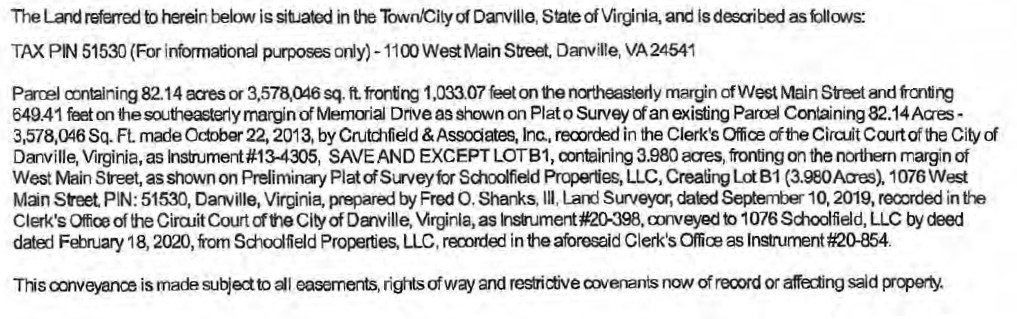
Exhibit B
|US-DOCS\121268241.11||
KL3 3324538.13
Exhibit 10.28
FIRST AMENDMENT TO
SECOND AMENDED AND RESTATED PUT-CALL RIGHT AGREEMENT
This FIRST AMENDMENT TO SECOND AMENDED AND RESTATED PUT-
CALL RIGHT AGREEMENT (this “Amendment”) is entered into as of May 1, 2023, by and among CLAUDINE PROPCO LLC, a Delaware limited liability company (together with its successors and permitted assigns, “VICI”) and CAESARS CONVENTION CENTER OWNER, LLC, a Delaware limited liability company (together with its successors and permitted assigns, “Owner”). VICI and Owner are together referred to herein as the “Parties”, and each individually, a ”Party”).
RECITALS
WHEREAS, VICI and Owner are party to that certain Second Amended and Restated Put-Call Right Agreement, dated as of September 18, 2020, pursuant to which, among other things, subject to and upon the terms and conditions thereof, Owner was granted the right to require VICI to purchase the Eastside Convention Center Property from Owner and VICI was granted the right to require Owner to sell the Eastside Convention Center Property to VICI (the “Put-Call Agreement”);
WHEREAS, concurrently with the execution of this Amendment, Owner is repaying the Mortgage Loan in full pursuant to the terms of a payoff letter between Owner and VICI Lendco LLC, and, in connection therewith, the Parties desire to amend the Put-Call Agreement as set forth herein.
NOW THEREFORE, in consideration of the mutual covenants and agreements hereinafter set forth and for other good and valuable consideration, the receipt and sufficiency of which are hereby acknowledged, the parties hereto, intending to be legally bound hereby, agree as follows:
1.Definitions. Except as otherwise defined herein, all capitalized terms used herein without definition shall have the meanings applicable to such terms, respectively, as set forth in the Put-Call Agreement.
2.Amendments to the Put-Call Agreement.
(a)Section 1 of the Put-Call Agreement is hereby amended such that the definition of “VICI Election Period” is hereby amended and restated as follows:
“VICI Election Period” means the period of time commencing on September 18, 2025 and ending on December 31, 2028.
(b)Section 5(j) of the Put-Call Agreement is hereby amended and restated as follows:
(j) Financial Statements and Access to Eastside Convention Center Property. At any time and from time to time after September 18, 2024, within thirty (30) days after request therefor by VICI, Owner shall provide: (x) to VICI, Financial Statements for the then most recent period of four (4) consecutive Fiscal Quarters ended at least ninety (90) days prior to such date, and (y) to VICI and its consultants
and representatives, access to the Eastside Convention Center Property pursuant to, and VICI and its consultants and representatives shall comply with, the Access Provisions.
(c)Section 3(a) of the Put-Call Agreement is hereby amended by adding an “and” prior to clause (v), and by deleting the following: “and (vi) there shall exist no Event of Default (as defined in the Mortgage Loan Agreement),”.
(d)The Parties agree that all references in the Put-Call Agreement to the Mortgage Loan and the Mortgage Loan Agreement (as well as references to applicable defined terms solely and to the extent included in the Put-Call Agreement by reference to Mortgage Loan Agreement) shall be of no further force and effect.
3.No Other Modification or Amendment to the Put-Call Agreement. The Put-Call Agreement shall remain in full force and effect except as expressly amended or modified by this Amendment. From and after the date of this Amendment, all references in the Put-Call Agreement to the “Agreement” shall be deemed to refer to the Put-Call Agreement as amended by this Amendment.
4.Governing Law; Venue. This Amendment shall be governed by and construed in accordance with the laws of the State of Nevada, which State the Parties agree has a substantial relationship to the Parties and to the underlying transaction embodied hereby. This Amendment is the product of joint drafting by the Parties and shall not be construed against either Party as the drafter hereof. With respect to any action relating to this Amendment (other than disputes submitted to arbitration pursuant to the terms of the Put-Call Agreement), Owner and VICI irrevocably submit to the exclusive jurisdiction of the courts of the State of Nevada sitting in Clark County, Nevada and the United States District Court having jurisdiction over Clark County Nevada, and Owner and VICI each waives: (a) any objection to the laying of venue of any suit or action brought in an such court; (b) any claim that such suit or action has been brought in an inconvenient forum; (c) any claim that the enforcement of this Section is unreasonable, unduly oppressive, and/or unconscionable; and (d) the right to claim that such court lacks jurisdiction over that Party.
5.Counterparts. This Amendment may be executed in any number of counterparts, each of which shall be a valid and binding original, but all of which together shall constitute one and the same instrument. Facsimile or digital copies of this Agreement, including the signature pages hereof, shall be deemed to be originals for all purposes.
6.Miscellaneous. If any term or provision of this Amendment or any application thereof shall be held invalid or unenforceable, the remainder of this Amendment and any other application of such term or provisions shall not be affected thereby. This Amendment may not be changed or modified except by an agreement in writing signed by the Parties. The paragraph headings and captions contained in this Amendment are for convenience of reference only and in no event define, describe or limit the scope or intent of this Amendment or any of the provisions or terms hereof.[Signature Page Follows]
2
IN WITNESS WHEREOF, the parties hereto have caused this Amendment as of the date first set forth above.
VICI:
CLAUDINE PROPCO LLC,
a Delaware limited liability company
a Delaware limited liability company
By: /s/ David Kieske
Name: David Kieske
Title: Treasurer
Name: David Kieske
Title: Treasurer
[signatures continued on following page]
[Signature Page to Amendment to Second Amended and Restated Put-Call Agreement] | ||
OWNER:
CAESARS CONVENTION CENTER OWNER, LLC,
a Delaware limited liability company
By: /s/ Bret D. Yunker
Name: Bret D. Yunker
Title: Chief Financial Officer
[Signature Page to Amendment to Second Amended and Restated Put-Call Agreement] | ||
ACKNOWLEDGMENT AND AGREEMENT OF OWNER GUARANTOR
The undersigned (“Owner Guarantor”) hereby: (a) acknowledges receipt of the First Amendment to Second Amended and Restated Put-Call Agreement (the “Amendment”; capitalized terms used herein without definition having the meanings set forth in the Amendment), dated as of May 1, 2023, by and among CLAUDINE PROPCO LLC, a Delaware limited liability company (together with its successors and permitted assigns, “VICI”) and CAESARS CONVENTION CENTER OWNER, LLC, a Delaware limited liability company (together with its successors and permitted assigns, “Owner”); (b) consents to the terms and execution thereof; (c) ratifies and reaffirms Owner Guarantor’s obligations to VICI pursuant to the terms of that certain Second Amended and Restated Guaranty, dated as of September 18, 2020 (the “Guaranty”), by Owner Guarantor in favor of VICI, and agrees that nothing in the Amendment in any way impairs or lessens the Owner Guarantor’s obligations under the Guaranty; and (d) acknowledges and agrees that the Guaranty is in full force and effect and is valid, binding and enforceable in accordance with its terms.
IN WITNESS WHEREOF, the undersigned has caused this Acknowledgment and Agreement of Owner Guarantor to be duly executed as of May 1, 2023.
[Acknowledgment and Agreement of Owner Guarantor] | ||
CAESARS RESORT COLLECTION, LLC,
a Delaware limited liability company
By: /s/ Bret D. Yunker
Name: Bret D. Yunker
Title: Chief Financial Officer
[Signature Page to Acknowledgment and Agreement of Owner Guarantor] | ||
ACKNOWLEDGMENT AND AGREEMENT OF GUARANTOR
The undersigned (“Guarantor”) hereby: (a) acknowledges receipt of the First Amendment to Second Amended and Restated Put-Call Agreement (the “Amendment”; capitalized terms used herein without definition having the meanings set forth in the Amendment), dated as of May 1, 2023, by and among CLAUDINE PROPCO LLC, a Delaware limited liability company (together with its successors and permitted assigns, “VICI”) and CAESARS CONVENTION CENTER OWNER, LLC, a Delaware limited liability company (together with its successors and permitted assigns, “Owner”); (b) consents to the terms and execution thereof; (c) ratifies and reaffirms Guarantor’s obligations to Owner pursuant to the terms of that certain Second Amended and Restated Guaranty, dated as of September 18, 2020 (the “Guaranty”), by Guarantor in favor of Owner, and agrees that nothing in the Amendment in any way impairs or lessens Guarantor’s obligations under the Guaranty; and (d) acknowledges and agrees that the Guaranty is in full force and effect and is valid, binding and enforceable in accordance with its terms.
IN WITNESS WHEREOF, the undersigned has caused this Acknowledgment and Agreement of Guarantor to be duly executed as of May 1, 2023.
[Acknowledgment and Agreement of Guarantor] | ||
VICI PROPERTIES 1 LLC,
a Delaware limited liability company
By: /s/ David Kieske
Name: David Kieske
Title: Treasurer
Name: David Kieske
Title: Treasurer
[Acknowledgment and Agreement of Guarantor] | ||
Exhibit 14.1
Caesars Entertainment, Inc.
Code of Ethics and Business Conduct
This Code of Ethics and Business Conduct, which includes our Conflicts of Interest Policy attached as Exhibit A hereto (collectively, the “Code”), embodies the commitment of Caesars Entertainment, Inc. and its subsidiaries (the “Company”) to conduct business in accordance with all applicable laws, rules and regulations, and ethical standards. All employees, officers, and members of the Caesars Entertainment, Inc. Board of Directors (the “Board”) are expected to adhere to those principals and procedures set forth in the Code that apply to them.
We also expect the consultants that we retain generally to abide by the Code.
The Code includes standards that are designed to deter wrongdoing and to promote:
(1)Honest and ethical conduct, including the ethical handling of actual or apparent conflicts of interest between personal and professional relationships;
(2)Full, fair, accurate, timely, and understandable disclosure in reports and documents that the Company files with, or submits to, the Securities and Exchange Commission (the “SEC”) and in other public communications made by the Company;
(3)Compliance with applicable governmental laws, rules and regulations;
(4)The prompt internal reporting of violations of the Code to an appropriate person or persons identified in the Code; and
(5)Accountability for adherence to the Code.
Section I
A.Implementation and Oversight of The Code
The Board is ultimately responsible for the implementation of the Code. The Board has designated the Company’s Chief Legal Officer to be the compliance officer (such person, or such other person as the Board may subsequently designate as the compliance officer, the “Compliance Officer”) for the implementation and administration of the Code, provided, however, that notwithstanding any provision to the contrary in this Code, any matter submitted to the Audit Committee of the Board pursuant to the Company’s Whistleblower Hotline Policy and Procedures shall not be reviewed or otherwise administered by the Compliance Officer unless so directed by the Audit Committee.
Questions regarding the application or interpretation of the Code are inevitable.
Directors, officers, employees and consultants of the Company should direct all questions to the Compliance Officer.
1
The Code, and all amendments of the Code, will be included in the Company’s periodic filings with the SEC and will be available on the Company’s website.
Statements in the Code to the effect that certain actions may be taken only with the “Company’s approval” mean that the Compliance Officer must give prior written approval before the proposed action may be undertaken. The Compliance Officer will act in a manner that is consistent with the requirements and spirit of the Code.
The Code should be read in conjunction with the Company’s other policy statements, including, without limitation, the Company’s Whistleblower Hotline Policy and Procedures, Conflicts of Interest Policy, Company’s Securities Trading Policy and Gaming Compliance Policy.
Periodic training may be provided regarding the contents and importance of the Code and related policy statements and the manner in which violations must be reported and waivers must be requested.
B.Honest and Ethical Conduct
One person’s dishonest or unethical conduct can harm the Company’s reputation and compromise the trust that the public and our shareholders have in the Company. For that reason, each director, officer, employee and consultant must be familiar with and comply with the Code. Compliance with the Code - and therefore all laws and regulations - forms the foundation of honest and ethical conduct. Accordingly, compliance with the Code is not simply expected; it is mandatory. In addition, the Company expects that directors, officers, employees and consultants of the Company will:
oEstablish an example by their behavior as a model for others subject to the Code.
oSustain a culture where honest and ethical conduct is recognized, valued and exemplified by all directors, officers, employees, consultants and other representatives of the Company.
oPersonally participate in, and where applicable, lead compliance efforts through meetings with others subject to the Code and monitor compliance matters and programs.
oRaise and encourage others to raise concerns and questions about ethical conduct and integrity.
The Company will take such disciplinary or preventive action as it deems appropriate to address any existing or potential violation of the Code brought to its attention. The Company’s Conflicts of Interest Policy, which is attached to the Code as Exhibit A, is an integral part of the Code and all Company directors, officers, employees and consultants should conduct themselves in accordance with its requirements and spirit.
A personal conflict of interest occurs when an individual’s private interest improperly interferes with the interests of the Company. Personal conflicts of interest are prohibited as a matter of Company policy, unless they have been approved by the Company. In particular, a
2
director, officer, employee, or consultant must never use his or her position with the Company to obtain any improper personal benefit for himself or herself, for his or her family members, or for any other person, including loans or guarantees of obligations, from any person or entity, provided, however, that the Code is not intended to prohibit doing business with vendors, service providers, licensed lenders and the like who do business with the Company, so long as one does not exploit his or her position with the Company to obtain preferential treatment and so long as any such actions are not in violation of any applicable law or regulation (including, without limitation, SEC and Nasdaq rules).
Service to the Company should never be subordinated to personal gain and advantage.
Conflicts of interest, unless properly waived by the Company, must be avoided.
Any director, officer, employee or consultant who is aware of a transaction or relationship that could reasonably be expected to give rise to a conflict of interest should disclose and discuss the matter fully and promptly with the Compliance Officer, provided however, that alternatively, any complaint may be reported anonymously as provided by the Company’s Whistleblower Policy and Procedures referenced herein.
C.Full, Fair, Accurate, Timely and Understandable Public Disclosure
It is the Company’s policy that the information in its public communications, including SEC filings, be full, fair, accurate, timely, and understandable. All directors, officers, employees and consultants who are involved in the Company’s disclosure process are responsible for acting in furtherance of this policy. In particular, these individuals are required to maintain familiarity with the disclosure requirements applicable to the Company and are prohibited from knowingly misrepresenting, omitting, or causing others to misrepresent or omit, material facts about the Company to others, whether within or outside the Company, including the Company’s independent auditors. Our disclosures should comply with the letter and the spirit of applicable law.
All directors, officers, employees and consultants must follow these guidelines:
oAct honestly, ethically and with integrity.
oComply with the Code.
oEndeavor to ensure full, fair, timely, accurate and understandable disclosure in the Company’s filings with the SEC.
oThrough communication, make sure that others at the Company understand the Company’s obligations to the public and under the law with respect to its disclosures, including that results are never more important than compliance with the law.
oEncourage others at the Company to raise questions and concerns regarding the Company’s public disclosures and ensure that such questions and concerns are appropriately addressed.
3
oProvide the Company’s directors, officers, employees, consultants and advisors involved in the preparation of the Company’s disclosures to the public with information that is accurate, complete, objective, relevant, timely and understandable.
oAct in good faith, responsibly, and with due care, competence and diligence, without misrepresenting material facts or allowing such person’s independent judgment to be subordinated by others.
oProactively promote honest and ethical behavior among peers in the work environment.
oAchieve proper and responsible use of and control over Company assets and resources.
oRecord or participate in the recording of entries in the Company’s books and records that are accurate.
oComply with the Company’s disclosure controls and procedures, internal controls and procedures for financial reporting and other policy statements.
D.Compliance with Laws, Rules, and Regulations
It is the Company’s policy to comply with all applicable laws, rules, and regulations. Some laws carry criminal penalties. It is the personal responsibility of each director, officer, employee and consultant to adhere to the standards and restrictions imposed by those laws, rules, and regulations. The Company expects each director, officer, employee and consultant to refrain from any illegal, dishonest, or unethical conduct.
Generally, it is both illegal and against Company policy for any director, officer, employee and consultant who is aware of material nonpublic information relating to the Company, any of the Company’s customers or any other private or governmental issuer of securities to buy or sell any securities of those issuers, or recommend that another buy, sell or hold the securities of those issuers. It is the Company’s policy for all directors, officers, employees and consultants to comply with the Company’s Securities Trading Policy. Any director, officer, employee or consultant with questions regarding these types of transactions should contact the Compliance Officer.
E.Duty to Report and Raise Questions and Concerns; Internal Reporting Procedure
Each director, officer, employee, and consultant must report promptly to the Compliance Officer, as well as the Director of Compliance of any involved Property, the existence (or good faith suspected existence) of any of the following:
•Any outside association, interest, relationship or activity, as it arises, that actually, potentially or apparently involves a conflict of interest violation (or suspected violation) of the Code;
•any action or inaction that does not comply with gaming laws or regulations in any jurisdiction in which the Company does business;
4
•any action or inaction that does not comply with any condition or limitation placed on any license or approval granted by any Gaming Authority to the Company or any of its gaming operations;
•any other event or circumstance which the employee, officer, director or consultant believes, in good faith, could impact the Company’s suitability for licensure, or may bring discredit to the Company or the gaming industry; and
•any violation of the Code.
Failure to report such relationships, activities, interests, non-compliance with gaming laws or regulations or violations of the Code will be a ground for disciplinary action.
In addition to the foregoing obligation to report to the Compliance Officer, employees who serve as Directors of Compliance shall also report such relationships, activities, interests, non-compliance with gaming laws or regulations or violations of the Code to the General Manager of the involved Property (unless the General Manager is the subject of, or otherwise involved in, such actual or potential violation). If, after consultation with the Compliance Officer and the General Manager, the Director of Compliance still maintains a good faith belief that the actual or potential violation has not been adequately addressed, he or she shall report such matter directly to the Company’s Compliance Committee.
Subject to the provisions of the Code, the Compliance Officer will review disclosures of any actual, potential or apparent violation of the Code with at least one member of the Company’s Audit Committee and , if applicable, at least one member of the Company’s Compliance Committee, to determine the appropriate manner by which the Company’s approval or disapproval would be provided. Each director, officer, employee, and consultant must cooperate fully in the review process by providing all information that the Compliance Officer deems necessary to conduct an effective review. Company actions with respect to the conflict of interest or potential conflict of interest will take into account the spirit of the Code.
Upon becoming employed by or associated with the Company each director, officer, employee, and consultant must sign a statement reflecting awareness and understanding of the Code, including the Conflicts of Interest Policy (“Ethics Statement”). At the same time, each director, officer, employee and consultant must report either the absence or presence of actual, potential or apparent conflicts of interest. The Company may from time to time request that any such person affirm his or her awareness of the Code and Conflicts of Interest Policy by delivering an updated Ethics Statement. A form of Ethics Statement is attached as Exhibit B hereto.
All interests, relationships or participation in transactions disclosed by any director, officer, employee or consultant in accordance with this policy shall be held in confidence unless the best interests of the Company dictate otherwise.
The Company recognizes the potentially serious impact of a false accusation.
Employees, officers, directors and consultants are expected as part of the ethical standards required by this Code to act responsibly in reporting violations. Making a complaint without a
5
good-faith basis is itself a violation of the Code. Any employee, officer, director or consultant who makes a complaint in bad faith will be subject to disciplinary action, up to and including separation of employment.
Employees, officers, directors and consultants who report violations or suspected violations in good faith, as well as those who participate in investigations, will not be subject to retaliation of any kind.
Retaliation, which will be broadly construed, is generally defined as the use of authority or influence for the purpose of interfering with, or discouraging a report of, a violation of the Code or an investigation of an alleged Code violation. The Company will not permit retaliation where a report of an actual or potential violation was made in good faith.
If you believe someone has retaliated against you because of your good faith report of an actual or suspected violation, you should immediately advise Human Resources as well as the Compliance Officer, and the Director of Compliance of the involved Property.
F.Accountability
All who are subject to the Code are responsible for complying with it and for reporting any known or suspected violations of it. The Company recognizes that such a mandate may not be meaningful without an accompanying provision for accountability and discipline of violations of the Code.
Subject to the terms of the Code, reported violations of the Code will be investigated, addressed promptly and treated confidentially to the extent possible. The Company will strive to impose discipline for each Code violation that fits the nature and particular facts of the violation. The Company uses a system of progressive discipline and generally will issue warnings or letters of reprimand for less significant, first-time violations. Violations of a more serious nature may result in termination of employment or suspension without pay, demotion, loss or reduction of bonus or option awards, or any combination of such disciplinary measures.
Violations of the Code that go unaddressed are treated by the SEC as implicit waivers of the Code. Accordingly, any violation that is discovered and not addressed will have to be disclosed in accordance with the rules and regulations of the SEC or applicable listing standards. In such cases, the SEC’s rules will require disclosure of the nature of any violation, the date of the violation and the name of the person who committed the violation. Such disclosure would be harmful to the Company and the individuals involved in the violation.
Subject to the provisions of the Code and the Company’s Whistleblower Policy and Procedures, all investigations of reported violations of the Code will be supervised by the Compliance Officer. A violation shall be deemed to have occurred and appropriate consequences shall be determined only by the Board of Directors, any of its committees, or such other person designated by the Board to act on its behalf.
6
G.Protected Disclosures
Nothing in this Code or any agreement between you and the Company:
•will preclude, prohibit or restrict you from (i) communicating with, any federal, state or local administrative or regulatory agency or authority, including but not limited to the Securities and Exchange Commission (the “SEC”); (ii) participating or cooperating in any investigation conducted by any governmental agency or authority; or (iii) filing a charge of discrimination with the United States Equal Employment Opportunity Commission or any other federal state or local administrative agency or regulatory authority.
•prohibits, or is intended in any manner to prohibit, you from (i) reporting a possible violation of federal or other applicable law or regulation to any governmental agency or entity, including but not limited to the Department of Justice, the SEC, the U.S. Congress, and any governmental agency Inspector General, or (ii) making other disclosures that are protected under whistleblower provisions of federal law or regulation. Nothing in this Code or any agreement between you and the Company is intended to limit your right to receive an award (including, without limitation, a monetary reward) for information provided to the SEC. You do not need the prior authorization of anyone at the Company to make any such reports or disclosures, and you are not required to notify the Company that you have made such reports or disclosures.
•is intended to interfere with or restrain the immunity provided under 18 U.S.C.
§1833(b). You cannot be held criminally or civilly liable under any federal or state trade secret law for the disclosure of a trade secret that is made (i) (A) in confidence to federal, state or local government officials, directly or indirectly, or to an attorney, and (B) for the purpose of reporting or investigating a suspected violation of law; (ii) in a complaint or other document filed in a lawsuit or other proceeding, if filed under seal; or (iii) in connection with a lawsuit alleging retaliation for reporting a suspected violation of law, if filed under seal and does not disclose the trade secret, except pursuant to a court order.
The foregoing provisions regarding protected disclosures are intended to comply with all applicable laws. If any laws are adopted, amended or repealed after the date hereof, this Code shall be deemed to be amended to reflect the same.
Section II
A.Corporate Opportunities
Directors, officers and employees owe a duty to the Company to advance the Company’s legitimate business interests when the opportunity to do so arises. Directors, officers and employees are prohibited from taking for themselves (or directing to a third party) a business opportunity that is discovered through the use of corporate property, information, or position unless previously approved by the Board. More generally, directors, officers, employees and
7
consultants are prohibited from using corporate property, information, or position for personal gain or competing with the Company.
Sometimes the line between personal and Company benefits may be difficult to discern. The only prudent course of conduct for our directors, officers, employees and consultants is to make sure that any use of Company property or services that is not solely for the benefit of the Company is approved beforehand through the Compliance Officer.
B.Confidentiality
In carrying out the Company’s business, directors, officers, employees and consultants often learn confidential or proprietary information about the Company, its customers, or other third parties. Directors, officers, employees and consultants must maintain the confidentiality of all information so entrusted to them, except when disclosure is authorized or legally mandated. Confidential or proprietary information includes, among other things, any non-public information concerning the Company, including its business relationships, financial performance, results or prospects, personnel information, guest information, compensation data, computer processes, customer lists, marketing strategies, pending projects or proposals, and any non-public information provided by a third party with the expectation that the information be kept confidential and used solely for the business purpose for which it was conveyed. Directors, officers, employees and consultants should refer to the Company’s Legal Department for more detailed guidance on this topic.
C.Fair Dealing
The successful business operation and reputation of the Company are built upon the principals of fair dealing and ethical conduct. Our reputation for integrity and excellence requires careful observance of the spirit and letter of all applicable laws and regulations as well as a scrupulous regard for standards of conduct and personal integrity consistent with this Code. We do not seek competitive advantages through illegal or unethical business practices. Each director, officer, employee and consultant should endeavor to deal fairly with the Company’s customers, service providers, suppliers, competitors, and other employees. No director, officer, employee or consultant should take unfair advantage of anyone through manipulation, concealment, abuse of privileged information, misrepresentation of material facts, or any unfair dealing practice.
D.Equal Employment Opportunity and Harassment
Our focus in personnel decisions is on merit and contribution to the Company’s success.
Concern for the personal dignity and individual worth of every person is an indispensable element in the standard of conduct that we have set for ourselves. The Company affords equal employment opportunity to all qualified persons without regard to any impermissible criterion or circumstances. This means equal opportunity in regard to each individual’s terms and conditions of employment and in regard to any other matter that affects in any way the working environment of the employee. We do not tolerate or condone any type of discrimination prohibited by law, including harassment.
8
E.Protection and Proper Use of Company Assets
All employees, officers, directors, and consultants should protect the Company’s assets and ensure their efficient use. All Company assets should be used for legitimate business purposes only.
F.Outside Activities/Employment
Non-salaried employees may hold a job with another employer so long as he or she notifies the Company and satisfactorily performs his or her job responsibilities with the Company. All employees will be judged by the same performance standards and will be subject to the Company’s scheduling demands, regardless of any existing outside work requirements.
If the Company determines that an employee’s outside work interferes with performance or the ability to meet the requirements of the Company as they are modified from time to time, the employee may be asked to terminate the outside employment if he or she wishes to remain employed by the Company.
Any outside association, including employment and activities with other entities, should not encroach on the time and attention any director, officer or employee is expected to devote to his or her Company duties and responsibilities, adversely affect the quality or quantity of his or her work product or entail his or her use of any Company assets, including its real and personal property, or imply (without the Company’s approval) the Company’s sponsorship or support. In addition, under no circumstances is any director, officer or employee permitted to compete with the Company.
Section III
Waivers and Amendments of The Code
From time to time, the Board may amend the Code or waive certain provisions of the Code. Any such amendment shall be disclosed in the manner and within the time required by applicable laws, regulations, rules and listing standards. Any requests for a waiver of any provision of the Code must be submitted in writing to the Compliance Officer for review. If a waiver of any provision of the Code is granted, the Company must publicly disclose the nature of the granted waiver, including any implicit waiver, the name of the person requesting the waiver, the date of the waiver and any other disclosures as and to the extent required by any rule of the SEC or applicable listing standard. Waivers of any provision of the Code may be made only by the Board.
Section IV
Anonymous Reporting of Violations
Any violation of the Code and any violation by the Company or its directors, officers, employees or consultants of the securities laws, rules or regulations or other laws, rules or regulations applicable to the Company may be reported anonymously using any one of the methods described in the Company’s Whistleblower Hotline Policy and Procedures, including,
9
without limitation, the making of a phone call to a whistleblower hotline at 800-418-6482, extension 687. All such calls shall be subject to the Company’s Whistleblower Hotline Policy and Procedures. A copy of the Company’s Whistleblower Hotline Policy and Procedures is available on the Company’s website, in employee break rooms and on employee bulletin boards.
Section V
Certain Relationships and Related Transactions
Any proposed transaction between the Company and a related party, or in which a related party would have a direct or indirect material interest, must be promptly disclosed to the Compliance Officer, the Company’s Audit Committee, and the Company’s Compliance Committee, and must be approved by the Company’s Audit Committee. Any director having an interest in the transaction is not permitted to vote on such transaction.
The Audit Committee will determine whether or not to approve such transaction on a case by case basis and in accordance with the provisions of the Audit Committee Charter and the Code.
A “related party” is any of the following:
•an executive officer of the Company;
•a director (or director nominee) of the Company;
•an immediate family member of any executive officer or director (or director nominee);
•a beneficial owner of five percent or more of any class of the Company’s voting securities;
•an entity in which one of the above described persons has a substantial ownership interest or control of such entity; or
•any other person or entity that would be deemed to be a related person under Item 404 of SEC Regulation S-K or applicable Nasdaq rules and regulations.
Originally Adopted by Board of Directors on October 31, 2019; Revised October 27, 2022
10
EXHIBIT A
CAESARS ENTERTAINMENT, INC. CONFLICTS OF INTEREST POLICY
I.GENERAL STATEMENT OF POLICY
It is the policy of Caesars Entertainment, Inc. and its subsidiaries (the “Company”) that directors, officers and employees (“covered persons”) at all levels be free from any interest, influence or relationship that might conflict, or appear to conflict, with the best interests of the Company, and that they perform their work with undivided loyalty as measured by the highest standards of law and ethics. The existence of an actual or potential conflict of interest depends on specific facts. The principles discussed here are intended to alert covered persons to the possibilities and furnish general guidance. In any uncertain situation, the covered persons should immediately discuss the matter fully and frankly with his/her supervisor. Where there is any doubt as to the existence of a conflict of interest, the situation should be disclosed fully, in writing, to the Compliance Officer (as defined in the Code of Ethics and Business Conduct).
II.SCOPE OF COVERAGE
This policy applies to both direct and indirect interests of a covered person and members of his or her immediate family. It extends to transactions by any person who may act on behalf of such covered person or family members in connection with such interests. In general, a covered person will be regarded as having a beneficial interest in any property owned or any transactions entered into by such covered person’s spouse or minor children.
Further, this policy is applicable to all parts of the Company including all domestic and foreign subsidiaries and affiliated companies.
A.Common Conflict of Interest Situations
The following sections describe a number of common categories of conflicts of interest. They illustrate the application of Company policy to certain particular situations where conflicts are most likely to arise. They are not all-inclusive, however, and do not cover all possible situations where conflicts might occur in violation of Company policy:
B.Relationships with Vendors, Purchasers and Competitors of the Company
Any covered person who holds any position or employment with, or who receives any compensation, credits or loans from, or who owns or acquires, directly or indirectly, a beneficial interest in, or rights to the profits of income of, any concern he or she has reason to believe may supply products or services to, or purchase from, or compete with, the Company, is required to disclose the full details concerning such interest or relationship. In such circumstances, a conflict may arise if such covered person is in a position to influence decisions with respect to any Company transaction involving such other party and if the interest or relationship is such that it might bring into question such covered person’s continued ability to make independent, impartial judgments in the Company’s best interest. In this connection, the mere ownership of
1
securities of a vendor, purchaser or competitor which are listed on a stock exchange or publicly traded in a recognized over-the-counter market and amounting to less than one percent of the class outstanding, need not be reported.
C.Gifts or Favors
A covered person may not solicit money, entertainment, hospitality, gifts or favors, including the below market purchases of goods or services (collectively, “gifts”), from any individual or concern which a covered person has reason to believe may transact business, or may seek to transact business, with the Company.
Covered persons in one of the Company’s purchasing departments, or covered persons whose primary responsibility is to purchase supplies or services on behalf of the Company, may not accept gifts from any individual or concern which a covered person has reason to believe may transact business, or may seek to transact business, with the Company.
Other covered persons may accept gifts provided that:
(i)the value of such gift (and the collective value of all such gifts from the same individual or concern in the same calendar year) is trivial and inconsequential (generally $500 or less); or
(ii)gifts involving entertainment or hospitality are not excessive or lavish under the circumstances as determined by the Compliance Officer1 and, if such gift includes travel, it is also approved by the covered person’s supervisor.
All offers of gifts or favors beyond this policy should be immediately reported to the employee’s supervisor, in the case of a covered person who is an employee, and to the Compliance Officer.
D.Sensitive Payments
The use of the Company funds or assets by employees for any unlawful purpose is strictly prohibited. Covered persons shall not:
1.Establish for any purpose undisclosed or unrecorded funds or assets of the Company.
2.Make false or artificial entries in the books and records of the Company for any reason.
3.Engage in any arrangement that results in such prohibited acts.
_________________________
1 By way of example, gifts of entertainment or hospitality that would generally be permitted include regular season sporting or cultural events (e.g., baseball or football games, ballet, symphony, and theater) and local golf outings. Depending upon the circumstances, special events such as exclusive cultural events and post-season sporting events may be permitted as determined by the Company’s Compliance Officer.
2
Any covered person having information or knowledge of any unrecorded fund or asset or any prohibited act shall promptly report such matter to the Compliance Officer.
E.Foreign Transactions and Payments
Having due regard for the responsibilities relating to international operations, it is the Company’s policy that all covered persons and agents comply with the ethical standards and applicable legal requirements of the Foreign Corrupt Practices Act and of each foreign country in which business is conducted.
The Foreign Corrupt Practices Act makes it a criminal offense for a United States company or agent acting on its behalf to pay anything of value to any foreign government official to influence any official action in securing, retaining, or directing business. This prohibition applies to bribes, kick-backs or like payments made directly to such foreign officials or indirectly through seemingly legitimate payments such as commissions or consulting fees paid to overseas agents or representatives.
F.Political Campaign Contributions
Political campaign contributions include direct expenditures or contributions, in cash or property, to candidates for nomination or election to public office or to political parties, as well as indirect assistance or support such as the furnishing of goods, services or equipment, or other political fund-raising events.
No political campaign contributions shall be made by the Company in cash or by any other means whereby the amount or origin of the contribution cannot be readily established by reference to the documents and records of the Company. All contributions shall be made to the candidates authorized campaign committee, or to a political party, or to other recipients who may legally receive such contributions and all reporting requirements of the state or local jurisdictions shall be complied with. Each contribution shall be clearly recorded on the Company’s books as a political campaign contribution or its equivalent and shall not be deducted for federal, state or local income tax purposes unless authorized under applicable law.
The Foreign Corrupt Practices Act also prohibits contributions to foreign political parties or candidates for foreign political office for the purpose of influencing their actions to secure, retain or direct business. The prohibition applies regardless of whether the contribution is lawful under the laws of the country in which it is made. Accordingly, company policy strictly prohibits any payments with corporate funds, to, or any use of corporate assets for the benefit of, any foreign political party or candidate for political office.
III.SUMMARY OF GENERAL OBLIGATIONS OF EMPLOYEES
Under this policy, covered persons are responsible for:
oFull and immediate disclosure to the Compliance Officer of any interest which they or members of their immediate families have at the time of association with the Company, or acquire during such covered person’s association with the Company, which create or appear to create a possible conflict with the
3
Company’s interests. In furtherance of this, all new employees will be routinely provided a copy of the Conflicts of Interest Policy and will be required to execute a signed acknowledgement of its receipt; and
oTaking any actions regarded by the Company as being necessary to eliminate or satisfactorily regulate a conflict of interest situation.
IV.FAILURE TO COMPLY
Failure to comply with this policy and procedures can result in disciplinary actions up to and including termination of employment, and/or initiation of appropriate legal action.
V.FURNISHING DISCLOSURE INFORMATION
With respect to any disclosure information furnished in accordance with the Company’s Conflicts of Interest Policy, the Company will endeavor to properly protect such information.
4
EXHIBIT B
CAESARS ENTERTAINMENT, INC.
CODE OF ETHICS AND BUSINESS CONDUCT CONFIRMATION STATEMENT
Date:
I, hereby confirm the following statements to Caesars Entertainment, Inc. (the “Company”):
(1)I am a director, officer, employee or consultant of the Company and/or one of its subsidiaries.
(2)I have read and I understand the Company’s Code of Ethics and Business Conduct (the “Code”), including its Conflicts of Interest Policy.
(3)There is no actual, potential or apparent conflict of interest between myself or any of my immediate family members and the Company (or any of its subsidiaries) as described in the Code, except:
.
(4)I understand that I am under an ongoing obligation to notify the Compliance Officer should any of the information in this confirmation statement change.
(5)I understand that the Code and all amendments to the Code are available for my review on the Company’s website and upon request from the Company’s Corporate Secretary.
________________________________________________
(Signature)
__________________________________________________
(Name)
__________________________________________________
(Title)
1
Exhibit 19.1
Caesars Entertainment, Inc. Securities Trading Policy
1.2.What are the Consequences of Engaging in Illegal Insider Trading or
Otherwise Violating this Policy? 2
3.Application of the Policy to Transactions in Convertible or Exchangeable
Securities or Shares Obtained Upon Conversion or Exchange 6
CAESARS ENTERTAINMENT, INC. SECURITIES TRADING POLICY
This Securities Trading Policy (this “Policy”) is applicable to each director, officer, employee and consultant (“you”) of Caesars Entertainment, Inc. and its subsidiaries (collectively, the “Company”). In the course of performing your duties for the Company, you may, at times, have information about the Company or another company that is not generally available to the public. Because of your relationship with the Company, if you are aware of “material,” “non- public” information about the Company, federal and state securities laws prohibit you from trading in the securities of the Company and other controlled businesses (together with the Company, the “Caesars Companies” and any individual entity an “Caesars Company”) or providing such information to others who may trade on the basis of that information.
1.Introduction
We have adopted this Policy to:
•Explain some of your obligations to the Company and under the law, including the proper conduct for trading in securities of the Caesars Companies;
•Promote compliance with the laws prohibiting “insider trading” and help our directors, officers, employees and consultants avoid the severe consequences resulting from violations of these laws;
•Prevent even the appearance of “insider trading;” and
•Protect our reputation for integrity and ethical conduct.
1.1.What is Insider Trading?
The federal securities laws prohibit persons who become aware of “material,” “non-public” information about a company from buying or selling that company’s securities on the basis of that information. This form of misconduct is commonly known as “insider trading.” Insider trading also refers to the unauthorized disclosure of material, non-public information to others who then trade on the basis of that information, conduct commonly known as “tipping.” In this Policy, when we use the term insider trading, we include tipping. The terms “material” and “non-public” are discussed in Sections 2.5 and 2.6 below.
1.2.What are the Consequences of Engaging in Illegal Insider Trading or Otherwise Violating this Policy?
Sanctions for violations of the prohibitions on insider trading can be severe, including civil fines of up to three times the profit gained or loss avoided, criminal fines of up to $5,000,000 and jail terms of up to 25 years. The federal securities laws also may impose insider trading liability on companies (and their directors, officers and supervisory personnel) if they fail to take reasonable steps to prevent insider trading.
Any failure to comply with this Policy may subject a director, officer or employee to Company- imposed sanctions, including termination for cause, whether or not the failure to comply constitutes or results in a violation of law.
2.Elements of the Policy
2.1.Who is Subject to the Requirements of this Policy?
This Policy applies to each director, officer and employee of the Caesars Companies (collectively, “Covered Persons”) and to the “Related Persons” of each such person.
“Related Persons” are:
▪family members who reside with Covered Persons;
▪anyone else who lives in the household of a Covered Person and is subject to such person’s influence or control;
▪any family members who do not live in the household of a Covered Person but whose transactions in “Company Securities” (as defined in Section 2.3 below) are directed by a Covered Person or are subject to such a person’s influence or control (such as parents or children who consult with such a person before they trade in Company Securities); and
▪any trust, partnership, corporation or other entity over which a Covered Person has investment control.
Because insider trading transactions involving Company Securities can be imputed to you, and potentially to the Company, you are responsible for making sure that transactions in any security covered by this Policy, whether by you personally or by any member of your family or other Related Person, comply with this Policy. In this Policy, when we refer to “Covered Persons” or to “you,” we include the applicable Related Persons.
Which specific provisions of this Policy apply to you and your Related Persons will depend upon your position with the Company. All persons covered by this Policy must comply with the general prohibition on insider trading discussed in Section 2.4 below. Additional trading window limitations and pre-clearance and notification requirements – which are set forth in supplements to this Policy (the “Policy Supplements”) – apply only to “Blackout Insiders” and “Pre-Clearance Insiders” of the Caesars Companies. All Blackout Insiders and Pre-Clearance Insiders will receive a copy of the applicable Policy Supplements.
2.2.Who are “Blackout Insiders” and “Pre-Clearance Insiders”?
“Blackout Insiders” are:
▪anyone who is a director or officer who is subject to the reporting and liability provisions of Section 16 of the Securities Exchange Act of 1934, as amended, and the rules and regulations promulgated thereunder;
▪any other employee who may be designated as such from time to time by the Company’s General Counsel because such person, in the normal course of his or her duties or with respect to a particular matter, has, or is likely to have, regular or special access to inside information that warrants such person only being permitted to trade during defined trading windows;
▪any entity or person that designated or nominated, or caused to be designated or nominated, a director who is a Blackout Insider, whether such designation or nomination was undertaken or caused to be undertaken pursuant to a contractual agreement or contractual right or otherwise, provided that the director who is a Blackout Insider is also
an officer or employee of, or performs responsibilities of a similar nature for, the nominating entity or person or an affiliate thereof; and
▪in each case, the person’s Related Persons.
“Pre-Clearance Insiders” are a subset of Blackout Insiders consisting of directors and certain officers and key employees as determined by the Company, and their Related Persons. All Blackout Insiders and Pre-Clearance Insiders are subject to additional limitations on transferability of Company Securities, which are set forth in the Policy Supplements.
2.3.What Securities and Other Instruments are Covered by this Policy?
This Policy covers and defines as “Company Securities”:
▪any stock, bond (including convertible notes), debentures, options, warrants or other marketable equity or debt security issued by any Caesars Company; and
▪any security or other instrument issued by an unrelated third party and based on any equity or debt security (including exchange-traded options and credit default swaps) of any Caesars Company.
2.4.What are the General Prohibitions of the Policy?
A.No Covered Person who is aware of material, non-public information relating to the Caesars Companies may, at any time, directly or through any other person or entity, including, but not limited, to any Related Person, friend or acquaintance:
•buy, sell, pledge or otherwise transfer Company Securities, or engage in any other action to take personal advantage of that information; or
•pass that information on to any other person or entity outside the Company, including, but not limited to, any Related Person, friend or acquaintance.
B.In addition, no Covered Person who, in the course of working for any Caesars Company, learns of material non-public information about any company with which any Caesars Company does or is considering doing business, including a customer or supplier, may, at any time, trade in that company’s securities until the information becomes public or is no longer material.
C.Similarly, no Covered Person may communicate such material, non-public information about that other company to any other person or entity outside the Caesars Companies, including, but not limited to, any Related Person, friend or acquaintance. These prohibitions apply equally to communications made through social media.
D.Finally, no Covered Person may engage in the following transactions involving Company Securities:
•entering into short sales of Company Securities; or
•buying or selling exchange-traded options (puts or calls) on Company Securities.
Transactions that you may consider necessary or justifiable for independent reasons (such as the need to raise money for an emergency expenditure or to satisfy margin requirements or “margin calls” in a securities account or to fund obligations secured by a pledge of Company Securities) are NOT excepted from this Policy. The federal securities laws do not recognize such mitigating circumstances and, in any event, even the appearance of an improper transaction must be avoided
to preserve both your and the Company’s reputation for adhering to the highest standards of business conduct.
2.5.What is “Material Information”?
Material information is any information that a reasonable investor would consider important in making a decision to buy, hold or sell securities. In general, any information that could be expected to affect the price of Company Securities, whether positively or negatively, should be considered material. Examples of information that ordinarily would be regarded as material are:
▪Projections of future earnings or losses, or other earnings guidance;
▪Quarterly or annual revenue, operating income or loss or earnings results;
▪Earnings that are inconsistent with the earnings guidance or the consensus expectations of the investment community;
▪A pending or proposed merger, acquisition, sale, tender offer, recapitalization or strategic alliance involving Caesars Companies in any way;
▪A pending or proposed acquisition or disposition of a significant asset;
▪A change in dividend policy, the declaration of a stock split, or an offering of additional securities (public or private);
▪The establishment of a program to repurchase securities of the Company;
▪A change in control or a change in senior management of the Company;
▪Development of a significant new product, invention, discovery or line of business;
▪Commencement of or developments regarding government investigations;
▪Developments regarding significant legislation or regulation affecting the Company’s business;
▪Commencement of or developments regarding significant litigation;
▪A pending or proposed offering of Company Securities or refinancing of outstanding debt of the Company;
▪A change in or dispute with the Company’s auditors, or a determination to take a significant impairment charge or to restate previously issued financial statements; and
▪A transaction involving a significant amount of Company Securities by a director, officer or other person who is a greater than 5% stockholder.
Please be aware that anyone scrutinizing your transactions will be doing so after the fact, with the benefit of “twenty-twenty hindsight.” As a practical matter, before engaging in any transaction, you should carefully consider whether law enforcement authorities and others might, after the fact, view as “material” any information of which you may be aware that has not been publicly disclosed.
2.6.What is “Non-Public” Information?
Information is considered “non-public” if it has not been disclosed broadly to the public markets (such as by press release or an SEC filing). The circulation of rumors, even if accurate and reported in the media, does not constitute adequate public dissemination for purposes of the insider trading laws or this Policy.
You must also wait a reasonable amount of time after public disclosure of material information relating to the Caesars Companies, or any other company whose securities are covered by this Policy, before trading in such securities, to ensure that the investing public has had time to absorb the information fully. Thus, as a general rule, information should be considered “non-
public” until two (2) full trading days after the information is released; this means the opening of business on the third trading day. For example, if in an ordinary trading week the non-public information is disclosed publicly during, or following the close of, business on Monday, then Company Securities could be bought or sold beginning the opening of trading on Thursday, if otherwise permitted under this Policy.
3.Application of the Policy to Transactions in Convertible or Exchangeable Securities or Shares Obtained Upon Conversion or Exchange
You may convert convertible or exchange exchangeable securities of Caesars Companies that you own at any time permitted under the terms of such securities.
You must comply with Sections 2.4 if you wish to engage in a sale or other transaction with respect to such convertible or exchangeable securities and/or the securities obtained upon conversion or exchange.
Blackout Insiders and Pre-Clearance Insiders are subject to additional restrictions set forth in the Policy Supplements.
4.Post-Termination Transactions
This Policy continues to apply to your transactions in Company Securities even after you have ceased to be a director, officer or employee as long as you are aware of material, non-public information. Neither you nor any of your Related Persons may trade until the time at which this information has become public.
Blackout Insiders and Pre-Clearance Insiders may be subject to additional restrictions on post- termination transactions, as described in the Policy Supplements.
5.Compliance Contacts and Responsibility
If you have any questions about this Policy or its application to any proposed transaction in Company Securities or any proposed adoption or change in a Rule 10b5-1 trading plan, you may contact Ed Quatmann, General Counsel, at (775) 348.3324 or equatmann@caesars.com.
Ultimately, however, the responsibility for adhering to this Policy and avoiding unlawful transactions, whether by you or your Related Persons, rests with you. You should use your best judgment and consult your personal legal and financial advisors as needed.
6.Certification
All persons covered by this Policy have an obligation to read it carefully and understand its provisions. Further, all persons covered by this Policy must certify compliance upon request of the Company.
7.Summary
•Do not buy, sell, pledge or otherwise transfer Company Securities — or any securities of any other company about which you have learned information in the course of working for any Caesars Company — if you are aware of material, non-public information.
•Do not share material, non-public information with others outside the Caesars Companies
— even family members or friends.
•Blackout Insiders and Pre-Clearance Insiders must comply with the additional requirements set forth in the Policy Supplements.
CAESARS ENTERTAINMENT, INC.
Securities Trading Policy
The undersigned hereby acknowledges that he/she has read and understands, and agrees to comply with, the Company’s Securities Trading Policy.
Signature:
Name Printed:
Date:
Exhibit 19.2
CAESARS ENTERTAINMENT INC.
Supplement to Securities Trading Policy (the “Policy”)
For “Blackout Insiders”
1.Purpose
Under the Policy, all “Blackout Insiders” are subject to limitations on transferability of Company Securities (for example, shares of the common stock of Caesars Entertainment, Inc., trading as CZR on the NASDAQ stock market (“NASDAQ”)) and must comply with the “Open Trading Window” and “Blackout Period” trading restrictions discussed in this Policy Supplement. Blackout Insiders may also only adopt (and, if permitted, modify or early terminate) a pre-arranged securities trading plan meeting the requirements of Rule 10b5-1 under the Securities Exchange Act of 1934 (a “Rule 10b5-1 trading plan”) during an Open Trading Window (as defined in Section 4(a) below), and only with the approval of the Office of the General Counsel and the Compensation Committee of the Board as described herein. This Policy Supplement sets forth trading restrictions and Rule 10b5-1 trading plan pre-clearance procedures to be followed.
Please note that these procedures are part of the Policy and are not to be interpreted as personal legal or financial advice.
2.Definitions
Each capitalized term used in this Policy Supplement without definition has the meaning given to it in the Policy. Please note in particular references to a Blackout Insider include that person’s Related Persons.
3.Compliance Contacts
All questions regarding the provisions of this Policy Supplement and the accompanying Policy should be directed to Ed Quatmann, General Counsel, at 775.348.3324 or equatmann@caesars.com. Ultimately, however, the responsibility for adhering to the Policy and this Policy Supplement and avoiding unlawful transactions, whether by you or any of your Related Persons, rests with you. You should use your best judgment and consult your personal legal and financial advisors as needed. Please see Section 1.2 of the Policy for a discussion of the potential consequences of violations of the insider trading laws, the Policy or this Policy Supplement.
4.Blackout Periods
(a)When are the Open Trading Window Periods?
Subject to the provisions of Section 6, unless otherwise indicated by the Company’s Board of Directors, Chief Executive Officer, and/or the Office of the General Counsel, trading windows for Blackout Insiders will open at the opening of trading on the NASDAQ on the first trading day after two full trading days have elapsed following the time we publicly release our quarterly or annual financial results (the “Window Opening Date”), and end at the close of
trading on the 17th day (or prior trading day if the 17th is not a trading day) of the last month of each fiscal quarter. For example, if we were to publicly release our quarterly results before the opening of trading on NASDAQ on a Tuesday, and there were no federal holidays in between, the Window Opening Date of the next Open Trading Window would be Thursday.
As a result, subject to the provisions of Section 6, Blackout Insiders will have four Open Trading Window Periods each year in which to engage in transactions in Company Securities. These windows will be the only time periods in which Blackout Insiders may trade in Company Securities; however, there are two very important exceptions:
•even during an Open Trading Window Period, you are prohibited from trading, both directly and indirectly through any other person or entity, including but not limited to any Related Person, friend or acquaintance, if you are aware of material, non-public information.
•the Board of Directors, the Chief Executive Officer and/or the Office of the General Counsel may determine not to open, or may terminate, an Open Trading Window at any time by notice to Company personnel if the particular facts and circumstances warrant such action.
A period during which Blackout Insiders are permitted to trade is referred to as an “Open Trading Window Period.” Any period that is not in an Open Trading Window Period is a “Blackout Period.”
(b)What are the Other Restrictions on Transactions Applicable to Blackout Insiders?
Gifts of Company Securities to Related Persons may be made at any time. The Related Person may, however, only transfer the Company Securities received as a gift during an Open Trading Window Period when the Related Person is not aware of any material, non-public information relating to the Caesars Companies. Gifts to recipients who are not Related Persons may only be made during an Open Trading Window Period and when the donor is not aware of material, non-public information relating to the Caesars Companies.
(c)May I request a hardship exception?
No. Transactions that you may consider necessary or justifiable for independent reasons (such as the need to raise money for an emergency expenditure, to satisfy margin requirements or “margin calls” in a securities account or to satisfy obligations subject to a pledge of Company Securities as collateral) are NOT excepted from this Policy. The federal securities laws do not recognize such mitigating circumstances and, in any event, even the appearance of an improper transaction must be avoided to preserve both your and the Company’s reputation for adhering to the highest standards of business conduct.
5.Application of Policy to Exercise of Options
Blackout Insiders may exercise options awarded to them under a stock incentive plan at any time permitted under the applicable incentive plan if they pay the exercise price in cash to the extent exercisable for cash (and subject to other obligations of applicable law and plan documents which, among other things, impose certain tax withholding obligations). During a Blackout Period, subject to Section 6(a) below, Blackout Insiders may not, however, sell Company Securities to raise the funds necessary to pay the exercise price of stock options. In
addition, during a Blackout Period, subject to Section 6(a) below, Blackout Insiders may not exercise stock appreciation rights (SARs).
6.Rule 10b5-1 Trading Plans
(a)Exception from Blackout Periods for Transactions Under Rule 10b5-1 Trading Plans
Transactions in Company Securities that are affected under a valid Rule 10b5-1 trading plan are not subject to the prohibition on trading on the basis of material, non-public information or to Blackout Periods.
The Company reserves the right to not permit any Rule 10b5-1 trading plans or to place limitations on the use of such plans. If such plans are permitted by the Company, the plan must also be approved by the Company. To be considered valid under Rule 10b5-1, the plan must be approved as described in Section 6(b) below. Moreover, the plan must be established in good faith, and only at a time when the individual who wishes to use the plan is not aware of material, non-public information regarding the Caesars Companies. The plan must be in writing, and must specify the amount, pricing and timing of the transactions in advance. Once a Rule 10b5-1 trading plan is adopted, the person who adopted the plan must not exercise any influence over the amount of securities to be traded, the price at which they are traded or the date of any given trade. Any modification or early termination of a Rule 10b5-1 trading plan before the termination date specified in the plan at the time of adoption could call into question whether that person had acted with the requisite good faith and/or had improperly exercised influence over the plan’s subsequent administration.
(b)Restriction on Creation, Modification or Early Termination of Rule 10b5-1 Trading Plans
Blackout Insiders (and Pre-Clearance Insiders) may only create (and if permitted, modify or early terminate) a Rule 10b5-1 trading plan during an Open Window Trading Period, and only with prior approval as described in the next paragraph.
To obtain approval, please contact the Office of the General Counsel as early as possible in the process. The Office of the General Counsel will promptly provide a preliminary approval or disapproval of the planned Rule 10b5-1 trading plan action. If preliminary approval is provided, the matter will be referred to the Compensation Committee of the Board for consideration at its next scheduled meeting. The Compensation Committee will then provide a final approval or disapproval in its sole discretion.
7.Additional Restrictions Applicable to Transactions Involving Convertible or Exchangeable Securities
This Policy Supplement prohibits the conversion of any convertible or exchangeable Company Securities by Blackout Insiders during a Blackout Period, unless:
(a)the conversion or exchange and sale of Company Securities received upon conversion or exchange occurs pursuant to a properly pre-cleared Rule 10b5-1 trading plan; or
(b)the Blackout Insider pre-clears the transaction, and represents to the Office of the General Counsel in writing:
i.that all Company Securities acquired upon such conversion or exchange will be held until at least the commencement of the next Open Trading Window Period, and
ii.that a request to the Office of the General Counsel will be submitted at the time of any proposed sale of such Company Securities in accordance with this Policy Supplement.
8.Certification
All persons covered by this Policy Supplement have an obligation to read it carefully and understand its provisions. Further, all persons covered by this Policy Supplement must certify compliance upon request of the Company.
CAESARS ENTERTAINMENT, INC.
Supplement to Securities Trading Policy For “Blackout Insiders”
The undersigned hereby acknowledges that he/she has read and understands, and agrees to comply with, the Company’s Securities Trading Policy and the Supplement thereto applicable to “Blackout Insiders.”
Signature:
Name Printed:
Date:
Exhibit 19.3
CAESARS ENTERTAINMENT, INC.
Supplement to Securities Trading Policy (the “Policy”)
For “Pre-Clearance Insiders” (Directors and Section 16 Officers)
1.Purpose
Under the Policy, all “Pre-Clearance Insiders” must pre-clear transactions in Company Securities, even during an Open Trading Window Period (as defined in the Policy Supplement for Blackout Insiders). “Pre-Clearance Insiders” are all directors and officers of the Company as defined by Section 16 of the Securities Exchange Act of 1934, as amended (the “Exchange Act”), and any other key employees of the Company, all as determined by the Company. This Policy Supplement sets forth pre-clearance procedures to be followed.
This Policy Supplement also sets forth the post-transaction notification procedures to be followed by all Caesars Company directors and Section 16 officers to facilitate compliance with the reporting provisions of Section 16 of the Exchange Act.
Please note that these procedures are part of the Policy and are not to be interpreted as personal legal or financial advice.
2.Definitions
Each capitalized term used in this Policy Supplement without definition has the meaning given to it in the Policy or Supplement to the Policy for Blackout Insiders. Please note in particular that references to a Pre-Clearance Insider include that person’s Related Persons.
3.Compliance Contacts
All questions regarding the provisions of this Policy Supplement and the accompanying Policy should be directed to Ed Quatmann, General Counsel, at 775.348.3324 or equatmann@caesars.com. Ultimately, however, the responsibility for adhering to the Policy and this Policy Supplement and avoiding unlawful transactions, whether by you or any of your Related Persons, rests with you. You should use your best judgment and consult your personal legal and financial advisors as needed. Please see Section 1.2 of the Policy for a discussion of the potential consequences of violations of the insider trading laws, the Policy or this Policy Supplement.
#4830-8368-7710v4 | ||
4.Pre-Clearance
(a)What Must be Pre-Cleared?
All Pre-Clearance Insiders must pre-clear all transactions in Company Securities to be affected either directly by them, or by or on behalf of a Related Person, subject to such exceptions as may be determined by the Board. Examples of transactions include:
•any purchase or sale of Company Securities in the public markets;
•any privately negotiated purchase or sale of Company Securities from any person or entity;
•any sale of any common stock received upon exercise of options awarded under a Company stock incentive plan; provided that Pre-Clearance Insiders may dispose of their shares under validly approved 10b5-1 plans or similar arrangements with plan administrators to satisfy any tax withholding obligations associated with such exercise;
•any sale of shares of common stock upon vesting of restricted stock issued under any Company incentive plan; provided that Pre-Clearance Insiders may dispose of their shares under validly approved 10b5-1 plans or similar arrangements with plan administrators to satisfy any tax withholding obligations associated with such vesting;
•any sale of shares of common stock received upon vesting of a restricted stock unit (RSU) issued under any Company incentive plan; provided that Pre-Clearance Insiders may dispose of their shares under validly approved 10b5-1 plans or similar arrangements with plan administrators to satisfy any tax withholding obligations associated with such vesting;
•any sale of any common stock received upon exercise of (“SARs”) awarded under a Company stock incentive plan; provided that Pre-Clearance Insiders may dispose of their shares under validly approved 10b5-1 plans or similar arrangements with plan administrators to satisfy any tax withholding obligations associated with such exercise;
•any investment reallocation or “fund-switching” involving Company Securities in plan funds (for example, allocations of holdings of Company Securities within a 401(k) or other defined contribution plan);
•any sale or conversion of, or sale of any shares of common stock received upon conversion of, any convertible notes or debentures of any Caesars Company;
•any gift of Company Securities, whether to a Related Person, a charitable institution, or any other person or entity;
•any pledge of Company Securities as collateral for a loan, or in connection with the opening of a margin account; and
•any monetization, hedging transaction or other non-standard transaction involving Company Securities (whether equity or debt).
#4830-8368-7710v4 | ||
2 | ||
(b)How and When Should Pre-Clearance be Requested?
Please contact Ed Quatmann, General Counsel, by telephone or e-mail as provided in Section 3 to request pre-clearance of a contemplated transaction (or in the General Counsel’s absence, the Chief Financial Officer). The Office of the General Counsel will provide a clearance or objection within two (2) business days and will use reasonable efforts to respond on the same day that the pre-clearance request is submitted.
When submitting a request, please include the following information:
•a description of the transaction you or your Related Person intends to effect,
•the type and amount of Company Securities involved in the transaction,
•the proposed transaction date, and
•contact information for the executing broker-dealer or other party that will execute the transaction.
Pre-clearance requests may be submitted at any time, including during Blackout Periods; however, pre-clearance will only be granted during Open Trading Window Periods.
The Chief Executive Officer or Chief Financial Officer, after consultation with the Company’s outside securities counsel in his or her sole discretion, is responsible for the disposition of any pre-clearance request submitted by the Office of the General Counsel.
(c)When does a Pre-Clearance Approval Expire?
After obtaining a pre-clearance approval, an irrevocable execution order must be given within five (5) trading days, or a new pre-clearance request is required.
5.Exception from Pre-Clearance Requirements for Transactions Under Validly Approved Rule 10b5-1 Trading Plans
The Company reserves the right to not permit any Rule 10b5-1 trading plans or to place limitations on the use of such plans. If such plans are permitted by the Company, the plan must also be approved by the Company. Although the adoption of a Rule 10b5-1 plan is itself subject to pre-approval, once the plan has been validly adopted and approved, transactions in Company Securities that are affected under the plan are not subject to pre-clearance. Please see Section 6 of the Blackout Insider Supplement to the Policy for further information regarding Rule 10b5-1 plans. In order to facilitate compliance with the post-transaction notification requirements discussed below, the Office of the General Counsel and Compensation Committee will withhold pre-clearance for any Rule 10b5-1 trading plan for director or Section 16 officer unless the plan requires the broker to notify the Office of the General Counsel in the manner specified below no later than the day the transaction is executed.
#4830-8368-7710v4 | ||
3 | ||
6.Post-Trade Notification Requirements for Directors and Section 16 Officers
Section 16(a) of the Exchange Act requires officers and directors to report certain transactions in the equity securities of the Company on a Form 4 filed with the Securities and Exchange Commission (“SEC”) in writing within two business days after the execution of the transaction (“T+2”). Any violation of these requirements must be disclosed in the Company’s SEC filings and may result in SEC-imposed sanctions. Although the responsibility for filing these reports rests with the individual officer or director, the Office of the General Counsel will prepare the necessary Form 4 filings for you provided that it receives a notification no later than the day the transaction is executed; provided, however, that such a notification is not required in connection with exercises of stock options or SARs that are reported to the Office of the General Counsel. The notification must include the date of execution, the type and amount of securities involved and the price.
The requirement to notify the Office of the General Counsel of the specifics of a particular reportable transaction in the Company’s equity securities is separate from, and in addition to, your obligation to pre-clear all transactions involving Company Securities with the Office of the General Counsel.
Any former Section 16 officer or director who wishes to engage in any transaction in the Company’s equity securities must continue to seek pre-clearance from, and provide post- transaction notification to, the Office of the General Counsel for a period of six (6) months following his or her departure from the Company for any reason.
Additional information concerning the requirements of Section 16 of the Exchange Act is available to officers and directors from the Office of the General Counsel.
7.Form 144 Filing Requirements
Rule 144 under the Securities Act of 1933 (“Securities Act") is a safe harbor to ensure that sales of the Company’s common stock (regardless of how acquired) by directors, executive officers and holders of more than 10% of the Company’s common stock comply with the Securities Act. In most cases, you (or the broker on your behalf) are required to file a Form 144 with the SEC concurrently with or before placing an order with your broker to sell the
Company’s common stock (including sales of common stock acquired upon vesting of RSUs). The Company’s treasury department will coordinate with the stock plan administrator to file a Form 144 for sales of stock held within your stock plan account that you acquired upon vesting of RSUs. However, the treasury department and the Office of the General Counsel do not coordinate the preparation and filing of Forms 144 for shares of common stock that you hold outside of your stock plan; your outside broker or other market professional should prepare it for you.
8.Certification
All persons covered by this Policy Supplement have an obligation to read it carefully and understand its provisions. Further, all persons covered by this Policy Supplement must certify compliance upon request of the Company.
#4830-8368-7710v4 | ||
4 | ||
CAESARS ENTERTAINMENT, INC.
Supplement to Securities Trading Policy
For “Pre-Clearance Insiders” (Directors and Section 16 Officers)
The undersigned hereby acknowledges that he/she has read and understands, and agrees to comply with, the Company’s Securities Trading Policy and the Supplement thereto applicable to “Pre-Clearance Insiders.”
Signature:
Name Printed:
Date:
#4830-8368-7710v4 | ||
5 | ||
Exhibit 21.1
CAESARS ENTERTAINMENT, INC.
LIST OF SUBSIDIARIES
As of February 17, 2026
Name | Jurisdiction of Incorporation | |||||||
1300 WSED, LLC | Delaware | |||||||
1301 WSED, LLC | Maryland | |||||||
1400 WSED, LLC | Delaware | |||||||
3535 LV Newco, LLC | Delaware | |||||||
AC Conference Newco, LLC | Delaware | |||||||
| American Wagering, Inc. | Nevada | |||||||
Aster Insurance Ltd. | Bermuda | |||||||
| AWI Manufacturing, Inc. | Nevada | |||||||
Bally's Las Vegas Manager, LLC | Delaware | |||||||
Bally's Park Place, LLC | New Jersey | |||||||
Benco, LLC | Nevada | |||||||
| Black Hawk Holdings, L.L.C. | Colorado | |||||||
Boardwalk Regency LLC | New Jersey | |||||||
| Brandywine Bookmaking, LLC | Delaware | |||||||
BV Manager, LLC | Delaware | |||||||
| BW Sub Co. | Nevada | |||||||
Caesars Asia Limited | Hong Kong | |||||||
Caesars Baltimore Investment Company, LLC | Delaware | |||||||
Caesars Baltimore Management Company, LLC | Delaware | |||||||
| Caesars Convention Center Owner, LLC | Delaware | |||||||
| Caesars Digital Canada, Inc. | Canada | |||||||
| Caesars Digital PR, Inc. | Puerto Rico | |||||||
Caesars Dubai, LLC | Delaware | |||||||
Caesars Enterprise Services, LLC | Delaware | |||||||
Caesars Entertainment Japan, LLC | Delaware | |||||||
Caesars Entertainment Windsor Limited | Canada | |||||||
| Caesars Growth Bally's LV, LLC | Delaware | |||||||
| Caesars Growth Baltimore Fee, LLC | Delaware | |||||||
| Caesars Growth Cromwell, LLC | Delaware | |||||||
| Caesars Growth Harrah's New Orleans, LLC | Delaware | |||||||
Caesars Growth Partners, LLC | Delaware | |||||||
| Caesars Growth PH Fee, LLC | Delaware | |||||||
| Caesars Growth PH, LLC | Delaware | |||||||
| Caesars Growth Quad, LLC | Delaware | |||||||
| Caesars Holdings, Inc. | Delaware | |||||||
| Caesars Interactive Entertainment New Jersey, LLC | New Jersey | |||||||
| Caesars Joint IP Company Limited | United Kingdom | |||||||
Caesars License Company, LLC | Nevada | |||||||
Caesars Massachusetts Investment Company, LLC | Delaware | |||||||
Caesars Nevada Newco LLC | Nevada | |||||||
Caesars New Jersey, LLC | New Jersey | |||||||
Caesars Octavius, LLC | Delaware | |||||||
Caesars Palace LLC | Delaware | |||||||
Caesars Palace Times Square LLC | Delaware | |||||||
Caesars Republic Dry Creek, LLC | Delaware | |||||||
Name | Jurisdiction of Incorporation | |||||||
Caesars Resort Collection, LLC | Delaware | |||||||
| Caesars Trademark LicenseCo, LLC | Delaware | |||||||
| Caesars Trading and Technology Services Limited | United Kingdom | |||||||
Caesars Virginia, LLC | Delaware | |||||||
Caesars World International Corporation (S) PTE, Ltd. | Singapore | |||||||
Caesars World International Far East Limited | Hong Kong | |||||||
Caesars World, LLC | Florida | |||||||
Caesars World Marketing LLC | New Jersey | |||||||
California Clearing Corporation | California | |||||||
Casino Computer Programming, Inc. | Indiana | |||||||
| CBAC Borrower, LLC | Delaware | |||||||
| CBAC Gaming, LLC | Delaware | |||||||
| CBAC Holding Company, LLC | Delaware | |||||||
| CCR Newco, LLC | Nevada | |||||||
| CCSC/Blackhawk, Inc. | Colorado | |||||||
Centaur Acquisition, LLC | Indiana | |||||||
Centaur Holdings, LLC | Delaware | |||||||
CEOC, LLC | Delaware | |||||||
CEWL Holdco, LLC | Delaware | |||||||
Chester Downs and Marina LLC | Pennsylvania | |||||||
| CIE Growth, LLC | Delaware | |||||||
| Circus and Eldorado Joint Venture, LLC | Nevada | |||||||
| Computerized Bookmaking Systems, Inc. | Nevada | |||||||
| Corner Investment Company, LLC | Nevada | |||||||
CPLV Manager, LLC | Delaware | |||||||
| CPTS Investment Company LLC | Delaware | |||||||
| CPTS JV Holding Company LLC | Delaware | |||||||
| CPTS JV LLC | Delaware | |||||||
| CPTS Manager LLC | Delaware | |||||||
Cromwell Manager, LLC | Delaware | |||||||
| CRS Annex, LLC | Nevada | |||||||
| Desert Palace, LLC | Nevada | |||||||
| Digital HoldCo, LLC | Delaware | |||||||
Eastside Convention Center, LLC | Delaware | |||||||
| Eldo Fit, LLC | Nevada | |||||||
| Eldorado Holdco LLC | Nevada | |||||||
| Eldorado Limited Liability Company | Nevada | |||||||
| Elgin Holdings I, LLC | Delaware | |||||||
| Elgin Holdings II, LLC | Delaware | |||||||
| Elgin Riverboat Resort - Riverboat Casino | Illinois | |||||||
| Entertainment RMG Canada, Inc. | Canada | |||||||
Flamingo CERP Manager, LLC | Nevada | |||||||
Flamingo Las Vegas Operating Company, LLC | Nevada | |||||||
| Four Suits Technology | Poland | |||||||
GB Investor, LLC | Delaware | |||||||
Giles Road Developer, LLC | Delaware | |||||||
Grand Casinos of Biloxi, LLC | Minnesota | |||||||
Name | Jurisdiction of Incorporation | |||||||
Grand Casinos, Inc. | Minnesota | |||||||
Harrah South Shore Corporation | California | |||||||
Harrah's Arizona Corporation | Nevada | |||||||
Harrah's Atlantic City Operating Company, LLC | New Jersey | |||||||
Harrah's Atlantic City Propco, LLC | Delaware | |||||||
Harrah's Chester Downs Investment Company, LLC | Delaware | |||||||
Harrah's Chester Downs Management Company, LLC | Nevada | |||||||
Harrah's Illinois LLC | Nevada | |||||||
Harrah's Iowa Arena Management, LLC | Delaware | |||||||
Harrah's Las Vegas, LLC | Nevada | |||||||
Harrah's Laughlin, LLC | Nevada | |||||||
Harrah's Management Company | Nevada | |||||||
Harrah's NC Casino Company, LLC | North Carolina | |||||||
| Harrah's Nebraska, LLC | Delaware | |||||||
Harrah's New Orleans Management Company, LLC | Nevada | |||||||
Harrah's North Kansas City LLC | Missouri | |||||||
| Harrah's Oklahoma, LLC | Delaware | |||||||
Harrah's Shreveport/Bossier City Investment Company, LLC | Delaware | |||||||
Harveys BR Management Company, Inc. | Nevada | |||||||
Harveys Iowa Management Company, LLC | Nevada | |||||||
Harveys Tahoe Management Company, LLC | Nevada | |||||||
HBR Realty Company, LLC | Nevada | |||||||
HCAL, LLC | Nevada | |||||||
HLV CERP Manager, LLC | Nevada | |||||||
Hoosier Park, LLC | Indiana | |||||||
Horseshoe Entertainment | Louisiana | |||||||
Horseshoe Gaming Holding, LLC | Delaware | |||||||
Horseshoe GP, LLC | Nevada | |||||||
Horseshoe Hammond, LLC | Indiana | |||||||
HTM Holding, LLC | Nevada | |||||||
| IC Holdings Colorado, Inc. | Colorado | |||||||
| IOC - Black Hawk Distribution Company, LLC | Colorado | |||||||
| IOC - Boonville, Inc. | Nevada | |||||||
| IOC - Lula, Inc. | Mississippi | |||||||
| IOC Black Hawk County, Inc. | Iowa | |||||||
| IOC Holdings, L.L.C. | Louisiana | |||||||
| IOC Services, LLC | Delaware | |||||||
| IOC-Natchez, Inc. | Mississippi | |||||||
| IPB Services, LLC | Delaware | |||||||
| Isle of Capri Bettendorf Marina Corporation | Iowa | |||||||
| Isle of Capri Bettendorf, LLC | Iowa | |||||||
| Isle of Capri Black Hawk, LLC | Colorado | |||||||
| Isle of Capri Casinos, LLC | Delaware | |||||||
| Isle Promotional Association, Inc. | Colorado | |||||||
| Jazz Casino Company, LLC | Louisiana | |||||||
| JCC Fulton Development, LLC | Louisiana | |||||||
| JCC Holding Company II, LLC | Delaware | |||||||
Name | Jurisdiction of Incorporation | |||||||
| Lady Luck Gaming Corporation | Delaware | |||||||
| Lady Luck Vicksburg, Inc. | Mississippi | |||||||
Laughlin CERP Manager, LLC | Nevada | |||||||
| Laundry Newco, LLC | Delaware | |||||||
| Lighthouse Point, LLC | Mississippi | |||||||
| LINQCUP, LLC | Delaware | |||||||
| MTR Gaming Group, Inc. | Delaware | |||||||
New Centaur, LLC | Delaware | |||||||
New Gaming Capital Partnership | Nevada | |||||||
New Robinson Property Group, LLC | Delaware | |||||||
| Old PID, Inc. | Pennsylvania | |||||||
OS Holdco, LLC | Nevada | |||||||
Parball LLC | Nevada | |||||||
| Parball Newco, LLC | Delaware | |||||||
Paris CERP Manager, LLC | Nevada | |||||||
Paris Las Vegas Operating Company, LLC | Nevada | |||||||
PHW Las Vegas, LLC | Nevada | |||||||
PHW Manager, LLC | Nevada | |||||||
| PHWCUP, LLC | Delaware | |||||||
| PHWLV, LLC | Nevada | |||||||
Pier at Caesars LLC | New Jersey | |||||||
Players Holding, LLC | Nevada | |||||||
Players International, LLC | Nevada | |||||||
Pompano Park JV Holdings LLC | Delaware | |||||||
| PPI Development, LLC | Delaware | |||||||
| PPI, Inc. | Florida | |||||||
Rio CERP Manager, LLC | Nevada | |||||||
Rio Properties, LLC | Nevada | |||||||
Robinson Property Group LLC | Mississippi | |||||||
Romulus Risk and Insurance Company, Inc. | Nevada | |||||||
| Scioto Downs, Inc. | Ohio | |||||||
Showboat Atlantic City Operating Company, LLC | New Jersey | |||||||
Southern Illinois Riverboat/Casino Cruises, LLC | Illinois | |||||||
| St. Charles Gaming Company, L.L.C. | Louisiana | |||||||
| TEI (ES), LLC | Delaware | |||||||
| TEI (St. Louis Re), LLC | Delaware | |||||||
| TEI (STLH), LLC | Delaware | |||||||
The Quad Manager, LLC | Delaware | |||||||
| Tropicana Atlantic City Corp. | New Jersey | |||||||
| Tropicana Entertainment, Inc. | Delaware | |||||||
| Tropicana Laughlin, LLC | Nevada | |||||||
| Tropicana St. Louis LLC | Delaware | |||||||
| Tropicana St. Louis RE LLC | Delaware | |||||||
Tunica Roadhouse LLC | Delaware | |||||||
Vegas Development Land Owner, LLC | Delaware | |||||||
| WH NV III, LLC | Delaware | |||||||
| William Hill Nevada I | Nevada | |||||||
Name | Jurisdiction of Incorporation | |||||||
William Hill Nevada II | Nevada | |||||||
| William Hill New Jersey, Inc. | Delaware | |||||||
| William Hill US Holdco, Inc. | Delaware | |||||||
Windsor Casino Limited | Canada | |||||||
| ZF BidCo Pty Ltd | Australia | |||||||
| Zeroflucs Group Pty Ltd. | Australia | |||||||
| Zeroflucs Labs Pty Ltd. | Australia | |||||||
| Zeroflucs Pty Ltd. | Australia | |||||||
Ziqni Ltd. | United Kingdom | |||||||
Ziqni Holdco Ltd | United Kingdom | |||||||
Exhibit 23.1
CONSENT OF INDEPENDENT REGISTERED PUBLIC ACCOUNTING FIRM
We consent to the incorporation by reference in Registration Statement Nos. 333-280383, 333-232336, and 333-245051 on Form S-8 of our reports dated February 17, 2026, relating to the financial statements of Caesars Entertainment, Inc. (the “Company”) and the effectiveness of the Company’s internal control over financial reporting appearing in this Annual Report on Form 10-K for the year ended December 31, 2025.
/s/ DELOITTE & TOUCHE LLP
Las Vegas, Nevada
February 17, 2026
Exhibit 31.1
CERTIFICATION PURSUANT TO RULE 13a‑14(a) AND 15d‑14(a)
OF THE SECURITIES EXCHANGE ACT OF 1934
I, Thomas R. Reeg, certify that:
1.I have reviewed this Annual Report on Form 10‑K of Caesars Entertainment, Inc.;
2.Based on my knowledge, this report does not contain any untrue statement of a material fact or omit to state a material fact necessary to make the statements made, in light of the circumstances under which such statements were made, not misleading with respect to the period covered by this report;
3.Based on my knowledge, the financial statements, and other financial information included in this report, fairly present in all material respects the financial condition, results of operations and cash flows of the registrant as of, and for, the periods presented in this report;
4.The registrant’s other certifying officer(s) and I are responsible for establishing and maintaining disclosure controls and procedures (as defined in Exchange Act Rules 13a‑15(e) and 15d‑15(e)) and internal control over financial reporting (as defined in Exchange Act Rules 13a‑15(f) and 15d‑15(f) for the registrant and have:
(a)Designed such disclosure controls and procedures, or caused such disclosure controls and procedures to be designed under our supervision, to ensure that material information relating to the registrant, including its consolidated subsidiaries, is made known to us by others within those entities, particularly during the period in which this report is being prepared;
(b)Designed such internal control over financial reporting, or caused such internal control over financial reporting to be designed under our supervision, to provide reasonable assurance regarding the reliability of financial reporting and the preparation of financial statements for external purposes in accordance with generally accepted accounting principles;
(c)Evaluated the effectiveness of the registrant’s disclosure controls and procedures and presented in this report our conclusions about the effectiveness of the disclosure controls and procedures as of the end of the period covered by this report based on such evaluation; and
(d)Disclosed in this report any change in the registrant’s internal control over financial reporting that occurred during the registrant’s most recent fiscal quarter (the registrant’s fourth fiscal quarter in the case of an annual report) that has materially affected, or is reasonably likely to materially affect, the registrant’s internal control over financial reporting; and
5.The registrant’s other certifying officer(s) and I have disclosed, based on our most recent evaluation of internal control over financial reporting, to the registrant’s auditors and the audit committee of the registrant’s board of directors (or persons performing the equivalent functions):
(a)All significant deficiencies and material weaknesses in the design or operation of internal control over financial reporting which are reasonably likely to adversely affect the registrant’s ability to record, process, summarize and report financial information; and
(b)Any fraud, whether or not material, that involves management or other employees who have a significant role in the registrant’s internal control over financial reporting.
| Date: February 17, 2026 | |||||||||||
| /s/ THOMAS R. REEG | |||||||||||
| Thomas R. Reeg | |||||||||||
| Chief Executive Officer | |||||||||||
| (Principal Executive Officer) | |||||||||||
Exhibit 31.2
CERTIFICATION PURSUANT TO RULE 13a-14(a) AND 15d-14(a)
OF THE SECURITIES EXCHANGE ACT OF 1934
I, Bret Yunker, certify that:
1.I have reviewed this Annual Report on Form 10-K of Caesars Entertainment, Inc.;
2.Based on my knowledge, this report does not contain any untrue statement of a material fact or omit to state a material fact necessary to make the statements made, in light of the circumstances under which such statements were made, not misleading with respect to the period covered by this report;
3.Based on my knowledge, the financial statements, and other financial information included in this report, fairly present in all material respects the financial condition, results of operations and cash flows of the registrant as of, and for, the periods presented in this report;
4.The registrant’s other certifying officer(s) and I are responsible for establishing and maintaining disclosure controls and procedures (as defined in Exchange Act Rules 13a-15(e) and 15d-15(e)) and internal control over financial reporting (as defined in Exchange Act Rules 13a-15(f) and 15d-15(f) for the registrant and have:
(a)Designed such disclosure controls and procedures, or caused such disclosure controls and procedures to be designed under our supervision, to ensure that material information relating to the registrant, including its consolidated subsidiaries, is made known to us by others within those entities, particularly during the period in which this report is being prepared;
(b)Designed such internal control over financial reporting, or caused such internal control over financial reporting to be designed under our supervision, to provide reasonable assurance regarding the reliability of financial reporting and the preparation of financial statements for external purposes in accordance with generally accepted accounting principles;
(c)Evaluated the effectiveness of the registrant’s disclosure controls and procedures and presented in this report our conclusions about the effectiveness of the disclosure controls and procedures as of the end of the period covered by this report based on such evaluation; and
(d)Disclosed in this report any change in the registrant’s internal control over financial reporting that occurred during the registrant’s most recent fiscal quarter (the registrant’s fourth fiscal quarter in the case of an annual report) that has materially affected, or is reasonably likely to materially affect, the registrant’s internal control over financial reporting; and
5.The registrant’s other certifying officer(s) and I have disclosed, based on our most recent evaluation of internal control over financial reporting, to the registrant’s auditors and the audit committee of the registrant’s board of directors (or persons performing the equivalent functions):
(a)All significant deficiencies and material weaknesses in the design or operation of internal control over financial reporting which are reasonably likely to adversely affect the registrant’s ability to record, process, summarize and report financial information; and
(b)Any fraud, whether or not material, that involves management or other employees who have a significant role in the registrant’s internal control over financial reporting.
| Date: February 17, 2026 | |||||||||||
| /s/ BRET YUNKER | |||||||||||
| Bret Yunker | |||||||||||
| Chief Financial Officer | |||||||||||
| (Principal Financial Officer) | |||||||||||
Exhibit 32.1
CERTIFICATION
of
Thomas R. Reeg
Chief Executive Officer
I, Thomas R. Reeg, Chief Executive Officer of Caesars Entertainment, Inc. (the “Company”), do hereby certify in accordance with 18 U.S.C. 1350, as adopted pursuant to Section 906 of the Sarbanes-Oxley Act of 2002, that, to my knowledge:
1.The Annual Report on Form 10-K of the Company for the fiscal year ended December 31, 2025 (the “Report”) fully complies with the requirements of Section 13(a) or 15(d) of the Securities Exchange Act of 1934 (15 U.S.C. 78m or 78o(d)); and
2.The information contained in the Report fairly represents, in all material respects, the financial condition and results of operations of the Company.
| Date: February 17, 2026 | |||||||||||
| /s/ THOMAS R. REEG | |||||||||||
| Thomas R. Reeg | |||||||||||
| Chief Executive Officer | |||||||||||
Exhibit 32.2
CERTIFICATION
of
Bret Yunker
Chief Financial Officer
I, Bret Yunker, Chief Financial Officer of Caesars Entertainment, Inc. (the “Company”), do hereby certify in accordance with 18 U.S.C. 1350, as adopted pursuant to Section 906 of the Sarbanes-Oxley Act of 2002, that, to my knowledge:
1.The Annual Report on Form 10-K of the Company for the fiscal year ended December 31, 2025 (the “Report”) fully complies with the requirements of Section 13(a) or 15(d) of the Securities Exchange Act of 1934 (15 U.S.C. 78m or 78o(d)); and
2.The information contained in the Report fairly represents, in all material respects, the financial condition and results of operations of the Company.
| Date: February 17, 2026 | |||||||||||
| /s/ BRET YUNKER | |||||||||||
| Bret Yunker | |||||||||||
| Chief Financial Officer | |||||||||||
Exhibit 97.1
CAESARS ENTERTAINMENT, INC.
POLICY FOR RECOVERY OF ERRONEOUSLY AWARDED COMPENSATION
Caesars Entertainment, Inc. (the “Company”) has adopted this Policy for Recovery of Erroneously Awarded Compensation (the “Policy”), effective as of December 1, 2023 (the “Effective Date”). This Policy supersedes and replaces in its entirety the Clawback & Recoupment Policy adopted by the Board of Directors of the Company on February 27, 2019. Capitalized terms used in this Policy but not otherwise defined herein are defined in Section 11.
1.Persons Subject to Policy
This Policy shall apply to current and former Officers of the Company.
2.Compensation Subject to Policy
This Policy shall apply to Incentive-Based Compensation received on or after the Effective Date. For purposes of this Policy, the date on which Incentive-Based Compensation is “received” shall be determined under the Applicable Rules, which generally provide that Incentive-Based Compensation is “received” in the Company’s fiscal period during which the relevant Financial Reporting Measure is attained or satisfied, without regard to whether the grant, vesting or payment of the Incentive-Based Compensation occurs after the end of that period.
3.Recovery of Compensation
In the event that the Company is required to prepare a Restatement, the Company shall recover, reasonably promptly, the portion of any Incentive-Based Compensation that is Erroneously Awarded Compensation, unless the Committee has determined that recovery would be Impracticable. Recovery shall be required in accordance with the preceding sentence regardless of whether the applicable Officer engaged in misconduct or otherwise caused or contributed to the requirement for the Restatement and regardless of whether or when restated financial statements are filed by the Company. For clarity, the recovery of Erroneously Awarded Compensation under this Policy will not give rise to any person’s right to voluntarily terminate employment for “good reason” (or any similar term of like effect) under any plan, program or policy of or agreement with the Company or any of its affiliates.
4.Manner of Recovery; Limitation on Duplicative Recovery
The Committee shall, in its sole discretion, determine the manner of recovery of any Erroneously Awarded Compensation, which may include, without limitation, reduction or cancellation by the Company or an affiliate of the Company of Incentive-Based Compensation or Erroneously Awarded Compensation, reimbursement or repayment by any person subject to this Policy of the Erroneously Awarded Compensation, and, to the extent permitted by law, an offset of the Erroneously Awarded Compensation against other compensation payable by the Company or an affiliate of the Company to such person. Notwithstanding the foregoing, unless otherwise prohibited by the Applicable Rules, to the extent this Policy provides for recovery of Erroneously Awarded Compensation already recovered by the Company pursuant to Section 304 of the
1 | ||
Sarbanes-Oxley Act of 2002 or Other Recovery Arrangements, the amount of Erroneously Awarded Compensation already recovered by the Company from the recipient of such Erroneously Awarded Compensation may be credited to the amount of Erroneously Awarded Compensation required to be recovered pursuant to this Policy from such person.
5.Administration
This Policy shall be administered, interpreted and construed by the Committee, which is authorized to make all determinations necessary, appropriate or advisable for such purpose. The Board of Directors of the Company (the “Board”) may re-vest in itself the authority to administer, interpret and construe this Policy in accordance with applicable law, and in such event references herein to the “Committee” shall be deemed to be references to the Board. Subject to any permitted review by the applicable national securities exchange or association pursuant to the Applicable Rules, all determinations and decisions made by the Committee pursuant to the provisions of this Policy shall be final, conclusive and binding on all persons, including the Company and its affiliates, equityholders and employees. The Committee may delegate administrative duties with respect to this Policy to one or more directors or employees of the Company, as permitted under applicable law, including any Applicable Rules.
6.Interpretation
This Policy will be interpreted and applied in a manner that is consistent with the requirements of the Applicable Rules, and to the extent this Policy is inconsistent with such Applicable Rules, it shall be deemed amended to the minimum extent necessary to ensure compliance therewith.
7.No Indemnification; No Liability
The Company shall not indemnify or insure any person against the loss of any Erroneously Awarded Compensation pursuant to this Policy, nor shall the Company directly or indirectly pay or reimburse any person for any premiums for third-party insurance policies that such person may elect to purchase to fund such person’s potential obligations under this Policy. None of the Company, an affiliate of the Company or any member of the Committee or the Board shall have any liability to any person as a result of actions taken under this Policy.
8.Application; Enforceability
Except as otherwise determined by the Committee or the Board, the adoption of this Policy does not limit, and is intended to apply in addition to, any other clawback, recoupment, forfeiture or similar policies or provisions of the Company or its affiliates, including any such policies or provisions of such effect contained in any employment agreement, bonus plan, incentive plan, equity-based plan or award agreement thereunder or similar plan, program or agreement of the Company or an affiliate or required under applicable law (the “Other Recovery Arrangements”). The remedy specified in this Policy shall not be exclusive and shall be in addition to every other right or remedy at law or in equity that may be available to the Company or an affiliate of the Company.
2 | ||
9.Severability
The provisions in this Policy are intended to be applied to the fullest extent of the law; provided, however, to the extent that any provision of this Policy is found to be unenforceable or invalid under any applicable law, such provision will be applied to the maximum extent permitted, and shall automatically be deemed amended in a manner consistent with its objectives to the extent necessary to conform to any limitations required under applicable law.
10.Amendment and Termination
The Board or the Committee may amend, modify or terminate this Policy in whole or in part at any time and from time to time in its sole discretion. This Policy will terminate automatically when the Company does not have a class of securities listed on a national securities exchange or association.
11.Definitions
“Applicable Rules” means Section 10D of the Exchange Act, Rule 10D-1 promulgated thereunder, the listing rules of the national securities exchange or association on which the Company’s securities are listed, and any applicable rules, standards or other guidance adopted by the Securities and Exchange Commission or any national securities exchange or association on which the Company’s securities are listed.
“Committee” means the committee of the Board responsible for executive compensation decisions comprised solely of independent directors (as determined under the Applicable Rules), or in the absence of such a committee, a majority of the independent directors serving on the Board.
“Erroneously Awarded Compensation” means the amount of Incentive-Based Compensation received by a current or former Officer that exceeds the amount of Incentive-Based Compensation that would have been received by such current or former Officer based on a restated Financial Reporting Measure, as determined on a pre-tax basis in accordance with the Applicable Rules.
“Exchange Act” means the Securities Exchange Act of 1934, as amended.
“Financial Reporting Measure” means any measure determined and presented in accordance with the accounting principles used in preparing the Company’s financial statements, and any measures derived wholly or in part from such measures, including GAAP, IFRS and non- GAAP/IFRS financial measures, as well as stock or share price and total equityholder return.
“GAAP” means United States generally accepted accounting principles.
“IFRS” means international financial reporting standards as adopted by the International Accounting Standards Board.
“Impracticable” means (a) the direct costs paid to third parties to assist in enforcing recovery would exceed the Erroneously Awarded Compensation; provided that the Company (i) has made reasonable attempts to recover the Erroneously Awarded Compensation, (ii) documented
3 | ||
such attempt(s), and (iii) provided such documentation to the relevant listing exchange or association, (b) to the extent permitted by the Applicable Rules, the recovery would violate the Company’s home country laws pursuant to an opinion of home country counsel; provided that the Company has (i) obtained an opinion of home country counsel, acceptable to the relevant listing exchange or association, that recovery would result in such violation, and (ii) provided such opinion to the relevant listing exchange or association, or (c) recovery would likely cause an otherwise tax-qualified retirement plan, under which benefits are broadly available to employees of the Company, to fail to meet the requirements of 26 U.S.C. 401(a)(13) or 26 U.S.C. 411(a) and the regulations thereunder.
“Incentive-Based Compensation” means, with respect to a Restatement, any compensation that is granted, earned, or vested based wholly or in part upon the attainment of one or more Financial Reporting Measures and received by a person: (a) after beginning service as an Officer; (b) who served as an Officer at any time during the performance period for that compensation; (c) while the issuer has a class of its securities listed on a national securities exchange or association; and (d) during the applicable Three-Year Period.
“Officer” means each person who serves as an executive officer of the Company, as defined in Rule 10D-1(d) under the Exchange Act.
“Restatement” means an accounting restatement to correct the Company’s material noncompliance with any financial reporting requirement under securities laws, including restatements that correct an error in previously issued financial statements (a) that is material to the previously issued financial statements or (b) that would result in a material misstatement if the error were corrected in the current period or left uncorrected in the current period.
“Three-Year Period” means, with respect to a Restatement, the three completed fiscal years immediately preceding the date that the Board, a committee of the Board, or the officer or officers of the Company authorized to take such action if Board action is not required, concludes, or reasonably should have concluded, that the Company is required to prepare such Restatement, or, if earlier, the date on which a court, regulator or other legally authorized body directs the Company to prepare such Restatement. The “Three-Year Period” also includes any transition period (that results from a change in the Company’s fiscal year) within or immediately following the three completed fiscal years identified in the preceding sentence. However, a transition period between the last day of the Company’s previous fiscal year end and the first day of its new fiscal year that comprises a period of nine to 12 months shall be deemed a completed fiscal year.
4 | ||
Exhibit 99.1
Description of Governmental Regulations
General
The ownership, operation, and management of our gaming, betting and racing facilities (generically referred to herein as “gaming”) are subject to significant regulation under the laws and regulations of each of the jurisdictions in which we operate. Gaming laws are generally based upon declarations of public policy designed to protect gaming consumers and the viability and integrity of the gaming industry. Gaming laws may also be designed to protect and maximize state and local revenues derived through taxes and licensing fees imposed on gaming industry participants, as well as to enhance development and tourism. To accomplish these public policy goals, gaming laws establish stringent procedures to ensure that participants in the gaming industry meet certain standards of character and fitness. In addition, gaming laws require gaming industry participants to:
•ensure that unsuitable individuals and organizations have no role in gaming operations;
•establish procedures designed to prevent cheating and fraudulent practices;
•establish and maintain responsible accounting practices and procedures;
•maintain effective controls over their financial practices, including establishing minimum procedures for internal fiscal affairs and the safeguarding of assets and revenues;
•maintain systems for reliable record keeping;
•file periodic reports with gaming regulators;
•ensure that contracts and financial transactions are commercially reasonable, reflect fair market value and are arms-length transactions; and
•establish programs to promote responsible gaming.
Typically, a state regulatory environment is established by statute and is administered by a regulatory agency with broad discretion to regulate the affairs of owners, managers, and persons with financial interests in gaming operations. Among other things, gaming authorities in the various jurisdictions in which we operate:
•adopt rules and regulations under the implementing statutes;
•interpret and enforce gaming laws;
•impose disciplinary sanctions for violations, including fines and penalties;
•review the character and fitness of participants in gaming operations and make determinations regarding their suitability or qualification for licensure;
•grant licenses for participation in gaming operations;
•collect and review reports and information submitted by participants in gaming operations;
•review and approve transactions, such as acquisitions or change-of-control transactions of gaming industry participants, securities offerings and debt transactions engaged in by such participants; and
•establish and collect fees and taxes.
Any change in the laws or regulations of a gaming jurisdiction could have a material adverse effect on our gaming operations.
1
Licensing and Suitability Determinations
Gaming laws require us, each of our subsidiaries engaged in gaming operations, certain of our directors, officers and employees, and in some cases, certain of our shareholders and holders of our debt securities, to obtain licenses from gaming authorities. Licenses typically require a determination that the applicant qualifies or is suitable to hold the license. Gaming authorities have broad discretion in determining whether an applicant qualifies for licensing or should be deemed suitable. Criteria used in determining whether to grant or renew a license to conduct gaming operations, while varying between jurisdictions, generally include consideration of factors such as:
•the good character, honesty and integrity of the applicant;
•the financial stability, integrity and responsibility of the applicant, including whether the operation is adequately capitalized in the state and exhibits the ability to maintain adequate insurance levels; the quality of the applicant’s casino facilities;
•the amount of revenue to be derived by the applicable state from the operation of the applicant’s casino;
•the applicant’s practices with respect to minority hiring and training; and
•the effect on competition and general impact on the community.
In evaluating individual applicants, gaming authorities consider the individual’s business experience and reputation for good character, the individual’s criminal history and the character of those with whom the individual associates.
Many gaming jurisdictions limit the number of licenses granted to operate casinos within the state, and some states limit the number of licenses granted to any one gaming operator. Licenses under gaming laws are generally not transferable without regulatory approval. Licenses in most of the jurisdictions in which we conduct gaming operations are granted for limited durations and require renewal from time to time. There can be no assurance that any of our licenses will be renewed. The failure to renew any of our licenses could have a material adverse effect on our gaming operations.
In addition to us and our direct and indirect subsidiaries engaged in gaming operations, gaming authorities may investigate any individual who has a material relationship to or material involvement with any of these entities to determine whether such individual is suitable or should be licensed. Our officers, directors and certain key employees must file applications with the gaming authorities and may be required to be licensed, qualify or be found suitable in many jurisdictions. Gaming authorities may deny an application for licensing for any cause which they deem reasonable. Qualification and suitability determinations require submission of detailed personal and financial information followed by a thorough investigation. The applicant must pay all the costs of the investigation. Changes in licensed positions must be reported to gaming authorities and in addition to their authority to deny an application for licensure, qualification or a finding of suitability, gaming authorities have jurisdiction to disapprove a change in a corporate position.
If one or more gaming authorities were to find that an officer, director or key employee fails to qualify or is unsuitable for licensing or unsuitable to continue having a relationship with us, we would be required to sever all relationships with such person. In addition, gaming authorities may require us to terminate the employment of any person who refuses to file appropriate applications.
Moreover, in many jurisdictions, certain of our stockholders or holders of our debt securities may be required to undergo a suitability investigation similar to that described above. Many jurisdictions require any person who acquires beneficial ownership of more than a certain percentage of our voting securities, typically 5%, to report the acquisition to gaming authorities, and gaming authorities may require such holders to apply for qualification or a finding of suitability.
Most gaming authorities, however, allow an “institutional investor” to apply for a waiver. An “institutional investor” is generally defined as an investor acquiring and holding voting securities in the ordinary course of business as an institutional investor for passive investment purposes only, and not for the purpose of causing, directly or indirectly, the election of a member of our board of directors, any change in our corporate charter, bylaws, management, policies or operations, or those of any of our gaming affiliates, or the taking of any other action which gaming authorities find to be inconsistent with holding our voting securities for passive investment purposes only. Even if a waiver is granted, an institutional investor generally may not take any action inconsistent with its status when the waiver was granted without once again becoming subject to the foregoing reporting and application obligations.
2
Generally, any person who fails or refuses to apply for a finding of suitability or a license within the prescribed period after being advised that it is required by gaming authorities may be denied a license or found unsuitable, as applicable. Any stockholder found unsuitable or denied a license and who holds, directly or indirectly, any beneficial ownership of our voting securities beyond such period of time, as may be prescribed by the applicable gaming authorities, may be guilty of a criminal offense. Furthermore, we may be subject to disciplinary action if, after we receive notice that a person is unsuitable to be a stockholder or to have any other relationship with us or any of our subsidiaries, we: (i) pay that person any dividend or interest upon our voting securities; (ii) allow that person to exercise, directly or indirectly, any voting right conferred through securities held by that person; (iii) pay remuneration in any form to that person for services rendered or otherwise; or (iv) fail to pursue all lawful efforts to require such unsuitable person to relinquish his voting securities including, if necessary, the immediate purchase of said voting securities for cash at fair market value.
The gaming jurisdictions in which we operate also require that suppliers of certain goods and services to gaming industry participants be licensed and require us to purchase and lease gaming equipment, and certain supplies and services only from licensed suppliers.
Violations of Gaming Laws
If we or our subsidiaries violate applicable gaming laws, our gaming licenses could be limited, conditioned, suspended or revoked by gaming authorities, and we and any other persons involved could be subject to substantial fines. Further, a supervisor or conservator can be appointed by gaming authorities to operate our gaming properties, or in some jurisdictions, take title to our gaming assets in the jurisdiction, and under certain circumstances, earnings generated during such appointment could be forfeited to the applicable state or states. Furthermore, violations of laws in one jurisdiction could result in disciplinary action in other jurisdictions. As a result, violations by us of applicable gaming laws could have a material adverse effect on our gaming operations.
Some gaming jurisdictions prohibit certain types of political activity by a gaming licensee, its officers, directors and key people. A violation of such a prohibition may subject the offender to criminal and/or disciplinary action.
Reporting and Recordkeeping Requirements
We are required periodically to submit detailed financial and operating reports and furnish any other information about us and our subsidiaries which gaming authorities may require. Under federal law, we are required to record and submit detailed reports of currency transactions involving greater than $10,000 at our casinos as well as any suspicious activity that may occur at such facilities. We are required to maintain a current stock ledger which may be examined by gaming authorities at any time. If any securities are held in trust by an agent or by a nominee, the record holder may be required to disclose the identity of the beneficial owner to gaming authorities. A failure to make such disclosure may be grounds for finding the record holder unsuitable. Gaming authorities may require certificates for our securities to bear a legend indicating that the securities are subject to specified gaming laws.
Review and Approval of Transactions
Substantially all material loans, leases, sales of securities and similar financing transactions by us and our subsidiaries must be reported to and in some cases approved by gaming authorities. Neither we nor any of our subsidiaries may make a public offering of securities without the prior approval of certain gaming authorities. Changes in control through merger, consolidation, stock or asset acquisitions, management or consulting agreements, or otherwise are subject to receipt of prior approval of gaming authorities. Entities seeking to acquire control of us or one of our subsidiaries must satisfy gaming authorities with respect to a variety of stringent standards prior to assuming control. Gaming authorities may also require controlling stockholders, officers, directors and other persons having a material relationship or involvement with the entity proposing to acquire control to be investigated and licensed as part of the approval process relating to the transaction.
Certain gaming laws and regulations in jurisdictions we operate in establish that certain corporate acquisitions opposed by management, repurchases of voting securities and corporate defense tactics affecting us or our subsidiaries may be injurious to stable and productive corporate gaming, and as a result, prior approval may be required before we may make exceptional repurchases of voting securities (such as repurchases which treat holders differently) above the current market price and before a corporate acquisition opposed by management can be consummated. In certain jurisdictions, the gaming authorities also require prior approval of a plan of recapitalization proposed by the board of directors of a publicly traded corporation which is registered with the gaming authority in response to a tender offer made directly to the registered corporation’s stockholders for the purpose of acquiring control of the registered corporation.
3
Because of regulatory restrictions, our ability to grant a security interest in any of our gaming assets is limited and subject to receipt of prior approval from gaming authorities. Further, a pledge of the stock of a subsidiary holding a gaming license and the foreclosure of such a pledge may be ineffective without the prior approval of gaming authorities in certain jurisdictions. Moreover, our subsidiaries holding gaming licenses may be unable to guarantee a security issued by an affiliated or parent company pursuant to a public offering, or pledge their assets to secure payment of the obligations evidenced by the security issued by an affiliated or parent company, without the prior approval of certain gaming authorities.
Some jurisdictions also require us to file a report with the gaming authority within a prescribed period of time following certain financial transactions and the offering of debt securities. Certain gaming authorities reserve the right to order such transactions rescinded.
Certain jurisdictions require the implementation of a compliance review and reporting system created for the purpose of monitoring activities related to our continuing qualification. These plans require periodic reports to senior management of our company and to the regulatory authorities.
Certain jurisdictions require that an independent audit committee oversee the functions of surveillance and internal audit departments at our casinos.
License Fees and Gaming Taxes
We pay substantial license fees and taxes in many jurisdictions, including some of the counties and cities in which our operations are conducted, in connection with our casino gaming operations, computed in various ways depending on the type of gaming or activity involved. Depending upon the particular fee or tax involved, these fees and taxes are payable with varying frequency. License fees and taxes are based upon such factors as:
•a percentage of the gross gaming revenues received;
•the number of gaming devices and table games operated;
•admission fees for customers boarding our riverboat casinos; and/or
•one time fees payable upon the initial receipt of license and fees in connection with the renewal of license.
In many jurisdictions, gaming tax rates are graduated, such that they increase as gross gaming revenues increase. Furthermore, tax rates are subject to change, sometimes with little notice, and such changes could have a material adverse effect on our gaming operations.
In addition to taxes specifically unique to gaming, we are required to pay all other applicable taxes.
Operational Requirements
In most jurisdictions, we are subject to certain requirements and restrictions on how we must conduct our gaming operations. In many states, we are required to give preference to local suppliers and include minority and women-owned businesses as well as organized labor in construction projects to the maximum extent practicable as well as in general vendor business activity. Similarly, we may be required to give employment preference to minorities, women and in-state residents in certain jurisdictions.
Some gaming jurisdictions also prohibit a distribution, except to allow for the payment of taxes, if the distribution would impair the financial viability of the gaming operation. Moreover, many jurisdictions require a gaming operation to maintain insurance and post bonds in amounts determined by their gaming authority. In addition, our ability to conduct certain types of games, introduce new games or move existing games within our facilities may be restricted or subject to regulatory review and approval. Some of our operations are subject to restrictions on the number of gaming positions we may have and the maximum wagers allowed to be placed by our customers.
Some jurisdictions apply specific conditions that impact our ability to conduct gaming and non-gaming operations. Examples include but are not limited to: Our land-based casino in New Orleans operates under a casino operating contract (the “COC”) with the State of Louisiana by and through the Louisiana Gaming Control Board, which has been extended to 2054. Under the COC and Louisiana state law, our New Orleans casino is subject to restrictions on the number of hotel rooms, the amount of meeting space within the hotel and how we may market and advertise the rates we charge for rooms. In Iowa we have entered into agreements with non-profit organizations that hold the license to conduct gambling games. Similar conditions are applicable to subsidiaries in additional jurisdictions.
4
Indian Gaming
The terms and conditions of management contracts and the operation of casinos and all gaming on Indian land in the United States are subject to the Indian Gaming Regulatory Act of 1988, (the “IGRA”), which is administered by the National Indian Gaming Commission, (the “NIGC”), the gaming regulatory agencies of tribal governments, and Class III gaming compacts between the tribes for which we manage casinos and the states in which those casinos are located. IGRA established three separate classes of tribal gaming-Class I, Class II and Class III. Class I includes all traditional or social games solely for prizes of minimal value played by a tribe in connection with celebrations or ceremonies. Class II gaming includes games such as bingo, pull-tabs, punchboards, instant bingo and non-banked card games (those that are not played against the house) such as poker. Class III gaming includes casino-style gaming such as banked table games like blackjack, craps and roulette, and gaming machines such as slots and video poker, as well as lotteries and pari-mutuel wagering. Harrah’s Ak-Chin and Harrah’s Resort Southern California (Rincon) provide Class II gaming and, as limited by the tribal-state compacts, Class III gaming. Harrah’s Cherokee currently provides only Class III gaming.
IGRA prohibits all forms of Class III gaming unless the tribe has entered into a written agreement or compact with the state that specifically authorizes the types of Class III gaming the tribe may offer. These compacts may address, among other things, the manner and extent to which each state will conduct background investigations and certify the suitability of the manager, its officers, directors, and key employees to conduct gaming on tribal lands. We have received all necessary approvals and certifications to provide management and consulting services as required by state, federal and tribal authorities.
IGRA requires NIGC approval of management contracts for Class II and Class III gaming as well as the review of all agreements collateral to the management contracts. Management contracts which are not so approved are void.
Management contracts can be modified or canceled pursuant to an enforcement action taken by the NIGC based on a violation of the law or an issue affecting suitability.
Indian tribes are sovereign with their own governmental systems, which have primary regulatory authority over gaming on land within the tribes’ jurisdiction. Therefore, persons engaged in gaming activities, including the company, are subject to the provisions of tribal ordinances and regulations on gaming. These ordinances are subject to review by the NIGC under certain standards established by IGRA. The NIGC may determine that some or all of the ordinances require amendment, and that additional requirements, including additional licensing requirements, may be imposed on the management company. The possession of valid licenses from the Ak-Chin Indian Community, the Eastern Band of Cherokee Indians and the Rincon San Luiseno Band of Indians, are ongoing conditions of our agreements with these tribes.
Riverboat Casinos
In addition to all other regulations generally applicable to the gaming industry, certain of our riverboat casinos are also subject to regulations applicable to vessels operating on navigable waterways, including regulations of the U.S. Coast Guard, or alternative inspection requirements. These requirements set limits on the operation of the vessel, mandate that it must be operated by a minimum complement of licensed personnel, establish periodic inspections, including the physical inspection of the outside hull, and establish other mechanical and operational rules. In addition, the riverboat casinos may be subject to future U.S. Coast Guard regulations, or alternative security procedures, designed to increase homeland security which could affect some of our properties and require significant expenditures to bring such properties into compliance.
Racetracks
We conduct standard bred harness racing at Harrah’s Hoosier Park in Anderson, Indiana, harness racing at Harrah’s Philadelphia in Chester, Pennsylvania, thoroughbred racing at Horseshoe Indianapolis Racing & Casino in Shelbyville, Indiana, and live standard bred harness racing at Scioto Downs in the Columbus, Ohio area. Each of these facilities also offer pari-mutuel wagering and live wagering on races held at other facilities.
We currently operate a mix of poker, slot, table games and video lottery terminals at our racetracks depending on the local regulatory environment. Generally, our gaming operations at racetracks are regulated in the same manner as our gaming operations in other jurisdictions. In some jurisdictions, our ability to conduct gaming operations may be conditioned on the maintenance of agreements or certain arrangements with horsemen’s or labor groups or meeting minimum live racing requirements.
5
Regulations governing our horse, and harness racing operations are, in most jurisdictions, administered separately from the regulations governing gaming operations, with separate licenses and license fee structures. The racing authorities responsible for regulating our racing operations have broad oversight authority, which may include: annually reviewing and granting racing licenses and racing dates; approving the opening and operation of off track wagering facilities; approving simulcasting activities; licensing all officers, directors, racing officials and certain other employees of a racing licensee; and approving certain contracts entered into by a racing licensee affecting racing, pari-mutuel wagering, account wagering and off track wagering operations.
Interactive & Internet Business
We are subject to various federal, state and international laws and regulations that affect our interactive business, including those relating to the privacy and security of customer and employee personal information and those relating to the Internet, behavioral tracking, mobile applications, advertising and marketing activities, sweepstakes and contests. Additional laws in all of these areas are likely to be passed in the future, which could result in significant limitations on or changes to the ways in which we can collect, use, host, store or transmit the personal information and data of our customers or employees, communicate with our customers, and deliver products and services, or may significantly increase our compliance costs. As our business expands to include new uses or collection of data that is subject to privacy or security regulations, our compliance requirements and costs will increase and we may be subject to increased regulatory scrutiny.
Our Caesars Digital segment operates online sports betting and iGaming, including online poker, in various states where legalized. We continue to leverage the World Series of Poker (“WSOP”) brand within the United States with the licensing agreement that we entered into concurrently with the sale of WSOP brand on October 29, 2024, which includes agreements with third parties for the use of the WSOP brand on online gaming websites. We are required to operate under the regulations and established licensing requirements for each state or international jurisdiction in which we operate. Failure to maintain compliance with these regulations could result in fines or the suspension and possible revocation of our license(s). We and our partners continue to monitor other domestic markets for points of entry.
The gaming and other laws and regulations to which we are subject could change or could be interpreted differently in the future, or new laws and regulations could be enacted. For example, in 2018, the U.S. Department of Justice (the “DOJ”) reversed its previously- issued opinion published in 2011, which stated that interstate transmissions of wire communications that do not relate to a “sporting event or contest” fall outside the purview of the Wire Act of 1961 (the “Wire Act”). The DOJ’s updated opinion, which is the subject of ongoing litigation in federal court, stated instead that the Wire Act was not uniformly limited to gaming relating to sporting events or contests and that certain of its provisions apply to non-sports-related wagering activity. Any such material changes, new laws or regulations, or material differences in interpretations by courts or governmental authorities could adversely affect our business and operating results.
Some of our social gaming products and features are based upon traditional casino games, such as slots and table games. Although we do not believe these products and features constitute gambling, it is possible that additional laws or regulations may be passed in the future that would restrict or impose additional requirements on our social gaming products and features.
Sports Book Wagering & Online Wagering
We and our partners are subject to various federal, state and international laws and regulations that affect our sports wagering and online wagering businesses. Additional laws in any of these areas are likely to be passed in the future, which could result in impact to the ways in which we and our partners are able to offer sports wagering and online wagering in jurisdictions that permit such activities.
6